Why Certain Tithis Are Chosen for Fasting: Ekadashi, Chaturthi and Beyond
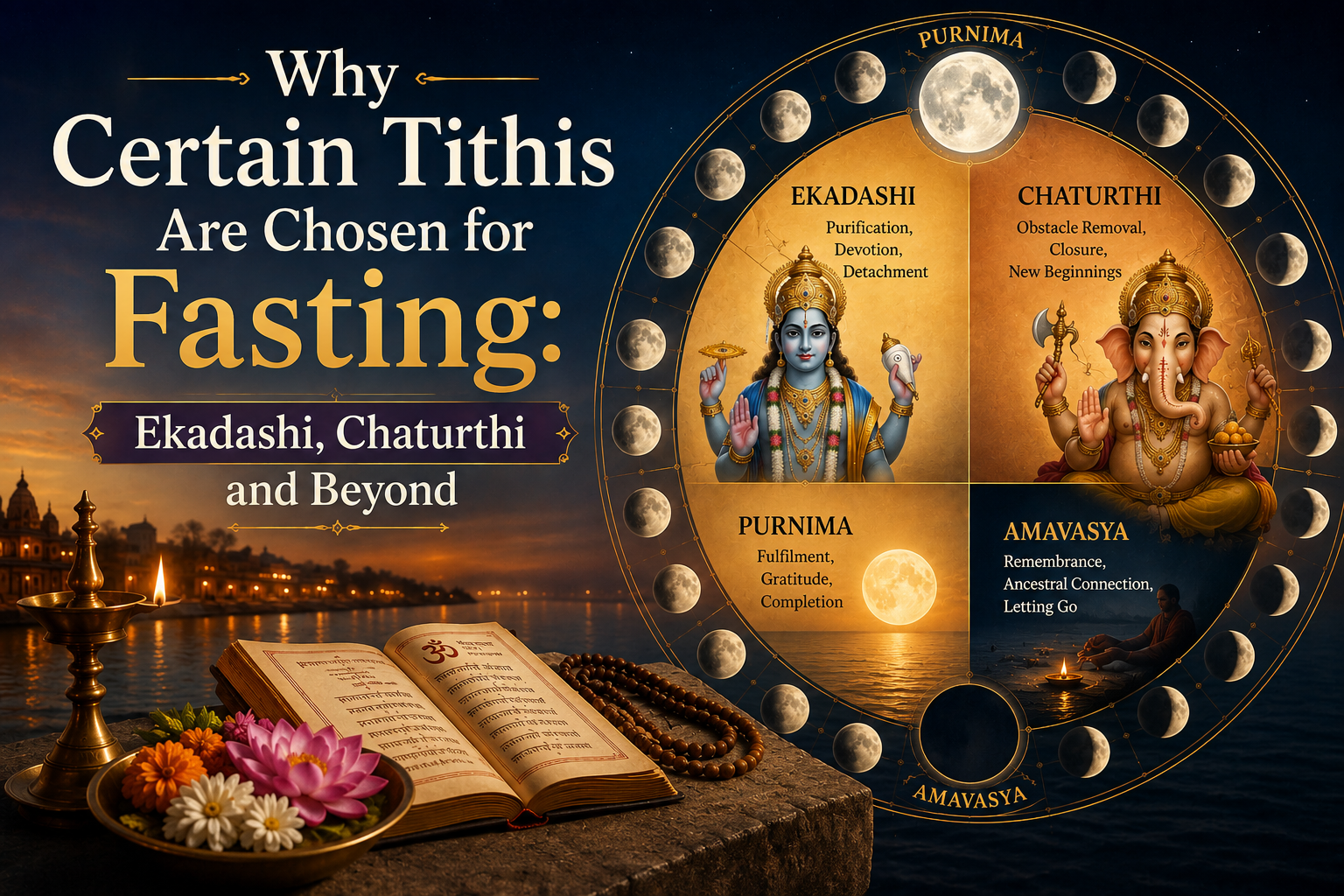
Table of contents
We've covered the five-way Tithi classification, Nanda, Bhadra, Jaya, Rikta, and Purna, in detail elsewhere on this site. This piece looks specifically at how that classification, and separate Puranic tradition, shape which Tithis become dedicated fasting days.
Why Does Chaturthi Fasting Make Sense Within the Rikta Classification?
Sankashti Chaturthi, the fast dedicated to Lord Ganesha observed on the fourth Tithi of the waning fortnight, connects directly to something already established in our main Tithi piece. Chaturthi belongs to the Rikta group, the classification specifically unsuited to new beginnings but genuinely favourable for closure-oriented practice.
This is a real thematic fit, not a coincidence. Sankashti Chaturthi fasting is specifically about obstacle removal, asking Ganesha to clear away what's blocking progress, which aligns precisely with Rikta's own character: not a day for starting something new, but a fitting day for closing out difficulty. The Rikta classification and the fasting tradition built around Chaturthi reinforce each other directly.
Does Ekadashi Fit the Same Pattern?
Not quite as neatly, and this is worth being honest about. Ekadashi, the eleventh Tithi, technically falls under the Nanda classification, the group associated with beginnings and joyful undertakings, alongside the 1st and 6th Tithis. On the surface, this sits somewhat awkwardly next to Ekadashi's actual character: a day of restraint, fasting, and austerity rather than active new beginnings.
Ekadashi's significance is rooted more directly in its own dedicated Puranic tradition than in the broader five-way classification. Classical texts, including the Padma Purana, describe Ekadashi's origin through the story of the demon Mura, and the fast itself is understood as purifying the ten senses and the mind, redirecting focus from worldly desire toward Vishnu specifically. This is a genuinely separate layer of reasoning, worth understanding as distinct from the general Tithi classification rather than forced to fit it.
Why Do Purnima and Amavasya Carry Such Different Significance?
Both Tithis mark the extremes of the lunar cycle, and both are classified as Purna, completion, in the five-way system, yet their fasting traditions point in genuinely different directions.
Purnima, the full moon, is associated with fulfilment and is the traditional day for Satyanarayan Puja, a ceremony of gratitude and completion. Amavasya, the new moon, is associated instead with remembrance, traditionally connected to honouring ancestors and Pitru-related observances. Both represent completion in their own way, one the completion of light, the other the completion of darkness before the cycle begins again, which is why the same underlying classification produces two genuinely distinct practical traditions.
Does a Tithi's Fasting Suitability Change With the Specific Activity?
Yes, and this connects directly to the broader principle covered in our main article: the same Tithi can suit one kind of activity and not another. A Tithi well suited to fasting and inward reflection isn't automatically well suited to launching a new business or holding a wedding, and vice versa. Rikta Tithis are a clear example, unsuited to new ventures generally, but genuinely well matched to the closure-oriented intention behind Chaturthi fasting specifically.
When to Get a Professional Reading Instead of a Generic Fasting Calendar
Given how much genuine nuance sits behind which Tithi suits which practice, a full reading is worth it if:
You want to understand which specific fasting Tithi aligns with a particular personal intention or life circumstance
You're planning a significant event and want to confirm the Tithi's suitability for that specific activity, not just its general classification
You want the exact Tithi timing for your location, since fasting start and end times shift with the Tithi's precise astronomical boundaries
Myth vs. Reality
Myth: Every fasting Tithi follows the same underlying logic. Reality: Some, like Chaturthi, connect directly to the broader five-way classification. Others, like Ekadashi, draw more heavily on their own dedicated Puranic tradition.
Myth: Purnima and Amavasya, both being extremes of the lunar cycle, carry similar significance. Reality: They point in genuinely different directions, Purnima toward fulfilment and gratitude, Amavasya toward remembrance and ancestral connection.
Myth: A Tithi good for fasting is automatically good for other significant activities too. Reality: Suitability genuinely depends on the specific activity, a Tithi well matched to inward reflection isn't automatically matched to launching something new.
Why Check This on DoPuja
Because exact Tithi timing shifts by date and location, and fasting traditionally follows precise astronomical boundaries rather than a fixed calendar date, accurate calculation matters here.
UmasDoPuja's Panchang tool uses the Swiss Ephemeris engine with NASA/JPL DE431 planetary data and correctly applied Lahiri Ayanamsa to calculate precise Tithi timing for your specific location. For guidance on which fasting practice suits your specific circumstances, Talk to Astrologer connects you with a real astrologer for that context.
Why Trust This
The Rikta classification's connection to Chaturthi fasting, and Ekadashi's roots in Puranic tradition specifically, are consistently documented across classical and current sources. We've been direct about where Ekadashi's fasting significance sits somewhat apart from the broader five-way classification, rather than forcing a thematic connection that isn't genuinely there.
Frequently Asked Questions
Why does Chaturthi fasting fit the Rikta classification so well?
Because Rikta is specifically suited to closure rather than beginnings, and Sankashti Chaturthi fasting is about removing obstacles, a genuine thematic match.
Does Ekadashi fit the same logic as Chaturthi?
Not as directly. Ekadashi falls under the Nanda classification, associated with beginnings, but its fasting significance is rooted more in its own dedicated Puranic tradition than in that broader framework.
Why are Purnima and Amavasya both classified as Purna despite feeling so different?
Both represent completion in their own way, Purnima the completion of light, Amavasya the completion of darkness, which is why the same classification produces genuinely different practical traditions.
Can a Tithi be good for fasting but not for other activities?
Yes. Suitability depends on the specific activity, a Tithi well matched to fasting and reflection isn't automatically suited to something like a wedding or business launch.
Where can I learn more about the general Tithi classification system?
Our dedicated Tithi article covers the full five-way classification, Nanda, Bhadra, Jaya, Rikta, and Purna, in complete detail.
Recommended articles
How Rahu Kaal Timing Changes With Sunrise Every Single Day
Learn why Rahu Kaal timing changes every day with sunrise, sunset, seasons, and location. Understand seasonal variations, latitude differences, and precise Panchang calculations.

Feeling Stuck for Years? You Might Be in Sade Sati
Feeling stuck in career, finances, or energy? Learn what Sade Sati means, its three phases, Dasha's role, traditional remedies, and when it ends.

Why Does Nothing Seem to Work Out? Understanding Kaal Sarp Dosha
Wondering why repeated setbacks keep happening? Understand Kaal Sarp Dosha, its effects, Rahu-Ketu periods, traditional remedies, and what your Kundali reveals.
Comments
Be the first to comment.