Grahan Dosha: What an Eclipse-Afflicted Chart Really Means
by SeoTeam· July 11, 2026· 8 min read· 4 viewsGrahan DoshaGrahan Dosha meaningGrahan Dosha in Vedic astrologySurya Grahan DoshaChandra Grahan DoshaSun Rahu conjunctionSun Ketu conjunctionMoon Rahu conjunctionMoon Ketu conjunctionRahu Ketu DoshaGrahan Dosha remediesGrahan Dosha calculatorEclipse DoshaVedic astrology doshasBirth chart analysis
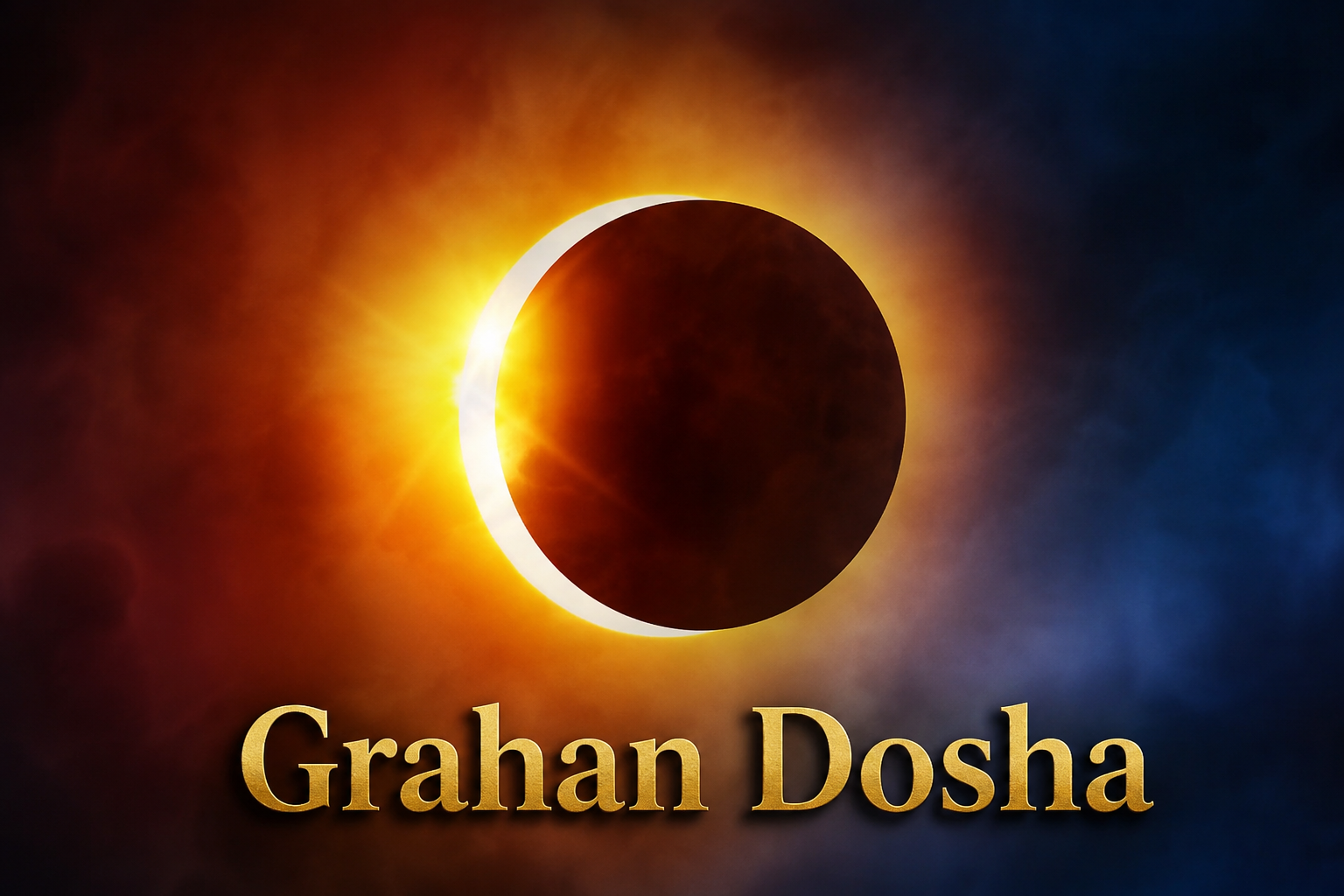
Table of contents
Eclipses have carried symbolic weight across nearly every ancient culture, and Vedic astrology is no exception. Grahan Dosha, literally the "eclipse affliction," is the chart-level expression of that symbolism: what it means when the shadow planets Rahu and Ketu sit close enough to the Sun or Moon to metaphorically "eclipse" them, at the moment of birth.
Here's what this dosha technically requires, how it splits into distinct types, and an important nuance that most casual explanations blur together.
What Is Grahan Dosha?
Grahan Dosha forms when Rahu or Ketu occupies the same house (and typically the same sign, in close degree proximity) as the Sun or the Moon in a birth chart. Since there are two shadow planets and two luminaries involved, this produces four possible combinations, each given its own name in classical and popular texts:
- Surya Grahan Dosha (Sun-Rahu conjunction): sometimes called Purna Surya Grahan Dosh
- Surya-Ketu Dosh (Sun-Ketu conjunction): sometimes called Partial Surya Grahan Dosh
- Chandra Grahan Dosha (Moon-Rahu conjunction): sometimes called Purna Chandra Grahan Dosh
- Chandra-Ketu Dosh (Moon-Ketu conjunction): sometimes called Partial Chandra Grahan Dosh
Worth flagging upfront: different sources use the "Purna" (full) and "Partial" labels somewhat inconsistently across these four combinations, so treat the specific Purna/Partial naming as a general convention rather than a fixed rule you'll see applied identically everywhere.
Surya Grahan Dosha vs. Chandra Grahan Dosha: Different Symbolic Territory
The distinction between which luminary is involved matters more than which node it is, in terms of what life areas the dosha tends to affect.
Surya Grahan Dosha (Sun conjunct Rahu or Ketu) involves the Sun, which represents identity, vitality, authority, and one's relationship with father figures and structures of power. Classical and popular sources associate this combination with challenges around confidence, authority conflicts, and one's sense of personal direction. The Brihat Parashara Hora Shastra describes Rahu and Ketu as "Chhaya Grahas," shadow planets that modify and distort the qualities of whatever they conjoin, and when Rahu (representing insatiable desire and unconventional paths) merges with the Sun's themes of identity and authority, the result is often described as a kind of internal tension between who you are and what you're chasing.
Chandra Grahan Dosha (Moon conjunct Rahu or Ketu) involves the Moon, which represents the mind, emotions, and psychological stability. This combination is more commonly associated with anxiety, restlessness, and difficulty finding emotional steadiness, since the Moon's core function (representing a settled, clear mind) is precisely what's being "eclipsed" by Rahu or Ketu's disruptive influence.
Is Being Born During an Actual Eclipse the Same Thing?
This is the single most important clarification to make, and it's where a lot of popular content gets muddled. There are actually two related but distinct ideas being discussed under the same name:
1. A natal chart conjunction: Rahu or Ketu sitting with the Sun or Moon in your birth chart, regardless of whether an actual astronomical eclipse was happening anywhere in the world at that moment.
2. Being literally born during an actual solar or lunar eclipse: a specific, much rarer astronomical event, since eclipses only occur a handful of times per year and are visible from limited locations.
Most of what's discussed as "Grahan Dosha" in modern astrology content refers to the first, more common scenario: a Sun/Moon-Rahu/Ketu conjunction present in the chart. Being born during an actual eclipse is a separate, additional layer some traditions consider more intense, but it's not a requirement for the dosha to be present. If you've seen your birth chart flagged for Grahan Dosha, it almost certainly refers to the conjunction itself, not literal birth during an eclipse event, and it's worth checking which one a given source or astrologer means when they use the term.
A Symbolic Eclipsing, Not a Literal One
The word "Grahan" means eclipse in Sanskrit, and the astrological use of the term is explicitly metaphorical: just as Rahu astronomically causes solar eclipses by passing between Earth and Sun, its conjunction with the Sun or Moon in a birth chart is described as metaphorically "eclipsing" that planet's usual clear expression. This is a symbolic framework for understanding a planetary combination, not a claim that something was literally obscured or damaged at birth.
Framed this way, Grahan Dosha is better understood as an indicator of internal tension, between clarity and confusion, or between identity and desire, rather than a marker of literal misfortune imposed from outside. The specific difficulties commonly associated with it (reduced confidence, anxiety, delays in decision-making) are described as arising from this internal tension rather than external bad luck.
What This Combination Is Traditionally Associated With
Popular and classical sources commonly link Grahan Dosha with a range of effects depending on house placement and which specific combination is present: financial difficulty (particularly if the conjunction falls in the 2nd house), reduced self-confidence and authority-related conflicts (more associated with Surya Grahan Dosha), heightened anxiety and restlessness (more associated with Chandra-Ketu combinations), and in some traditions, delays or complications related to marriage and childbearing.
It's worth being honest about what remedies here can and can't be expected to do. As one experienced Jyotish consultant put it plainly: remedies don't eliminate a natal conjunction, since it's a fixed, lifelong feature of the birth chart. What they're traditionally understood to do is help modify how that energy expresses itself and support someone in working with it more skillfully, not erase the underlying placement.
Traditional remedies commonly cited include:
- For Surya Grahan Dosha: reciting the Aditya Hridaya Stotra, chanting the Gayatri Mantra, and offering water to the rising sun from a copper vessel
- For Chandra Grahan Dosha: chanting Moon mantras (such as "Om Chandraaya Namaha"), donating milk on Mondays, and worship of Shiva, tied to the mythological story of Shiva rescuing the Moon from a curse
- General practices: feeding crows (associated with ancestors and Rahu's mythology), charitable donations, and broader Navagraha Puja to bring overall planetary balance
When to Get a Professional Reading Instead of Self-Diagnosing
Given how many combinations exist (four distinct conjunction types, plus the eclipse-at-birth distinction) it's worth getting a full reading rather than a quick self-check if:
- You're not certain whether your chart shows a conjunction at all, versus a wider separation that doesn't technically qualify
- You want to know whether your specific case also involves the rarer literal-eclipse-at-birth factor
- You're seeing effects (career, relationship, or health difficulties) and want to know whether this specific combination is a meaningful contributing factor or not
How to Check for Grahan Dosha in Your Chart
1. Locate the Sun and Moon's house and sign positions in your birth chart.
2. Check Rahu and Ketu's positions for close conjunction with either luminary.
3. Identify which of the four combinations applies, if any (Sun-Rahu, Sun-Ketu, Moon-Rahu, Moon-Ketu).
4. Separately check your birth date and time against known eclipse records, if you want to know whether the rarer literal-eclipse-at-birth factor also applies.
Myth vs. Reality
Myth: Grahan Dosha means you were born during a solar or lunar eclipse.
Reality: It usually refers to a Sun or Moon conjunction with Rahu or Ketu in the chart, a distinct and more common situation than literal birth during an actual eclipse event.
Myth: This dosha guarantees serious lifelong misfortune.
Reality: Effects vary substantially by house placement, degree of conjunction, and overall chart strength, and remedies are traditionally aimed at working with the pattern, not eliminating a fixed feature of the chart.
Myth: Surya and Chandra Grahan Dosha affect the same life areas.
Reality: They're tied to different core themes, identity and authority for Surya Grahan Dosha, and emotional and mental stability for Chandra Grahan Dosha.
Why Check This on DoPuja
Confirming a genuine Rahu or Ketu conjunction with the Sun or Moon requires checking precise planetary degrees, not just approximate sign placements, since a wide separation within the same sign may not carry the same weight as a tight conjunction. UmasDoPuja's Kundali reports use the Swiss Ephemeris engine with NASA/JPL DE431 planetary data and correctly applied Lahiri Ayanamsa, giving you a precise read on exactly how close any Rahu or Ketu conjunction actually is. For a deeper look at how this specific combination interacts with the rest of your chart, Talk to Astrologer connects you with a real astrologer for that fuller context.
Why Trust This
The framework described here, the Chhaya Graha (shadow planet) concept, the Sun and Moon's core significations, and the symbolic basis for calling this an "eclipse" affliction, draws on the Brihat Parashara Hora Shastra's classical treatment of Rahu and Ketu. It's worth being transparent that specific naming conventions (which combination is "Purna" versus "Partial") and the exact severity attributed to each type vary meaningfully across different modern sources, so we've focused on the more consistently agreed-upon mechanics rather than asserting one source's specific labelling as universally standard.
Frequently Asked Questions
Can someone have both Surya and Chandra Grahan Dosha at once?
Yes, since Rahu and Ketu are always in different houses (opposite each other), it's possible, though less common, for one to conjunct the Sun while circumstances elsewhere involve the Moon in a different way. Each combination is generally assessed independently.
Does Grahan Dosha go away over time?
As a natal chart placement, it's a fixed, lifelong feature. Its practical intensity may be experienced differently during different dasha periods, particularly during Rahu or Ketu Mahadasha.
Is Grahan Dosha the same as Kaal Sarp Dosha?
No. Kaal Sarp Dosha involves all seven classical planets being hemmed between Rahu and Ketu. Grahan Dosha specifically involves just the Sun or Moon conjuncting one of the nodes. A chart can have one without the other.
Should I be worried if I have this dosha?
Not automatically. As with most doshas discussed here, house placement, degree of conjunction, and overall chart strength all shape how significant the effect actually is in a given chart.
Are there gemstone remedies for Grahan Dosha?
Some traditions recommend specific gemstones tied to the involved luminary, but any gemstone recommendation should come from a qualified astrologer reviewing your full chart, not a generic online suggestion.
✦ Keep reading
Recommended articles
Feeling Stuck for Years? You Might Be in Sade Sati
Feeling stuck in career, finances, or energy? Learn what Sade Sati means, its three phases, Dasha's role, traditional remedies, and when it ends.
Why Does Nothing Seem to Work Out? Understanding Kaal Sarp Dosha
Wondering why repeated setbacks keep happening? Understand Kaal Sarp Dosha, its effects, Rahu-Ketu periods, traditional remedies, and what your Kundali reveals.
Struggling With Delayed Marriage? What Mangal Dosha Really Means
Struggling with delayed marriage because of Mangal Dosha? Learn what being Manglik really means, cancellation factors, traditional remedies, and when to seek a full Kundali reading.
Comments
Be the first to comment.
Leave a comment