Nadi Dosha in Kundali Matching: What It Means for Married Life.
by SeoTeam· July 11, 2026· 8 min read· 10 viewsNadi DoshaNadi Dosha meaningNadi Dosha in Kundali matchingNadi Dosha remediesNadi Dosha cancellationNadi Dosha calculatorAshtakoot matchingGuna MilanKundali matchingNadi KootaMarriage compatibility astrologyNakshatra matchingHoroscope matchingVedic astrology marriageNadi Dosha effects
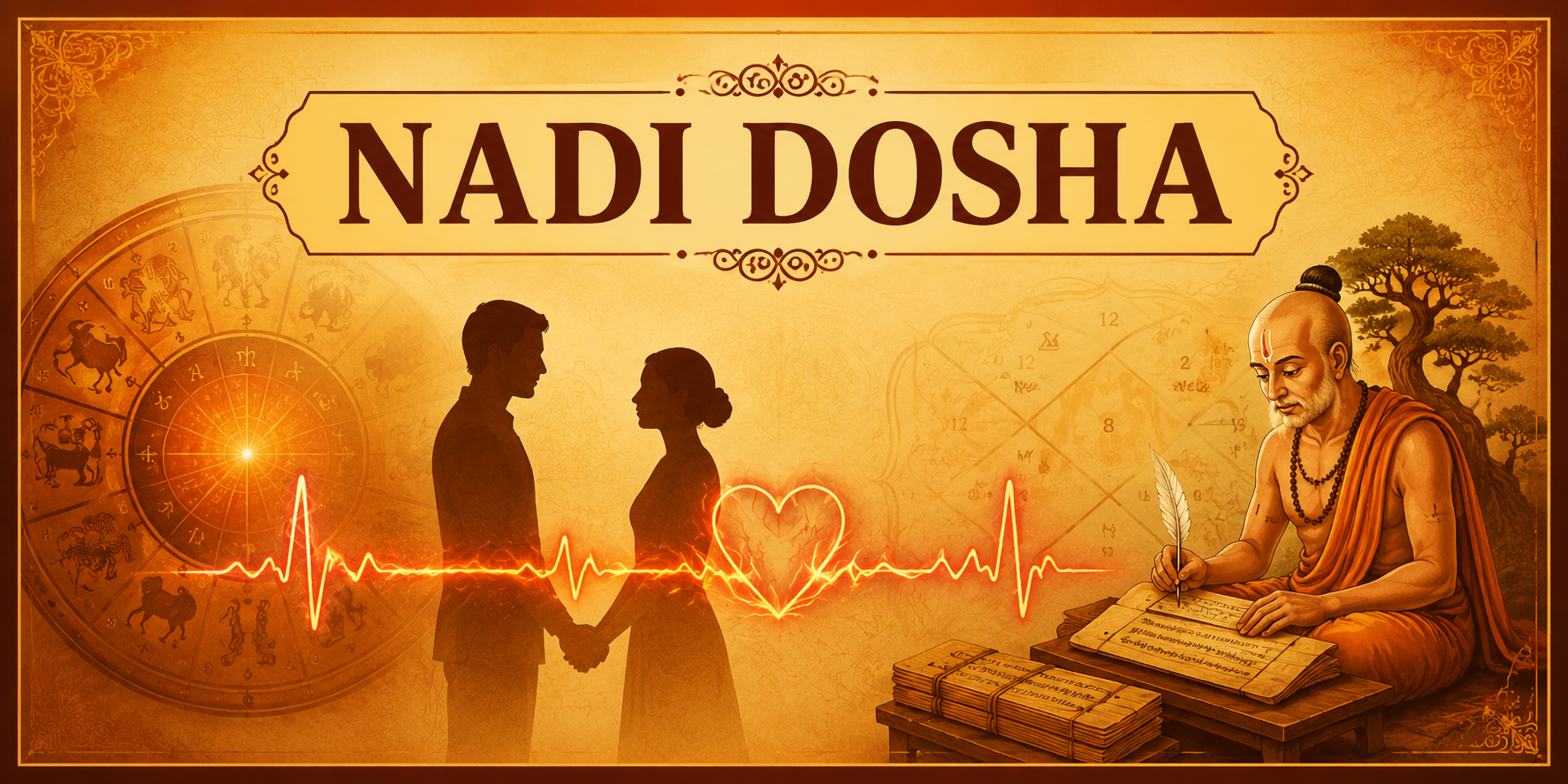
Table of contents
Of all the factors checked during Kundali matching, none carries as much weight, literally, as Nadi Dosha. It's worth eight points out of the 36 total in the Ashtakoot Guna Milan system, more than any other single factor. That weighting alone explains why a "Nadi Dosha present" result can derail a marriage conversation faster than almost anything else in a matching report.
Here's what this dosha actually checks for, why it's weighted so heavily, and why a flat "present" or "absent" result rarely tells the whole story.
What Is Nadi Dosha?
Nadi Dosha occurs when both partners share the same Nadi category, based on their birth Nakshatra (the specific one of the 27 Nakshatras the Moon occupied at the moment of birth, not their Moon sign or Rashi). The 27 Nakshatras are divided into three Nadi groups: Aadi, Madhya, and Antya, each corresponding to one of the three Ayurvedic doshas: Vata, Pitta, and Kapha respectively.
If both partners' birth Nakshatras fall into the same Nadi group, the Nadi Koota scores zero out of a possible eight points, and Nadi Dosha is considered present. If they fall into different groups, the full eight points are awarded and there's no dosha on this factor.
This is worth being precise about, since it's a common point of confusion: the check is based on the Moon's Nakshatra specifically, because the Moon governs bodily rhythms, emotional stability, and fertility-related cycles in Vedic astrology, which is exactly why it's relevant to the health and progeny concerns this Koota is meant to flag.
Why It's Weighted So Heavily
Eight points is the single largest allocation among the eight Kootas in the Ashtakoot system, more than Varna, Vashya, and Yoni Kootas combined. This heavy weighting reflects how seriously classical astrology treats the underlying Ayurvedic logic: the three Nadis mirror Vata, Pitta, and Kapha, the three constitutional types in Ayurveda. The traditional reasoning holds that two people sharing the same constitutional type could amplify shared physiological tendencies within a family line, rather than balancing each other out.
Because of this weighting, some astrologers refer to Nadi Dosha as "Nadi Maha Dosha," a stronger label reflecting how significantly it can move the needle on an overall Guna Milan score compared to other factors.
The Traditional Concern: Health and Progeny, Not General Happiness
It's worth being specific about what this dosha is traditionally understood to indicate, because it's frequently generalised into something broader than it actually is. Classical texts associate Nadi Dosha specifically with concerns around progeny health and constitutional compatibility, not a general prediction of an unhappy marriage. The idea traces back to Ayurvedic reasoning about shared physiological tendencies potentially compounding across generations, rather than anything related to emotional compatibility or day-to-day relationship dynamics.
This distinction matters in practice. A couple can share the same Nadi and still have strong indicators elsewhere in their charts, a well-placed 7th house, supportive Venus and Jupiter, a favourable Navamsa (D9) chart, all of which classical texts treat as relevant context alongside the Nadi Koota result, not overridden by it.
Cancellation Conditions: The Part Most Quick Checks Skip
This is the single most important thing to understand about Nadi Dosha, and it's the part that gets skipped most often by basic online matching tools. Classical Jyotish texts describe multiple cancellation conditions under which Nadi Dosha, even when technically present, is considered nullified or substantially reduced. Commonly cited conditions include:
- Both partners share the same Nakshatra but different Pada (quarter), in many traditions
- Both partners share the same Rashi (Moon sign) but different Nakshatra
- The Rashi lord being Jupiter, Venus, or Mercury, treated by some traditions as a benefic override
- Strong supporting factors elsewhere in the chart: a well-placed 7th house and lord, favourable Venus and Jupiter, and a supportive Navamsa chart
It's worth noting plainly that different regional and family traditions (paramparas) apply these cancellation rules differently, and two astrologers can look at the same pair of charts and reach different conclusions depending on which tradition's rules they follow. This isn't a flaw in the system so much as an honest reflection of how much regional variation exists within classical Jyotish practice.
One caution worth including here too: some traditions specifically flag a condition called Padavedha, where both partners share not just the same Nakshatra but the same Pada as well, as a more serious concern than ordinary Nadi Dosha, rather than a cancellation. This is a good example of why the specific details matter far more than a single flat "Nadi Dosha: Yes" result.
Why Basic Matching Tools Get This Wrong So Often
Many free online Kundali matching tools calculate only the basic 36-point Ashtakoot score and flag Nadi Dosha as a red warning without checking any cancellation conditions at all. This is one of the most common sources of unnecessary anxiety and, in some cases, unnecessary rejection of otherwise compatible matches. A proper assessment requires checking Pada, Rashi, planetary lordships, and broader chart strength, not just the same-Nadi flag in isolation.
When to Get a Professional Reading Instead of a Quick App Check
Given how many cancellation factors exist and how much they vary by tradition, it's worth getting a full reading rather than trusting a basic app score if:
- Your matching report flags Nadi Dosha, and you want to know whether any cancellation conditions actually apply in your specific case
- You're trying to understand which family tradition's cancellation rules are being applied, since this affects the conclusion
- You want the broader context (7th house strength, Venus and Jupiter placement, Navamsa chart) that a same-Nadi flag alone doesn't capture
How to Check for Nadi Dosha Yourself
1. Identify each partner's birth Nakshatra, based on the Moon's position at birth, not the Moon sign.
2. Determine each Nakshatra's Nadi group (Aadi, Madhya, or Antya).
3. Compare the two. Same group means the dosha is technically present; different groups mean full points with no dosha.
4. Check for cancellation conditions, including shared Pada, shared Rashi, and relevant planetary lordships.
5. Review the broader chart context, particularly 7th house strength and Navamsa compatibility, rather than stopping at the Nadi result alone.
Myth vs. Reality
Myth: Nadi Dosha means the marriage should not proceed.
Reality: Classical texts include extensive cancellation conditions specifically because Nadi Dosha was never intended to function as an absolute blocker on its own.
Myth: All same-Nadi pairings carry equal severity.
Reality: Some traditions distinguish between different Nadi-type pairings and their associated concerns, and cancellation conditions can substantially change the practical significance either way.
Myth: A quick online score is a complete assessment.
Reality: Most free tools check only the basic same-or-different Nadi comparison and skip cancellation analysis entirely, which is precisely where a lot of unnecessary anxiety comes from.
Why Check This on DoPuja
Because Nadi Dosha depends on precise identification of each partner's birth Nakshatra and Pada, calculation accuracy matters enormously here. UmasDoPuja's Kundali matching uses the Swiss Ephemeris engine with NASA/JPL DE431 planetary data and correctly applied Lahiri Ayanamsa, so Nakshatra and Pada positions are calculated precisely rather than approximated. Our matching reports also check for cancellation conditions rather than stopping at a flat same-Nadi flag, and review supporting factors like 7th house strength and Navamsa compatibility alongside the Ashtakoot score. For a full, personalised walkthrough of your specific matching report, Talk to Astrologer connects you with a real astrologer.
Why Trust This
The Nadi Koota framework and its Ayurvedic basis are well documented across classical Jyotish sources, including reference to the Parashara Hora Shastra's treatment of Ashtakoot matching. It's worth being transparent, though, that cancellation rules genuinely vary between regional and family traditions, and different practising astrologers can reach different conclusions from the same chart pair depending on which tradition's rules they apply. We've aimed to present the range of commonly cited cancellation conditions here rather than asserting one single tradition's rules as universally correct.
Frequently Asked Questions
Is Nadi Dosha checked from the Moon sign or the Nakshatra?
The birth Nakshatra specifically, based on the Moon's exact position at birth, not the broader Moon sign (Rashi).
Can Nadi Dosha be fully cancelled, or just reduced?
Depending on which cancellation conditions apply and which tradition is being followed, it can be treated as fully nullified in some cases and only partially mitigated in others.
Does Nadi Dosha affect anything besides health and progeny?
Its classical, specific association is with health and progeny compatibility. Broader relationship happiness is assessed through other factors in the full chart, not this Koota alone.
If our Nadi Dosha isn't cancelled, does that mean we shouldn't marry?
Classical texts don't treat it as an absolute blocker even without cancellation. Most astrologers would recommend reviewing the full chart context, including 7th house strength and other supporting factors, rather than deciding based on this one factor alone.
What is the traditional remedy if Nadi Dosha applies and isn't cancelled?
Nadi Dosha Nivaran Puja, a ceremonial worship typically performed before the engagement is formalized, is the most commonly cited traditional remedy.
✦ Keep reading
Recommended articles
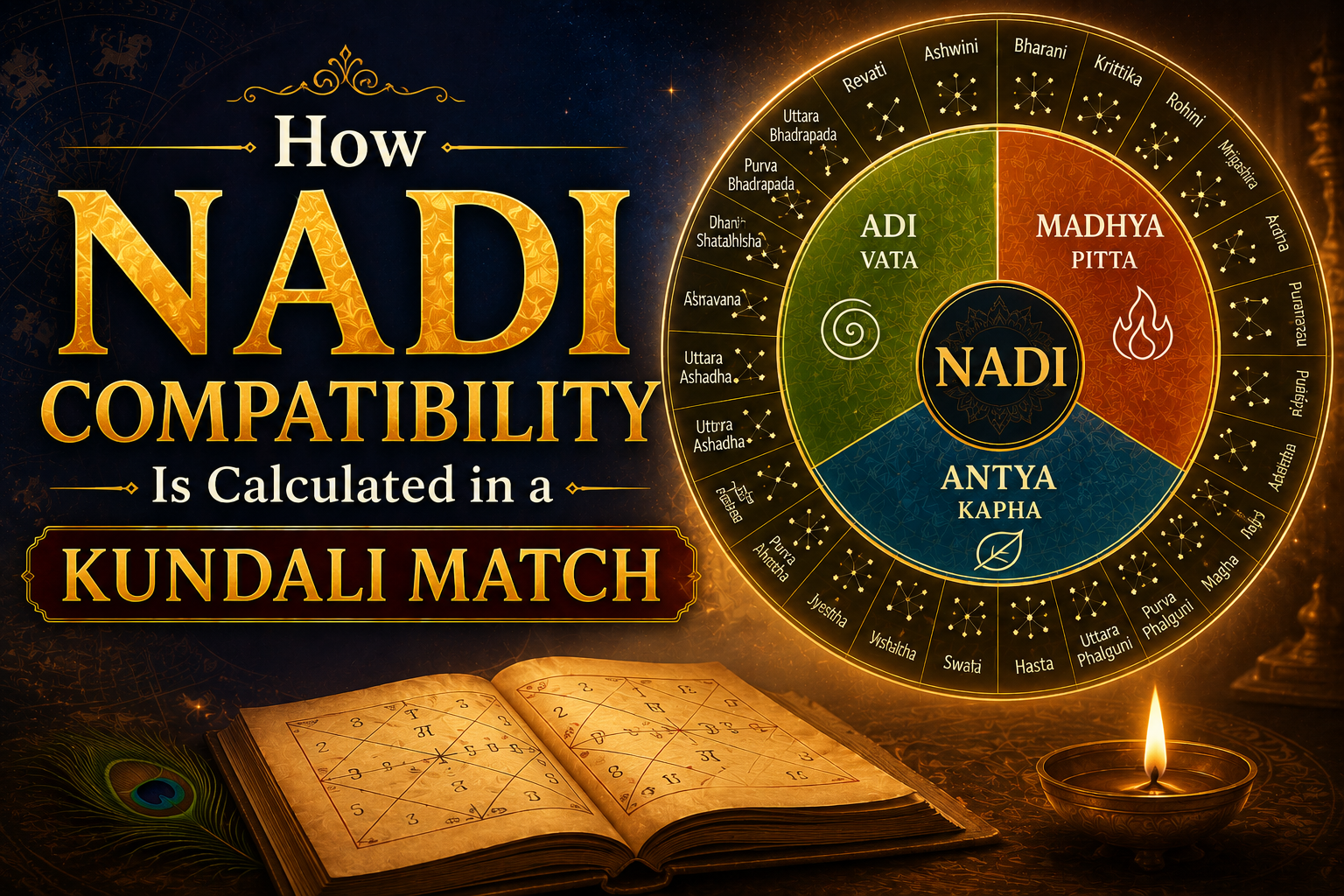
How Nadi Compatibility Is Calculated in a Kundali Match
Learn how Nadi compatibility is calculated in Kundali matching, from birth Nakshatra and Nadi groups to Nadi Dosha, Pada exceptions, and compatibility rules.

Moon Sign and Nakshatra: The Core of Ashtakoot Compatibility
Understand how Moon Sign and Nakshatra drive Ashtakoot compatibility, including Tara, Gana, Bhakoot, Nadi, scoring, doshas, and cancellation rules.
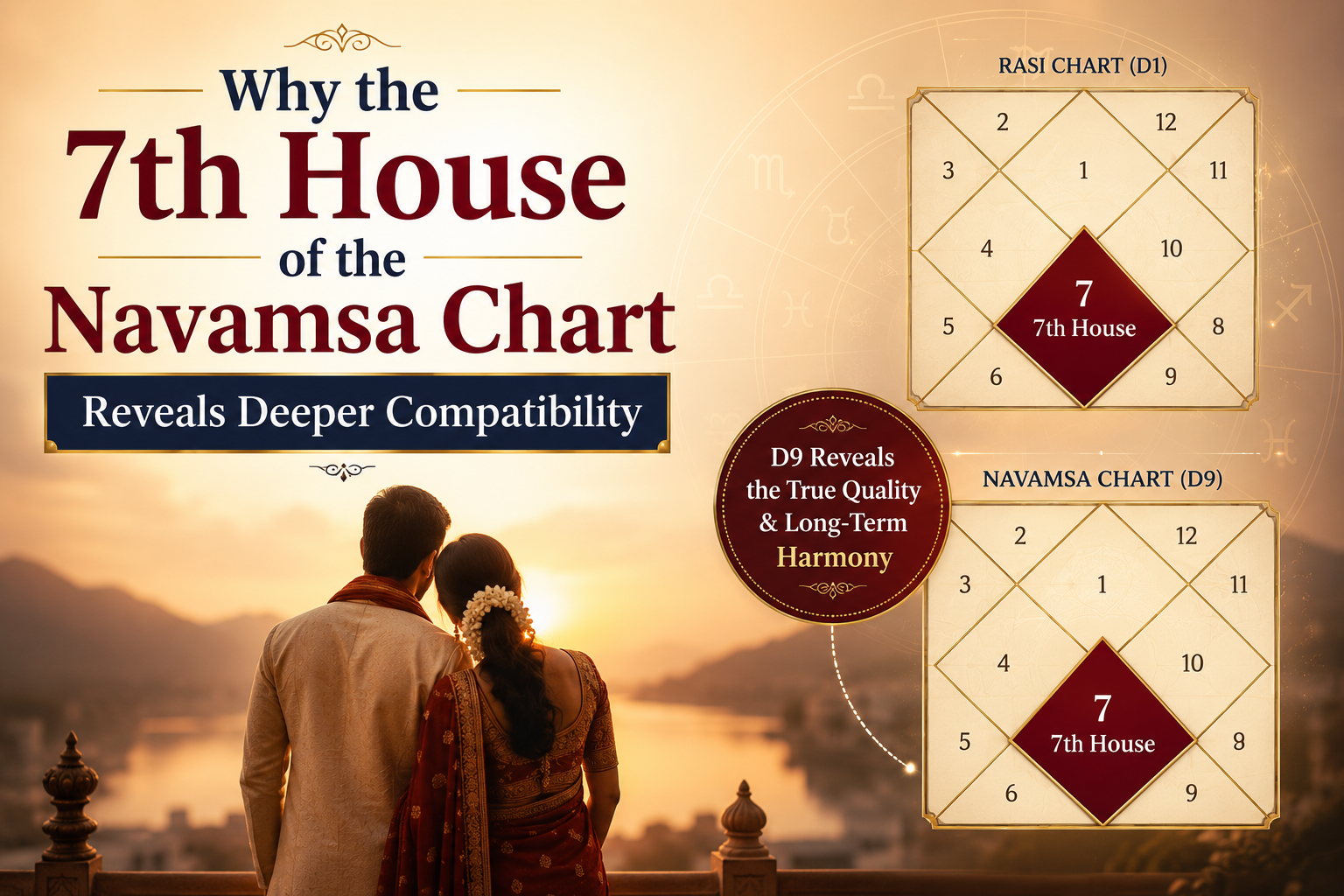
Why the 7th House of the Navamsa Chart Reveals Deeper Compatibility
Discover how the Navamsa 7th house, Venus placement, Vargottama, and D9 chart comparison reveal deeper marriage compatibility beyond Guna Milan.
Comments
Be the first to comment.
Leave a comment