How House Placement Changes the Strength of Gaja Kesari Yoga

Table of contents
We've covered the basic mechanics of Gaja Kesari Yoga and why it's more common than its reputation suggests elsewhere on this site. This piece goes deeper into what actually determines its real strength: both planets' dignity, combustion, and exactly which Kendra house is involved.
Why Does Jupiter's Dignity Matter So Much?
Jupiter exalted in Cancer, or in its own signs of Sagittarius or Pisces, is generally considered to strengthen this yoga's expression significantly. Jupiter debilitated in Capricorn, or placed in an enemy sign, is generally considered to challenge the yoga's auspiciousness considerably, even when the basic Kendra formation is technically present.
Does the Moon's Own Condition Matter as Much as Jupiter's?
Yes, and this is worth emphasising, since explanations often focus almost entirely on Jupiter. The Moon's own strength genuinely shapes the outcome too. A waxing Moon is generally considered more supportive than a waning one, and a Moon that's debilitated or heavily afflicted is considered to meaningfully reduce the yoga's real strength, even with a well-placed Jupiter.
Does Combustion Just Weaken This Yoga, or Cancel It Entirely?
This is worth being precise about, since it's stronger than a simple weakening. Several classical treatments hold that combustion of either planet, Jupiter or the Moon sitting too close to the Sun, doesn't just reduce the yoga's power, it disqualifies the formation from being considered genuinely active at all. This is a meaningfully stronger statement than "reduced results," worth checking specifically rather than assuming a technically present Kendra relationship is enough on its own.
Can Both Planets Ever Be Exalted at the Same Time?
This is a genuinely interesting technical point most explanations miss entirely. Through the standard Kendra relationship, counting the 1st, 4th, 7th, or 10th house from the Moon, it's actually geometrically impossible for both planets to be simultaneously exalted. When the Moon sits in its own exaltation sign, Taurus, Jupiter's exaltation sign, Cancer, simply doesn't fall in any of the four Kendra positions from there. The same mismatch applies in reverse.
The genuine best-case scenario works differently: a direct conjunction, both planets together in the same sign, specifically in Cancer. In this configuration, the Moon sits in its own sign (Cancer is the Moon's own sign) while Jupiter is simultaneously exalted (Cancer is also Jupiter's exaltation sign), both planets at genuinely peak dignity at once, achieved through conjunction rather than through separate Kendra houses.
How Does 1st House Placement Differ From 10th House Placement?
Each Kendra position colours the yoga's expression differently, and the 1st and 10th houses in particular tend to produce noticeably different outcomes.
Jupiter in the 1st house from the Moon (or conjunct it) is generally associated with confidence, a positive general outlook, and a strong sense of personal reputation, the yoga expressing through identity and self-perception directly.
Jupiter in the 10th house from the Moon is generally associated with career success and public authority specifically, the yoga expressing through professional standing and public-facing achievement rather than internal confidence.
For context, the 4th house placement is generally associated with domestic peace and comfort, while the 7th house placement is generally associated with harmonious partnership and marriage specifically. All four Kendra placements carry the yoga's core themes, but which area of life it shows up most visibly in genuinely depends on which specific house is involved.
When to Get a Professional Reading Instead of a Generic Check
Given how much this yoga's real strength depends on dignity, combustion, and exact house placement together, a full reading is worth it if:
You want to confirm neither Jupiter nor the Moon is combust, since this can disqualify the formation entirely rather than just weaken it
You want to know specifically which Kendra house is involved, since the 1st and 10th produce noticeably different real-world expressions
You want the Moon's own dignity checked, not just Jupiter's, since it's often the overlooked half of this assessment
Myth vs. Reality
Myth: Only Jupiter's condition matters for this yoga's strength.
Reality: The Moon's own dignity, particularly its waxing or waning phase, genuinely shapes the outcome too, not just Jupiter's placement and sign.
Myth: Combustion just makes this yoga somewhat weaker.
Reality: Several classical treatments hold that combustion of either planet disqualifies the formation from being considered genuinely active, a stronger statement than simple weakening.
Myth: The strongest version of this yoga has both planets exalted simultaneously.
Reality: This is actually geometrically impossible through the standard Kendra relationship. The genuine best case is a direct conjunction in Cancer, where the Moon is in its own sign, and Jupiter is exalted at once.
Why Check This on DoPuja
Because this yoga's real strength depends on both planets' dignity, combustion status, and exactly which house is involved, not just the basic Kendra formation, accurate calculation matters considerably here.
UmasDoPuja's Kundali tool uses the Swiss Ephemeris engine with NASA/JPL DE431 planetary data and correctly applied Lahiri Ayanamsa, checking Jupiter and the Moon's exact dignity, combustion, and house placement together precisely. For a full, personalised reading on your specific formation, Talk to Astrologer connects you with a real astrologer for that context.
Why Trust This
Jupiter and the Moon's dignity effects, the combustion caveat, and the geometric impossibility of simultaneous exaltation through the Kendra relationship are consistently documented across multiple independent Vedic astrology sources. The house-specific outcomes for the 1st, 4th, 7th, and 10th positions reflect a genuinely more complete picture than treating all four Kendra placements as interchangeable.
Frequently Asked Questions
Does the Moon's phase actually affect this yoga's strength?
Yes. A waxing Moon is generally considered more supportive than a waning one, and this matters alongside Jupiter's own dignity, not as a secondary detail.
What happens if Jupiter or the Moon is combust?
Several classical treatments hold that this disqualifies the formation from being considered genuinely active, stronger than simply reducing its results.
Can Jupiter and the Moon both be exalted at the same time in this yoga?
Not through the standard Kendra relationship, this is geometrically impossible. The genuine best case is a direct conjunction in Cancer, where the Moon is in its own sign, and Jupiter is exalted simultaneously.
How does a 1st house formation differ from a 10th house formation?
The 1st house version tends to express through confidence and personal reputation, while the 10th house version tends to express through career success and public authority specifically.
Is this yoga equally strong regardless of which Kendra house Jupiter occupies?
No. Each of the four Kendra positions colours its expression differently, though all four carry the yoga's core wisdom-and-stability theme.
Recommended articles

Why Some People Seem Naturally Lucky, and Whether You're One of Them
Discover why some people seem naturally lucky through Raj Yoga in Vedic astrology. Learn how the 1st house, Lagna lord, planetary strength, and multiple Raj Yogas shape success.
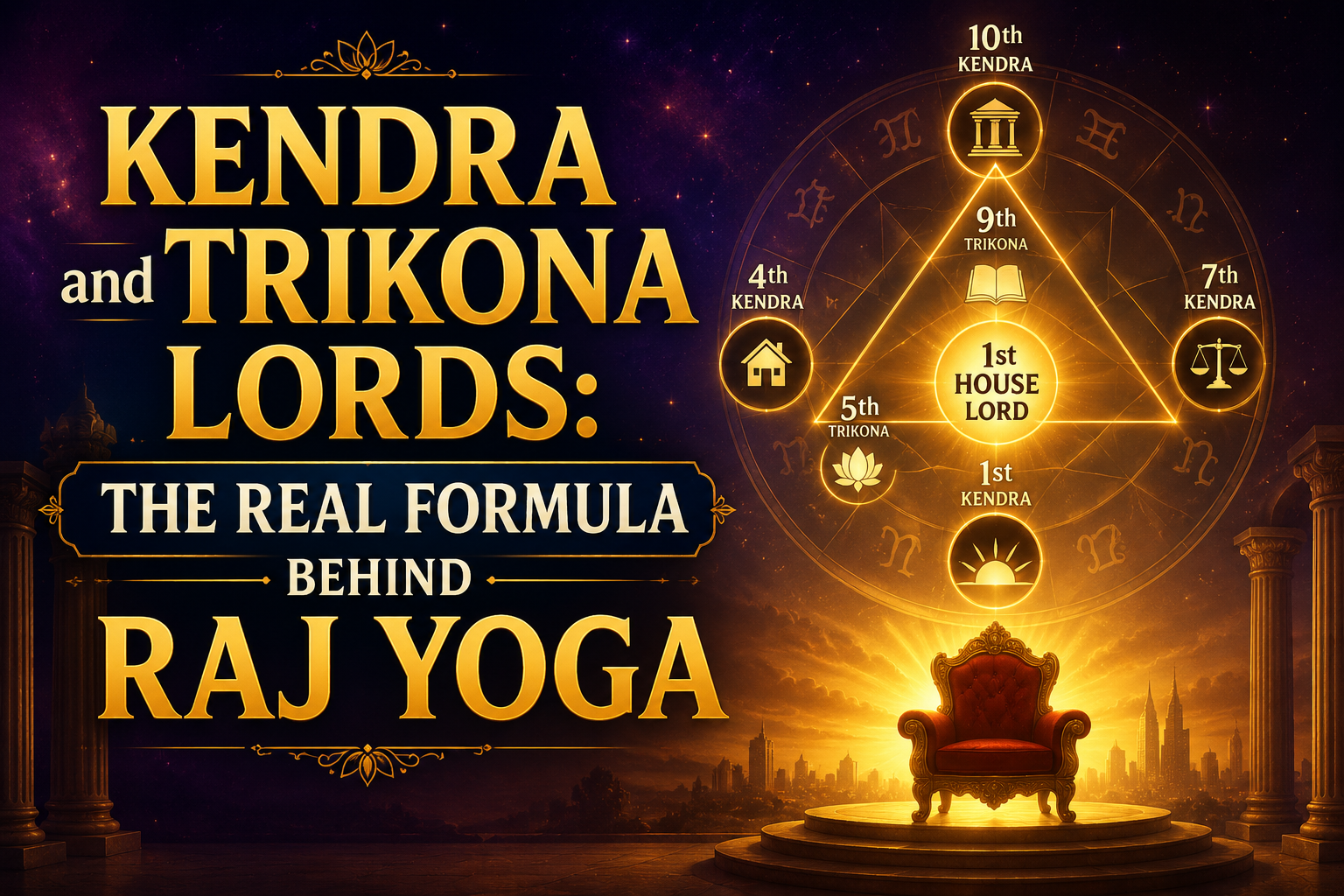
Kendra and Trikona Lords: The Real Formula Behind Raj Yoga
Discover how Kendra and Trikona lords form Raj Yoga, why the 1st house lord is uniquely important, and how multiple Raj Yogas compound with diminishing returns.

Feeling Stuck for Years? You Might Be in Sade Sati
Feeling stuck in career, finances, or energy? Learn what Sade Sati means, its three phases, Dasha's role, traditional remedies, and when it ends.
Comments
Be the first to comment.