Panchang Yoga Explained: The Celestial Maths of Time
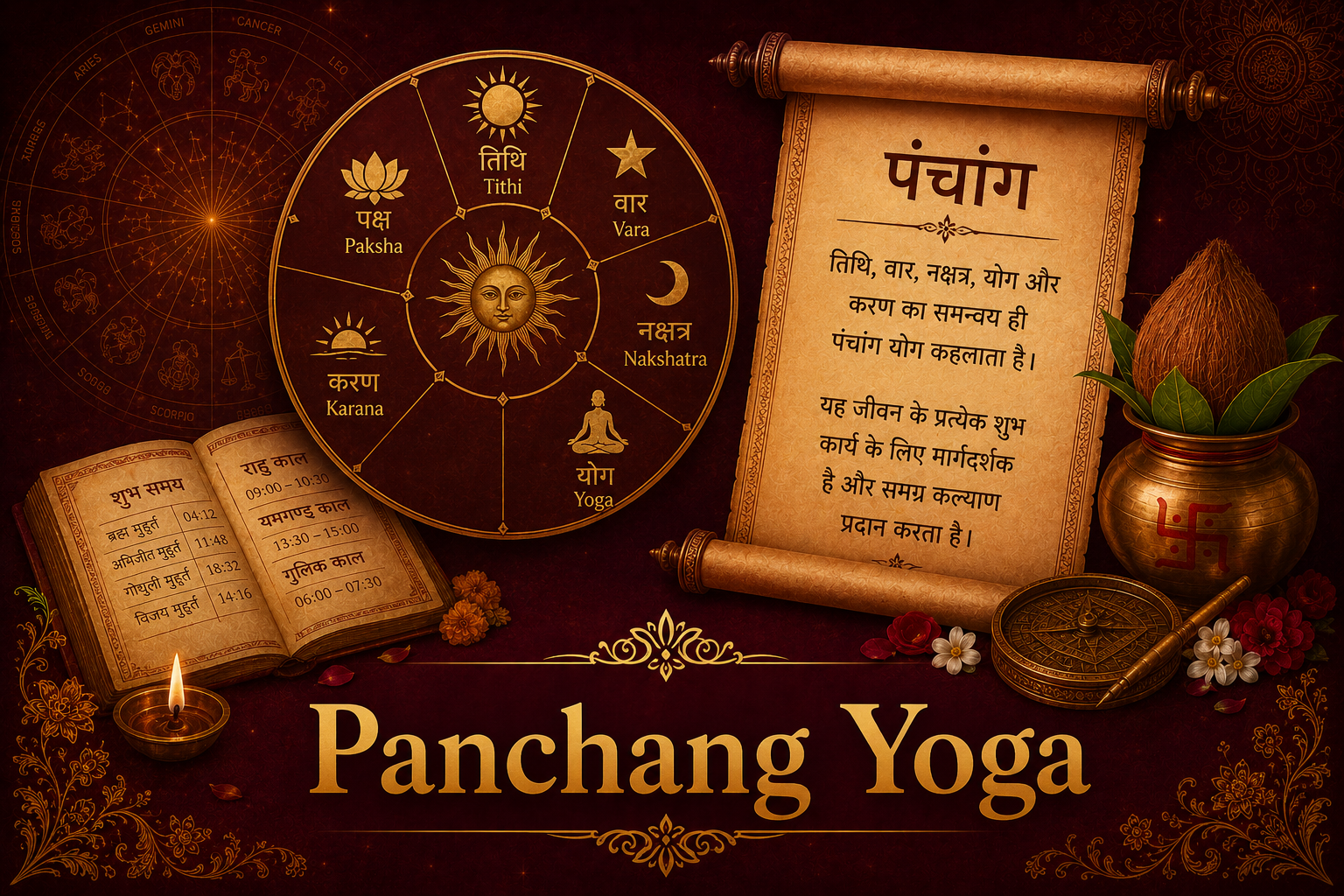
Table of contents
Introduction
When you look at a traditional Hindu calendar, you're interacting with the Panchang, the five-limbed Vedic almanac. Most people are familiar with at least two of its components: Tithi, which fixes our festivals, and Nakshatra, which often defines our birth stars. There's a third component that remains the most overlooked of the five: Panchang Yoga. Here's what this actually is, why it gets confused with an entirely different concept sharing the same name, and why it's harder to notice than the other four limbs.
What Is Panchang Yoga?
The Panchang has five limbs: Vara (weekday), Tithi (lunar day), Nakshatra (lunar mansion), Karana (half of a Tithi), and Yoga. Panchang Yoga, also called Nitya Yoga, is derived by adding the celestial longitudes of the Sun and the Moon, then dividing that sum by 13 degrees and 20 minutes. This creates a specific segment within a 27-part division of the combined solar-lunar path. Just as the zodiac divides into 27 Nakshatras of 13°20' each, this combined Sun-Moon path also divides into 27 Yogas of the same length. Where a Tithi measures the difference between the Moon and Sun's positions, a Yoga measures their sum. It's worth being clear about one distinction: this is entirely separate from the planetary combinations in a birth chart that are also called Yogas, such as Raj Yoga or Gaja Kesari Yoga. Panchang Yoga is Nitya, meaning daily, and applies to everyone on Earth simultaneously, regardless of their individual birth chart.
How Is Panchang Yoga Different From Physical Yoga?
Both terms come from the Sanskrit root Yuj, meaning to join or to yoke, which is where most of the confusion starts. Physical yoga, or Hatha Yoga, is a practised discipline: postures, breathwork, and ethics aimed at uniting individual and universal consciousness. It's something you actively do. Panchang Yoga is a mechanical, astronomical calculation. It has no connection to postures, mats, or physical exercise. It represents the mathematical joining of the Sun and Moon's longitudes, a celestial condition you exist within, not a practice you perform.
How Long Does Each Yoga Last?
A Panchang Yoga typically lasts between 22 and 24 hours, a cadence similar to a Nakshatra. The Moon moves roughly 13 degrees a day, the Sun roughly 1 degree, so their combined movement covers about 14 degrees daily. Since each Yoga segment spans 13°20', it's usually crossed within that 22- to 24-hour window. Like every Panchang element, Yogas don't align with the midnight-to-midnight clock. A specific Yoga might begin mid-afternoon on one day and end around midday the next, since Vedic timekeeping follows the actual position of the planets rather than a fixed clock division.
Why Is Yoga the Least Understood Limb of the Panchang?
A few reasons explain why this element gets so little attention compared to Tithi or Nakshatra.
There's no visual marker.
You can look up and see the Moon's phase to identify the Tithi, or the stars to track the Nakshatra. Yoga is a purely calculated sum with nothing to point to in the sky.
Tithi and Nakshatra dominate everyday culture.
Festivals are fixed by Tithi, and children are named by Nakshatra. Yoga is mainly consulted for detailed Muhurta work, so most people simply don't encounter it in daily life.
The word "yoga" is overloaded.
Searching for the term online returns results about physical fitness almost exclusively, which buries the astronomical definition entirely.
Its influence is considered subtle.
Each Panchang limb is traditionally linked to an element: Vara → Fire, Nakshatra → Air, Tithi → Water, Karana → Earth, and Yoga → Ether. Ether is associated with background atmosphere rather than a tangible event, so its effect is described as a general undertone rather than something easy to pinpoint.
Which of the 27 Yogas Are Considered Favourable?
The 27 Yogas run from Vishkambha to Vaidhriti. Some are classified as Shubha (auspicious), generally associated with creativity, relationship-building, and intellectual work. Others are classified as Ashubha (inauspicious), generally associated with introspection or a caution against starting new commitments. Undertaking a significant meeting during a Siddha or Saubhagya Yoga is traditionally considered supportive, while doing the same during a Shoola or Vyatipata Yoga is traditionally considered more likely to invite friction. As with the other Panchang elements, Yoga is checked alongside Tithi and Nakshatra during Muhurta selection, not treated as a standalone deciding factor.
Myth vs. Reality
Myth: Panchang Yoga predicts your future based on your birth star. Reality: Your birth star comes from your Nakshatra at the moment of birth. Panchang Yoga is a daily cycle shared by everyone on Earth simultaneously, not something personal to your individual chart.
Myth: Practising physical yoga poses during an auspicious Panchang Yoga enhances your results. Reality: The two systems operate on entirely different planes, one governs the body, the other governs the calendar. There's no classical basis for combining them.
When to Get a Professional Reading Instead of Checking a Generic Table
Yoga is only one of five Panchang elements, and its influence is meant to be read alongside Tithi, Nakshatra, and Karana together. A personalised consultation is worth it if you're planning a specific significant event, since marriage, Griha Pravesh, and business launch timing each carry additional event-specific rules covered in their own dedicated articles on this site.
Why Check This on DoPuja
Because a Yoga's exact start and end time shifts by location and doesn't follow the standard clock day, a generic printed table only gives an approximate picture. UmasDoPuja's Panchang tool uses the Swiss Ephemeris engine with NASA/JPL DE431 planetary data and correctly applied Lahiri Ayanamsa to calculate the precise Yoga active at any given moment for your specific location, alongside Tithi, Nakshatra, and Karana together. For a fuller muhurat check for a specific event, Talk to Astrologer connects you with a real astrologer for that context.
Why Trust This
The calculation method, the five-element correspondence, and the 27-Yoga structure described here are consistently documented across classical Panchang literature and current astrological references. The distinction between Panchang Yoga and natal-chart Yogas, and between Panchang Yoga and physical yoga, reflects genuine, commonly confused points that deserve direct clarification rather than being glossed over.
Frequently Asked Questions
Is Panchang Yoga a form of physical exercise?
No. It's a mathematical calculation representing the sum of the Sun and Moon's longitudes, with no connection to physical postures.
Does the Yoga of the day affect my birth chart?
No. Panchang Yoga is a daily, universal cycle that changes for everyone on Earth simultaneously, separate from your natal horoscope.
How often does Panchang Yoga change?
Roughly once a day, lasting between 22 and 24 hours depending on the Sun and Moon's exact movement, similar in cadence to a Nakshatra.
Should I change my plans if the day has a challenging Yoga?
Not necessarily. It's a tool for awareness and preparation, not a reason to cancel a non-negotiable task.
Why is it considered the least understood limb of the Panchang?
Because it has no visual marker in the sky, is overshadowed by Tithi and Nakshatra in daily culture, and shares its name with an entirely unrelated global fitness practice.
Recommended articles
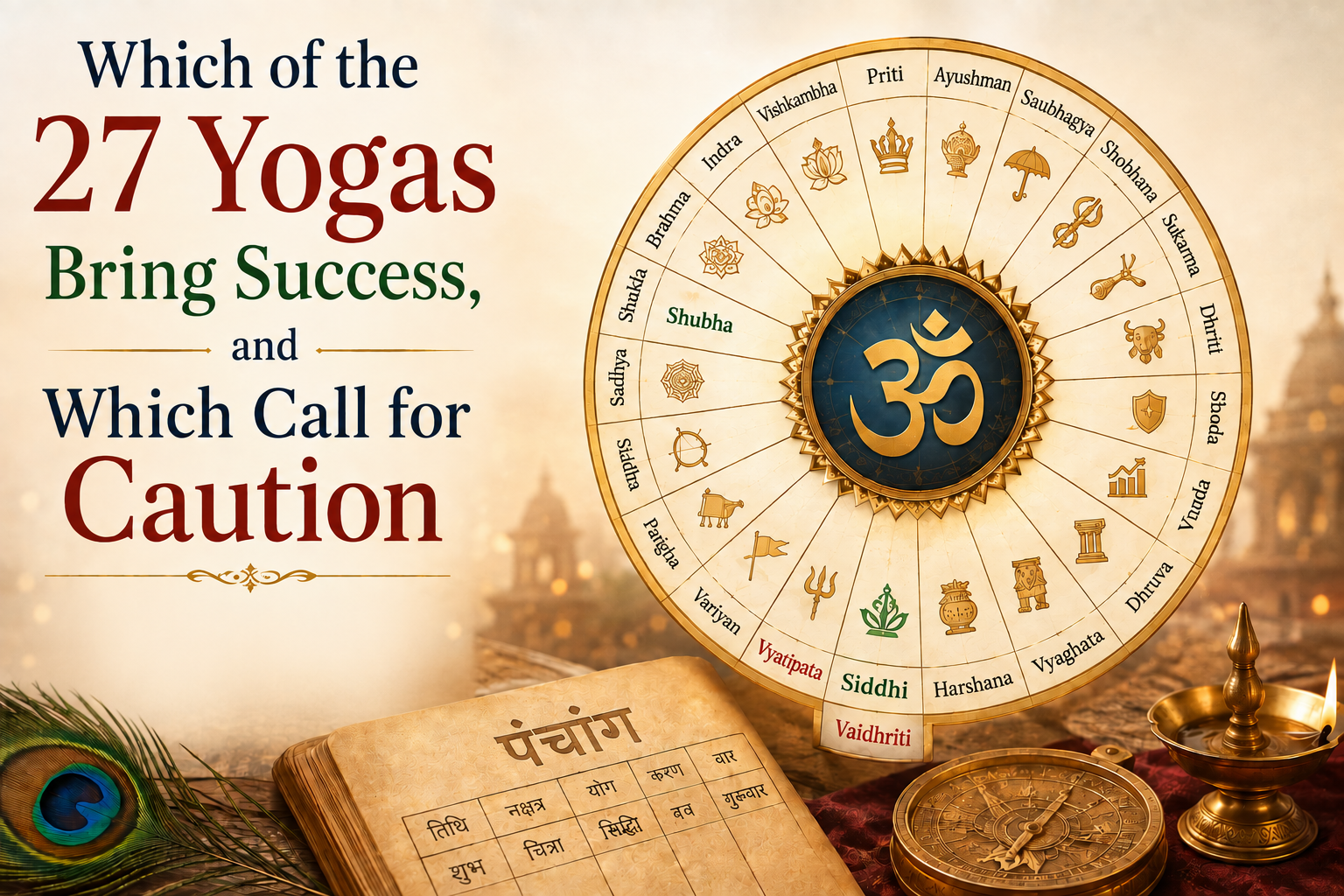
Which of the 27 Yogas Bring Success, and Which Call for Caution
Discover which of the 27 Panchang Yogas are auspicious, why Siddhi and Shubha favour success, why Vyatipata and Vaidhriti call for caution, and how Tithi and Nakshatra influence the final muhurat.
Why Does Nothing Seem to Work Out? Understanding Kaal Sarp Dosha
Wondering why repeated setbacks keep happening? Understand Kaal Sarp Dosha, its effects, Rahu-Ketu periods, traditional remedies, and what your Kundali reveals.
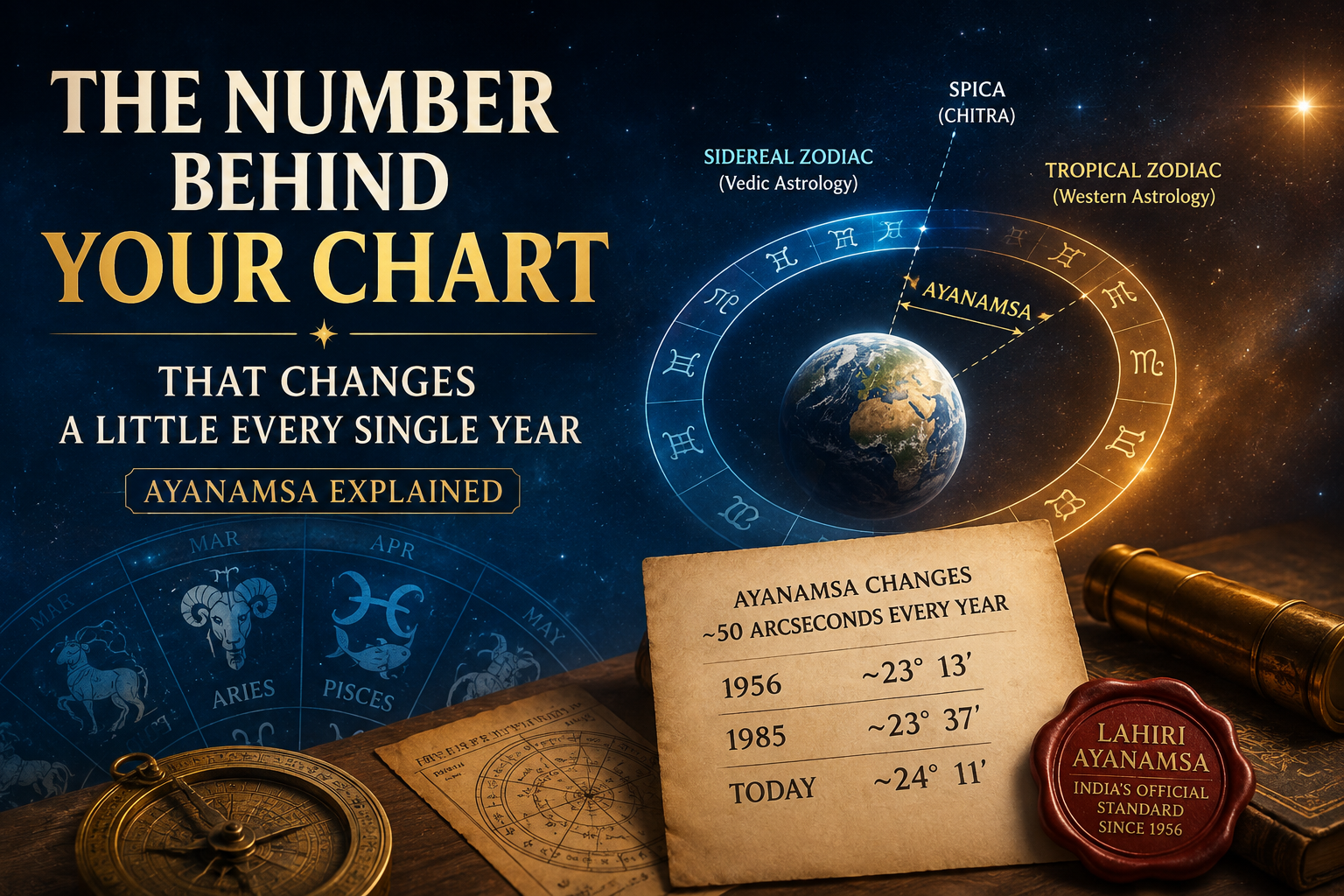
The Number Behind Your Chart That Changes a Little Every Single Year
Discover why Ayanamsa changes every year, how Lahiri Ayanamsa became the Vedic astrology standard, and why its precise value matters for accurate Kundali calculations.
Comments
Be the first to comment.