Pitra Dosha Explained: Ancestral Karma, Causes, and Remedies
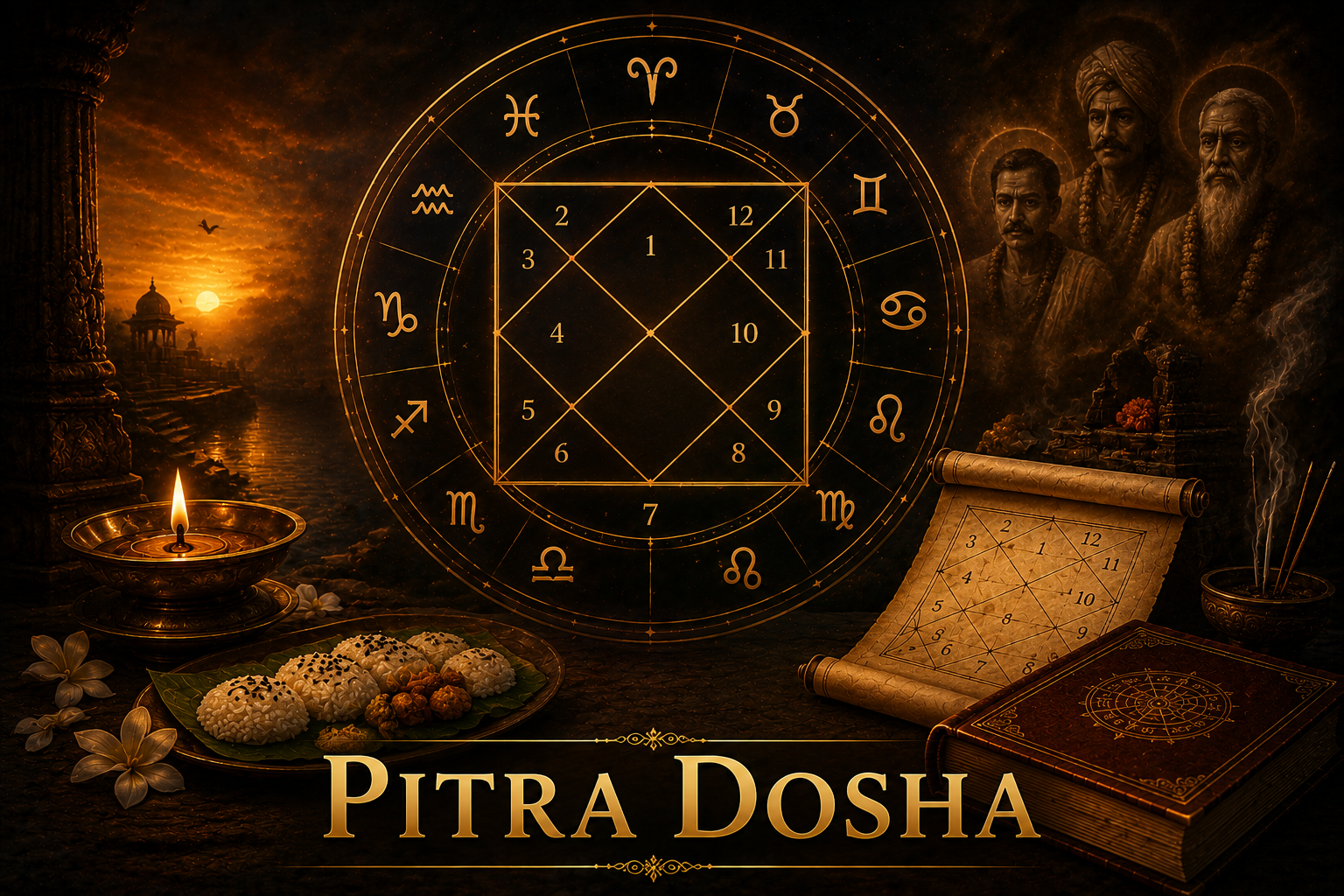
Table of contents
Pitra Dosha points to unresolved karmic patterns connected to ancestral lineage, most commonly linked to Sun-Rahu conjunctions or affliction of the 9th house (Pitri Bhava). It's traditionally understood as a call for resolution, not a punishment from angry ancestors. Jupiter's strength can meaningfully soften its effects. Traditional remedies focus on honouring ancestors through practices like Shraddha and Tarpan, alongside consistent, disciplined daily conduct.
Few terms in Vedic astrology carry as much weight as Pitra Dosha. Often misread as a curse from angry ancestors, it's better understood as a marker of unresolved karmic patterns within a family lineage.
Here's what actually forms this configuration, and an important correction on a related term that frequently gets confused with it.
What Is Pitra Dosha?
Pitra Dosha isn't traditionally framed as punishment. It's better described as a lingering connection between an individual and their family lineage, one calling for resolution through intention, ritual, and conscientious living. In this framework, the family line is treated as a continuous thread, and unresolved obligations from earlier generations can create resistance felt in the current one.
What Are the Astrological Mechanics Behind It?
This configuration primarily involves the Sun, Saturn, and Rahu, most often through the 9th house, known as Pitri Bhava, the house of ancestral karma.
What Is the Sun-Rahu Conjunction, and Why Does It Matter Here?
The Sun represents the father, the soul, and ancestral lineage. Rahu represents shadow energy and unresolved desire. When these two conjunct in a birth chart, this specific combination is classically called Surya-Rahu Grahan Yoga, an eclipse-type affliction, since Rahu is symbolically described as obscuring the Sun's light.
This placement is commonly associated with identity-related struggles, friction with the biological father, and in some traditions, hereditary health tendencies connected to the heart or eyes.
Why Does the 9th House Matter So Much?
The 9th house governs the father, ancestral connection, and accumulated good fortune from past actions. When this house is afflicted by Rahu, Ketu, or Saturn, the flow of paternal blessing is considered disrupted. If the 9th house lord sits in a difficult house, the 6th, 8th, or 12th, this is generally read as a sign that ancestral support is blocked, sometimes associated with legal difficulties or instability around family resources.
Is "Shapit Yoga" the Same Thing as Pitra Dosha?
This is worth correcting directly, since it's a genuinely common point of confusion. Shapit Yoga, also spelt Shrapit Yoga, meaning "cursed combination," specifically refers to a Saturn-Rahu conjunction, not a three-planet combination involving the Sun. It's a related but distinct configuration from Pitra Dosha, which more specifically involves the Sun.
It's also worth being transparent about something several careful sources note directly: this specific term doesn't appear to have roots in the earliest classical texts, and at least one traditional system, Lal Kitab, actually views a Saturn-Rahu combination favourably, associating it with material gain rather than misfortune. If you've encountered strongly conflicting descriptions of this specific combination, that genuine disagreement across traditions is likely why.
How Severe Is This, and What Determines That?
Severity generally depends on which house is most affected. If the 9th house itself is involved, this is read as striking directly at fortune and life direction. If the 5th house is involved, it's more commonly associated with challenges connected with children. If the 1st house is involved, it's associated with a sense of being overlooked, or health difficulties present from early in life.
Jupiter's strength matters considerably here. A well-placed Jupiter aspecting the Sun or the 9th house is traditionally considered a genuine protective factor, capable of turning what would otherwise be a significant obstacle into a more manageable lesson.
Myth vs. Reality
Myth: Pitra Dosha means your ancestors are angry and actively punishing you.
Reality: This framework doesn't describe ancestors seeking to punish. It's generally understood as a call for resolution from the lineage, not an act of malice.
Myth: A single remedy resolves everything instantly.
Reality: Karma is treated as cumulative in this framework. Remedies function as a catalyst, but they're understood to need consistent, supportive daily conduct alongside them, not as a standalone fix.
Myth: Shapit Yoga and Pitra Dosha are the same combination.
Reality: Shapit Yoga specifically refers to a Saturn-Rahu conjunction. Pitra Dosha more specifically involves the Sun, most commonly through a Sun-Rahu conjunction. They're related but distinct.
What Traditional Remedies Are Commonly Recommended?
Practices like Shraddha and Tarpan, ancestral offering rites, are considered central to addressing this pattern. Daily practices such as offering water and showing consistent respect to parents and elders, sometimes called Pitri Seva, are described by several sources as more foundational than any specific gemstone or ritual object. Feeding birds and charitable giving in an ancestor's name are also commonly cited starting points.
Beyond these general practices, some traditions also recommend specific gemstones or yantras intended to support the Sun or offset Rahu's influence. As with every remedy discussed across our content, these should only be adopted after proper consultation confirms they're actually suited to your specific chart.
Note for the Uma's Aura team: any specific claims about how remedial items for this dosha are sourced, prepared, or timed should be confirmed as current and accurate before publishing, rather than described in general terms we can't verify from here.
Common Mistakes to Avoid
A common mistake is searching for a quick external fix while neglecting the internal work, consistent conduct and genuine ancestral honour are generally described as doing more than an expensive remedy on its own. Another is assuming every family or career difficulty automatically traces back to this specific pattern, without checking the rest of the chart.
When to Get a Professional Reading Instead of Guessing
Given how much severity depends on precise house placement and Jupiter's specific condition, a full reading is worth it if:
You want to confirm whether a genuine Sun-Rahu or 9th-house affliction actually applies to your chart
You're unsure whether what you've read about is Pitra Dosha specifically or the related but distinct Shapit Yoga
You're considering a specific remedy and want confirmation it suits your actual placement
Why Check This on DoPuja
Because Pitra Dosha depends on precisely confirming Sun-Rahu conjunction, 9th house affliction, and Jupiter's protective strength together, not just a general impression, accurate calculation matters considerably here.
UmasDoPuja's Kundali tool uses the Swiss Ephemeris engine with NASA/JPL DE431 planetary data and correctly applied Lahiri Ayanamsa, checking these specific placements precisely rather than approximating. For a full, personalised reading on your specific chart and appropriate remedies, Talk to Astrologer connects you with a real astrologer for that context.
Why Trust This
The Sun-Rahu Grahan Yoga framework, the 9th house's role as Pitri Bhava, and Jupiter's protective function are consistently documented across classical Jyotish sources. On the Shapit Yoga distinction specifically, we've corrected the common conflation with Pitra Dosha and noted the genuine, documented disagreement across traditions on this specific term's classical standing.
Frequently Asked Questions
Is Pitra Dosha a permanent curse?
No. It's generally understood as a karmic pattern that can be addressed through consistent spiritual practice, ancestral rites, and conscious living, not a fixed, unchangeable curse.
Can this be present from birth?
Yes, it's typically inherited as part of the family lineage and present in a person's birth chart from the start.
How do I know if I actually have this configuration?
A proper reading of your Kundali by a qualified astrologer is the most reliable way to confirm its presence and assess its severity.
What's a good starting practice if I think this applies to me?
Simple, consistent practices like offering water and genuine respect to parents and elders daily are commonly described as more foundational than any specific remedy item.
Is Shapit Yoga the same as Pitra Dosha?
No. Shapit Yoga specifically refers to a Saturn-Rahu conjunction, a related but distinct combination from Pitra Dosha, which more specifically involves the Sun.
Recommended articles

Feeling Stuck for Years? You Might Be in Sade Sati
Feeling stuck in career, finances, or energy? Learn what Sade Sati means, its three phases, Dasha's role, traditional remedies, and when it ends.

Why Does Nothing Seem to Work Out? Understanding Kaal Sarp Dosha
Wondering why repeated setbacks keep happening? Understand Kaal Sarp Dosha, its effects, Rahu-Ketu periods, traditional remedies, and what your Kundali reveals.

Struggling With Delayed Marriage? What Mangal Dosha Really Means
Struggling with delayed marriage because of Mangal Dosha? Learn what being Manglik really means, cancellation factors, traditional remedies, and when to seek a full Kundali reading.
Comments
Be the first to comment.