Sun Mahadasha: What Six Years Under the Sun Really Bring
by SeoTeam· July 13, 2026· 8 min read· 1 viewsSun MahadashaSun Mahadasha effectsVimshottari DashaSun AntardashaSun Mahadasha remediesSun in astrologyVedic astrologyKundli analysisSun Mahadasha careerSun Mahadasha marriageSun Mahadasha healthJyotish astrology
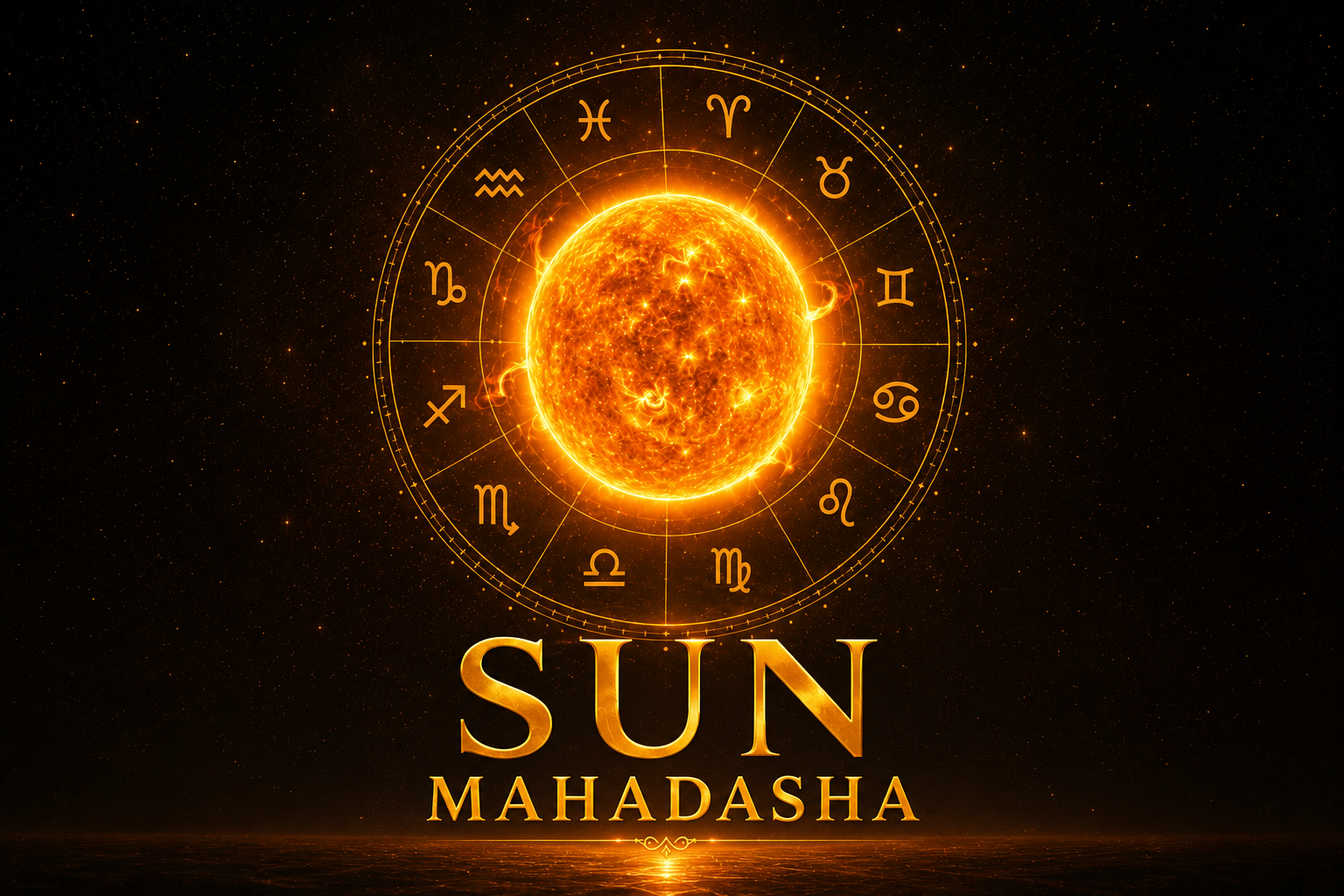
Table of contents
one Of the nine planetary periods in the Vimshottari Dasha system, Sun Mahadasha is the shortest, just six years out of a possible 120-year full cycle. But short doesn't mean minor. Classical texts treat this period as concentrated and intense precisely because of its brevity: six years of direct engagement with authority, identity, and vitality, compressed into a fraction of the time longer dashas get to unfold.
Here's what this period actually governs, why the same six years can look completely different for two people, and a common technical mix-up worth clearing up along the way.
The Basics: Six Years, the Shortest Mahadasha
In the Vimshottari Dasha sequence, the Sun's Mahadasha runs for exactly 6 years, following Venus's 20-year period and preceding the Moon's 10-year period. The full sequence runs Ketu (7), Venus (20), Sun (6), Moon (10), Mars (7), Rahu (18), Jupiter (16), Saturn (19), Mercury (17), adding up to the traditional 120-year total lifespan the system is built around.
The Sun's brevity relative to periods like Venus or Saturn reflects its classical nature: intense and concentrated rather than slow-building. Whichever dasha you're born into depends on your birth Nakshatra's ruling planet, so not everyone experiences Sun Mahadasha at the same age, but most people go through it at some point between their teens and mid-60s.
The Sun's Core Themes
As the natural karaka (significator) of the soul, the father, government, and authority, the Sun's Mahadasha activates a fairly specific cluster of life themes wherever it shows up in your chart:
- Authority and status. Interactions with government institutions, bosses, and official processes tend to intensify. Recognition, promotions, licenses, and institutional dealings often come to a head during this period.
- The father and paternal figures. Since the Sun is the primary significator of the father, this relationship, its quality, its challenges, matters connected to his health or status, frequently becomes a central theme.
- Self-identity and ego. This period is sometimes described as an "ego check": a strong Sun tends to produce healthy, grounded self-confidence, while a weak or afflicted one can swing toward either arrogance (overcompensation) or persistent self-doubt.
- Vitality and specific health areas. The Sun governs the heart, eyes, bones, and general constitution, so health themes connected to these areas often surface during this dasha, particularly when the Sun is weakly placed.
Why the Sun's Sign and House Matter So Much
This is the single most important variable in reading Sun Mahadasha, and it's why the same six-year period produces wildly different experiences for different people.
Sign dignity is the starting point. The Sun is exalted in Aries and in its own sign in Leo, both considered strong, favorable placements. It's debilitated in Libra, considered its most challenging sign placement. A Sun in Aries or Leo during its own Mahadasha tends to bring leadership opportunities, government favour, and robust vitality. A Sun in Libra tends to bring ego friction in partnerships, indecisiveness around authority matters, and health themes related to its debilitated condition.
House placement adds another layer. The Sun tends to perform well in angular houses (1st, 4th, 7th, 10th) and trinal houses (1st, 5th, 9th), and is generally considered weaker when placed in the 6th, 8th, or 12th houses (the dusthana or "difficult" houses) without other factors offsetting that placement.
Aspects and afflictions matter too. Benefic aspects from Jupiter tend to strengthen the Sun's positive expression, while close association with malefics, particularly Saturn, classically considered the Sun's chief planetary enemy, tends to intensify friction during this dasha.
A Technical Correction Worth Making: Can the Sun Actually Be "Combust"?
You'll frequently see Sun Mahadasha content refer to a "combust Sun" as a source of difficulty. This is worth clarifying precisely, because it's technically imprecise as commonly used. Combustion (Sanskrit: asthangata) refers to what happens to other planets when they sit too close in degree to the Sun, not something that happens to the Sun itself. The Sun is the source of combustion for other planets; it doesn't become combust itself in classical technical usage.
What actually weakens the Sun in a way sometimes loosely described as "combust" is a close conjunction with Rahu or Ketu, technically termed Grahana (an eclipse-like affliction), which genuinely does reduce the Sun's clear expression. If you've seen "combust Sun" used to describe a difficult Sun Mahadasha, it's most likely referring either to this Rahu/Ketu conjunction, or more loosely to other planets in the same house being combust by the Sun's presence there, both real considerations, just described somewhat imprecisely by the popular shorthand.
The Antardasha Sequence Matters Within the Six Years
Because Sun Mahadasha is only six years, its nine internal Antardasha sub-periods move quickly, and which one is active at a given moment shapes the specific texture of that stretch of time. Two are worth knowing about specifically:
- Sun-Jupiter Antardasha (roughly 9-10 months) is generally considered the most favourable sub-period, since Jupiter is a natural benefic that tends to expand the Sun's positive qualities, wisdom, authority, and opportunities for growth.
- Sun-Saturn Antardasha (roughly 11 months) is generally considered the most challenging, precisely because the Sun and Saturn are classical planetary enemies. Career delays, authority conflicts, and health concerns are more commonly associated with this specific window than with the Mahadasha as a whole.
This is a useful practical point: even within a generally favourable Sun Mahadasha, the Saturn sub-period can bring a temporarily harder stretch, and even within a generally difficult Sun Mahadasha, the Jupiter sub-period can offer real relief. The Mahadasha's overall character and its internal sub-period texture are both worth tracking.
An Important Caution: Not Every Sun Needs a Remedy
This is a nuance that gets skipped in a lot of remedy-focused content, and it's worth stating directly: if your Sun is already exalted, in its own sign, or well-placed in a kendra or trikona house with supportive aspects, deliberately strengthening it further through remedies isn't automatically a good idea. Several experienced astrologers are explicit on this point: strengthening an already-strong Sun can tip toward arrogance, domineering behaviour, and unnecessary conflict with others. Remedies are meant to address weakness, not to be applied indiscriminately to a placement that isn't struggling in the first place.
When to Get a Professional Reading Instead of Self-Diagnosing
Given how much depends on precise sign, house, and aspect combinations, it's worth getting a full reading rather than a general Mahadasha description if:
- You want to know your Sun's functional role from your specific ascendant, since the Sun can act as a benefic or a more neutral influence depending on which houses it rules for you
- You're currently in, or approaching, your Sun-Saturn Antardasha and want to plan around a potentially harder stretch
- You're unsure whether a remedy is actually warranted, given that a strong Sun generally doesn't need strengthening
Myth vs. Reality
Myth: The Sun is always a malefic planet to be feared.
Reality: The Sun is considered a natural benefic for dharma and spiritual growth. However, it behaves with more intensity and can act unfavourably in specific weak placements, similar to how fire purifies rather than simply destroys.
Myth: Sun in the 7th house means someone won't marry.
Reality: This is a common exaggeration. It more accurately suggests the ego has to learn to share power within a partnership, often with a strong-willed partner, not that marriage won't happen.
Myth: A "combust Sun" is a standard technical term describing a weak Sun.
Reality: Classically, the Sun causes combustion in other planets rather than becoming combust itself. What's usually meant by this loose phrase is either a Rahu/Ketu conjunction (Grahana) or other planets sharing the Sun's house becoming combust.
Why Check This on DoPuja
Reading Sun Mahadasha accurately requires precise knowledge of the Sun's exact degree, sign, house, and aspecting planets, along with your specific ascendant, to determine the Sun's functional role in your chart. UmasDoPuja's Kundali reports use the Swiss Ephemeris engine with NASA/JPL DE431 planetary data and correctly applied Lahiri Ayanamsa, so these details are calculated precisely rather than approximated. The full report also shows your current Antardasha within the Mahadasha, since that sub-period often matters as much as the broader six-year picture. For a personalised read on how your specific Sun placement is likely to shape this period, Talk to Astrologer connects you with a real astrologer for that context.
Why Trust This
The framework described here, the Sun's karakatvas (significations), its exaltation and debilitation points, the Vimshottari sequence and durations, draws on the Brihat Parashara Hora Shastra and the broader classical Jyotish tradition. Where nuance exists, such as the precise technical meaning of combustion or how remedies should be applied differently depending on whether the Sun is already strong, we've tried to represent the more careful, technically precise view rather than the looser popular shorthand often found in quick-reference content.
Frequently Asked Questions
Does everyone experience Sun Mahadasha the same way?
No. Outcomes depend heavily on the Sun's sign, house, aspects, and your specific ascendant, which determines whether the Sun acts as a stronger or more neutral influence in your particular chart.
Is Sun Mahadasha a good time to get married?
Not typically the primary marriage-timing period in the Vimshottari system, since the Sun's separative, individual-focused quality is less naturally suited to partnership themes than periods ruled by Venus or Jupiter.
What's the difference between Sun Mahadasha and Sun Antardasha?
Mahadasha refers to the Sun's own six-year major period. Antardasha refers to a Sun sub-period occurring within a different planet's Mahadasha, a much shorter window with its own distinct character.
Should I wear a ruby during my Sun Mahadasha?
Only if your Sun is genuinely weak or afflicted, and ideally after a proper chart review. If your Sun is already strong, a ruby isn't automatically recommended and could reinforce already-present ego tendencies.
How can I tell if my Sun is exalted, debilitated, or in its own sign?
This requires knowing your Sun's exact sign placement from an accurate birth chart, exalted in Aries, debilitated in Libra, own sign in Leo, with all other sign placements falling somewhere between these in terms of dignity.
✦ Keep reading
Recommended articles
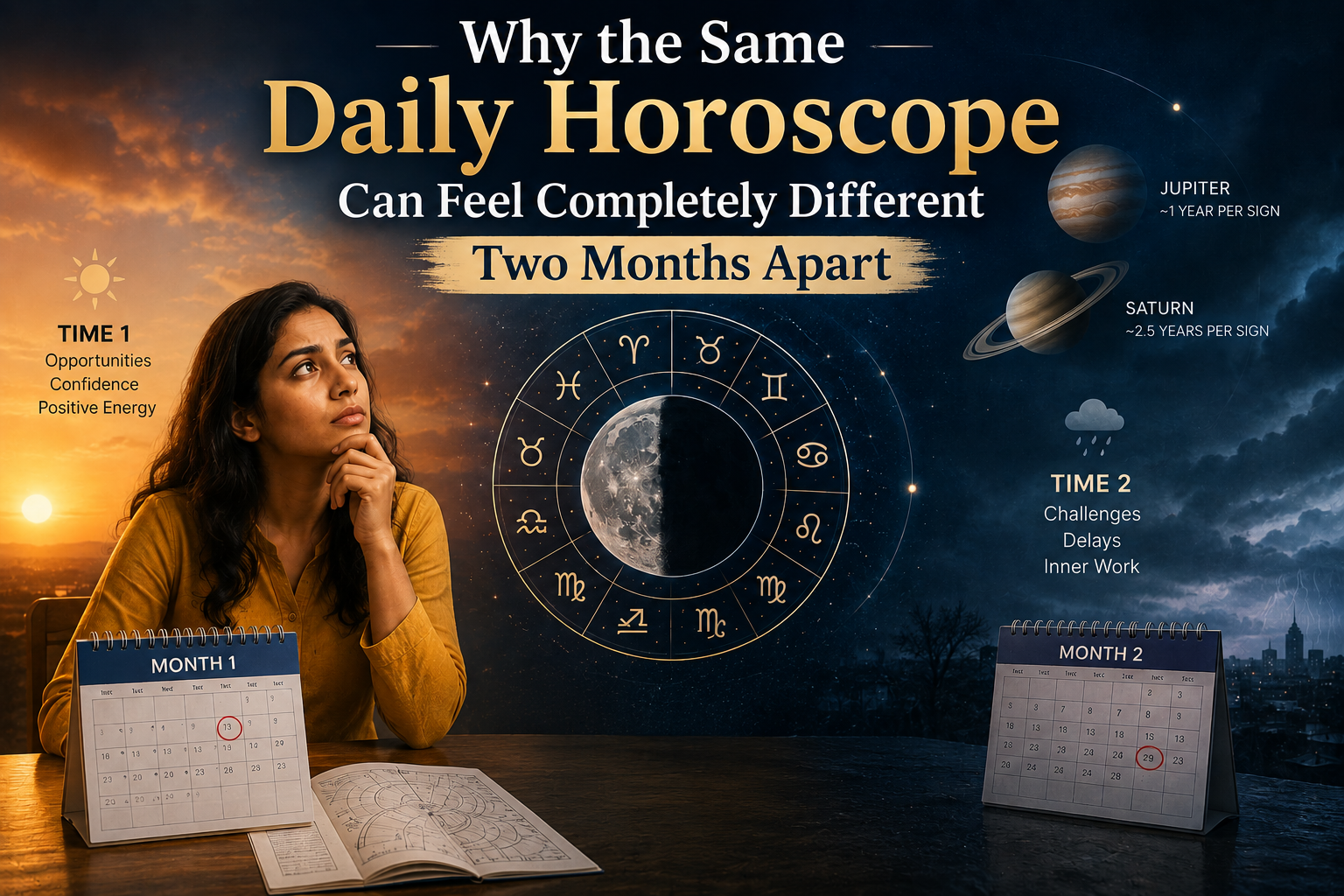
Why the Same Daily Horoscope Can Feel Completely Different Two Months Apart
Discover why the same daily Rashifal can feel different at different times. Learn how Moon transits, Jupiter, Saturn, Gochar Samyukti and Dasha shape daily predictions.
Feeling Stuck for Years? You Might Be in Sade Sati
Feeling stuck in career, finances, or energy? Learn what Sade Sati means, its three phases, Dasha's role, traditional remedies, and when it ends.
Why Does Nothing Seem to Work Out? Understanding Kaal Sarp Dosha
Wondering why repeated setbacks keep happening? Understand Kaal Sarp Dosha, its effects, Rahu-Ketu periods, traditional remedies, and what your Kundali reveals.
Comments
Be the first to comment.
Leave a comment