Kaal Sarp Dosha: What It Is and Why It's So Feared in Vedic Astrology
by SeoTeam· July 4, 2026· 7 min read· 6 viewsKaal Sarp DoshaKaal Sarp YogKaal Sarp Dosha FactsKaal Sarp Dosha MythsRahu Ketu YogRahu Ketu in AstrologyVedic AstrologyKundali AnalysisFree KundaliOnline KundaliBirth Chart ReadingHoroscope AnalysisAstrology GuideDoshas in KundaliKaal Sarp Dosha RemediesIs Kaal Sarp Dosha BadAstrology MythsJanam KundaliDoPujaHindu Astrology
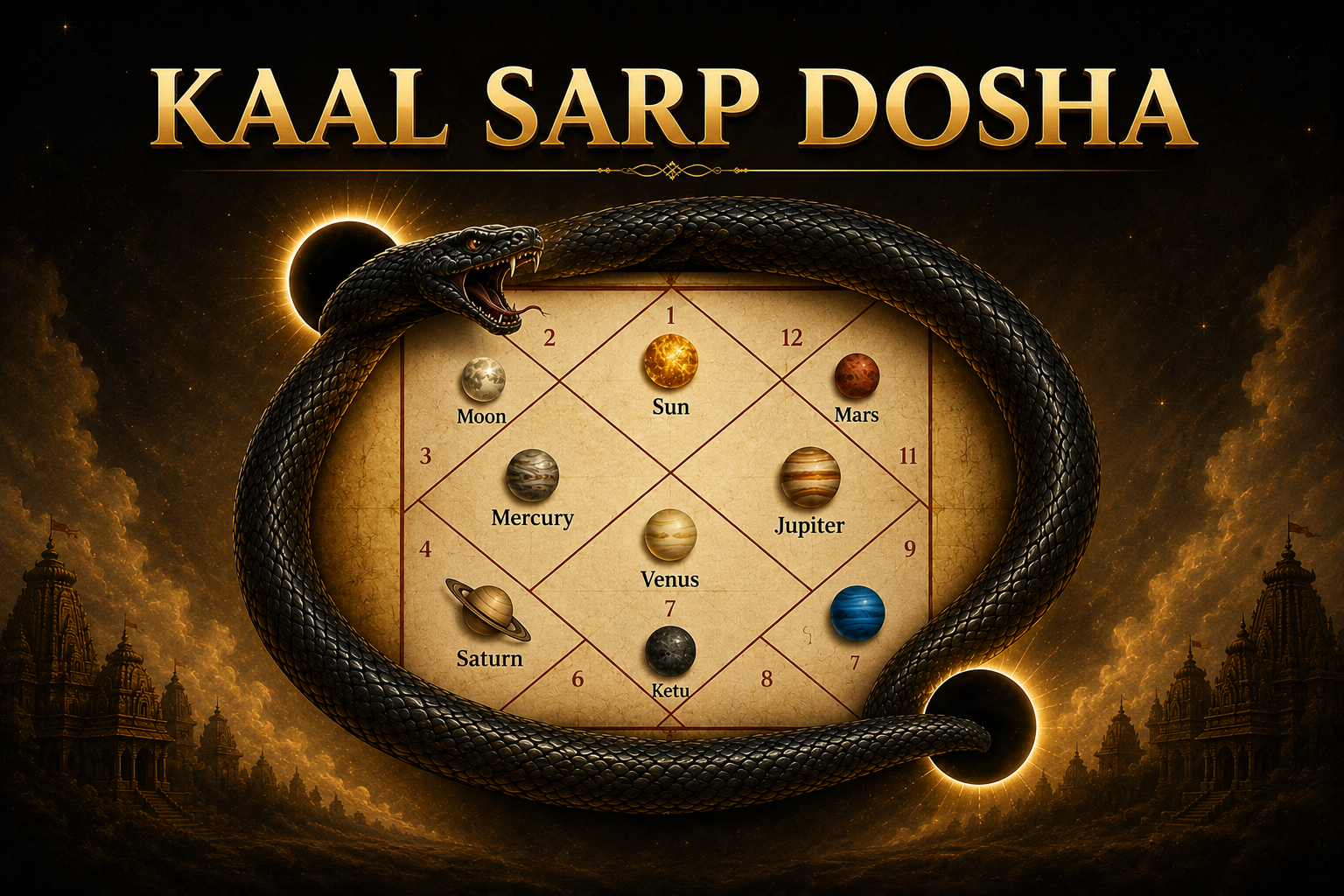
Table of contents
Few terms in Vedic astrology carry as much weight in casual conversation as "Kaal Sarp Dosha." Say it out loud in most Indian households and you'll get a reaction, usually one of quiet concern. But like Manglik Dosha, most of what gets repeated about it is oversimplified, and the actual classical picture is more nuanced than the popular version.
This article breaks down what Kaal Sarp Dosha technically is, why it isn't as universally damning as it's often made out to be, and how to actually check for it in your own chart.
What Is Kaal Sarp Dosha?
Kaal Sarp Dosha forms when all seven classical planets, Sun, Moon, Mars, Mercury, Jupiter, Venus, and Saturn, fall within the arc between Rahu and Ketu, the two lunar nodes. Picture the birth chart's 12 houses as a circle, with Rahu sitting in one house and Ketu directly opposite it (they're always exactly 180 degrees apart). If every other planet is hemmed on one side of that axis, the dosha is considered fully formed.
This matters because Rahu and Ketu aren't physical planets, they're mathematical points marking where the Moon's orbit crosses the ecliptic. In classical mythology, they represent a single serpent-demon split in two, which is part of where the "Sarp" (serpent) in the name comes from.
Full vs. partial formation matters. If all seven planets fall between the axis, that's a full Kaal Sarp Dosha. If one or two planets fall outside the arc, it's typically read as a partial formation, generally considered less intense, though still worth noting.
The 12 Types of Kaal Sarp Dosha
Classical texts classify Kaal Sarp Dosha into 12 types, based on which house Rahu occupies at birth. Each type is named and carries a different thematic emphasis:
- Anant Kaal Sarp (Rahu in 1st house) - themes around self-identity and health
- Kulik (2nd house) - themes around finances and family
- Vasuki (3rd house) - themes around courage and siblings
- Shankhpal (4th house) - themes around home and emotional security
- Padma (5th house) - themes around children and creativity
- Mahapadma (6th house) - themes around health and rivals
- Takshak (7th house) - themes around marriage and partnerships
- Karkotak (8th house) - themes around transformation and sudden change
- Shankhachud (9th house) - themes around fortune and higher learning
- Ghatak (10th house) - themes around career
- Vishdhar (11th house) - themes around income and gains
- Sheshnag (12th house) - themes around losses and spirituality
The specific type is meant to indicate which life area tends to feel the dosha's effects most, rather than a generic "everything goes wrong" outcome.
Why "Nothing Seems to Work Out" Isn't the Full Story
The classical association with Kaal Sarp Dosha is repeated setbacks, delays, or effort that doesn't translate into proportional results, a sense of running in place. This is real enough as a described pattern that it's easy to see why people fixate on it once they learn they have the dosha.
But it's worth being clear-eyed about what this actually represents in classical texts: a karmic-timing indicator tied to unresolved patterns, not a fixed curse locked in for life. The dosha's intensity is also read alongside dasha periods, effects are generally considered to intensify specifically during Rahu or Ketu Mahadasha and to ease outside of those windows.
Traditional remedies associated with this dosha include:
- Rahu-Ketu Shanti puja, performed by a qualified priest
- Worship on Nag Panchami, the festival specifically associated with serpent deities
- Chanting mantras associated with Rahu and Ketu
As with any traditional remedy, these are presented here as customary practice within the belief system, not as guaranteed interventions.
When a Quick Check Isn't Enough
A lot of people self-diagnose Kaal Sarp Dosha from a basic chart glance and stop there. It's worth getting a full reading instead of relying on a single-glance check if:
- You're not certain whether one or two planets actually fall just outside the Rahu-Ketu arc (this is the difference between full and partial formation, and it's easy to misjudge without precise planetary degrees)
- You want to know which of the 12 types applies to you, since that changes which life area is actually relevant
- You're currently in or approaching a Rahu or Ketu Mahadasha, since that's when this dosha is classically read as most active
Kaal Sarp Dosha vs. Sade Sati: Different Mechanisms, Often Confused
These two are frequently lumped together in casual conversation, but they work differently. Kaal Sarp Dosha is a static feature of your birth chart, either all your planets are hemmed between Rahu and Ketu at birth, or they're not; it doesn't change. Sade Sati, by contrast, is a transit-based phenomenon, Saturn's roughly 7.5-year journey through the houses around your natal Moon, which every person experiences multiple times across a lifetime regardless of their birth chart's Kaal Sarp status.
It's entirely possible to have Kaal Sarp Dosha without a particularly difficult Sade Sati, or vice versa. Astrologers typically check both independently rather than assuming one implies the other.
How to Identify Kaal Sarp Dosha in Your Chart
1. List all seven planet house positions from your birth chart, Sun, Moon, Mars, Mercury, Jupiter, Venus, Saturn.
2. Locate Rahu and Ketu's houses, remember they're always exactly opposite each other.
3. Check whether every planet falls within the arc on one side** of the Rahu-Ketu axis. If yes, that's a full formation.
4. If one or two planets fall outside, note it as a partial formation.
5. Identify which house Rahu occupies to determine which of the 12 types applies.
Myth vs. Reality
Myth: Kaal Sarp Dosha means a life full of failure.
Reality: Classical texts describe it as a pattern of delayed or non-linear progress, particularly during Rahu/Ketu dasha periods, not blanket failure across an entire lifetime.
Myth: Everyone with this dosha needs the same remedy.
Reality: The recommended focus varies by which of the 12 types applies, since each points to a different affected life area.
Myth: This dosha is mentioned explicitly in the oldest classical texts.
Reality: Many scholars note that Kaal Sarp Dosha, as a named, structured concept, is a later interpretive addition to the tradition, built on top of earlier, more general beliefs about Rahu and Ketu's influence.
Why Check This on DoPuja
Confirming full versus partial Kaal Sarp Dosha requires precise planetary degree positions, not just rough house placements, a distinction that's easy to get wrong with imprecise calculation tools. UmasDoPuja's Kundali reports are generated using the Swiss Ephemeris engine with NASA/JPL DE431 planetary data and correctly applied Lahiri Ayanamsa, giving you an accurate read on exactly where each planet falls relative to the Rahu-Ketu axis. The full report also identifies which of the 12 types applies to your chart and flags your current dasha period, so you can see whether you're in an active Rahu/Ketu phase right now. For a deeper, personalised read, Talk to Astrologer connects you with a real astrologer who can walk through your specific formation in context.
Why Trust This
The core mechanics described here, the Rahu-Ketu axis, the concept of hemmed planets, the 12 sub-types, are widely referenced across Vedic astrology texts and teaching traditions, though it's worth noting (as mentioned above) that Kaal Sarp Dosha's status as a formally named dosha is a later addition to the tradition rather than something explicit in the earliest surviving texts. There's also genuine, ongoing debate among practising astrologers about how much predictive weight this dosha deserves relative to other chart factors, we've tried to present it here as a widely-used interpretive framework rather than an uncontested settled fact.
Frequently Asked Questions
Can Kaal Sarp Dosha be fully cancelled, as Mangal Dosha can?
Classical texts don't offer a "cancellation" mechanism in the same structured way they do for Mangal Dosha. Remedies are traditionally aimed at easing its effects during active dasha periods rather than eliminating the placement itself.
Is partial Kaal Sarp Dosha still worth worrying about?
It's typically read as milder than full formation, but the specific planets that fall outside the arc, and their own strength, still matter for a complete picture.
Does having Kaal Sarp Dosha affect every area of my life equally?
No, this is exactly why the 12 types exist. The house Rahu occupies is meant to indicate where the effects are most concentrated.
How do I know if I'm currently in a Rahu or Ketu Mahadasha?
This requires calculating your Vimshottari Dasha sequence from your Moon's Nakshatra at birth, available in a full Kundali report.
Should I avoid major life decisions if I have this dosha?
Not necessarily. Many astrologers would say the more useful approach is checking your current dasha and general chart strength together, rather than avoiding decisions based on one static chart feature alone.
✦ Keep reading
Recommended articles

Why Does Nothing Seem to Work Out? Understanding Kaal Sarp Dosha
Wondering why repeated setbacks keep happening? Understand Kaal Sarp Dosha, its effects, Rahu-Ketu periods, traditional remedies, and what your Kundali reveals.

Why Your Horoscope Might Be Meant for a Million Other People Too
Discover why daily horoscopes are shared by millions, while a personalised Kundali reading uses your exact birth details, houses, Nakshatra, Dasha and unique chart combinations.
Why Some "Weak" Planets Are Actually Weaker Than Others
Discover how Paramocha degrees affect planetary weakness in Vedic astrology, why exact degree matters, and how it changes the strength of cancellation conditions.
Comments
Be the first to comment.
Leave a comment