Free Janam Kundali Guide: What Your Birth Chart Actually Reveals
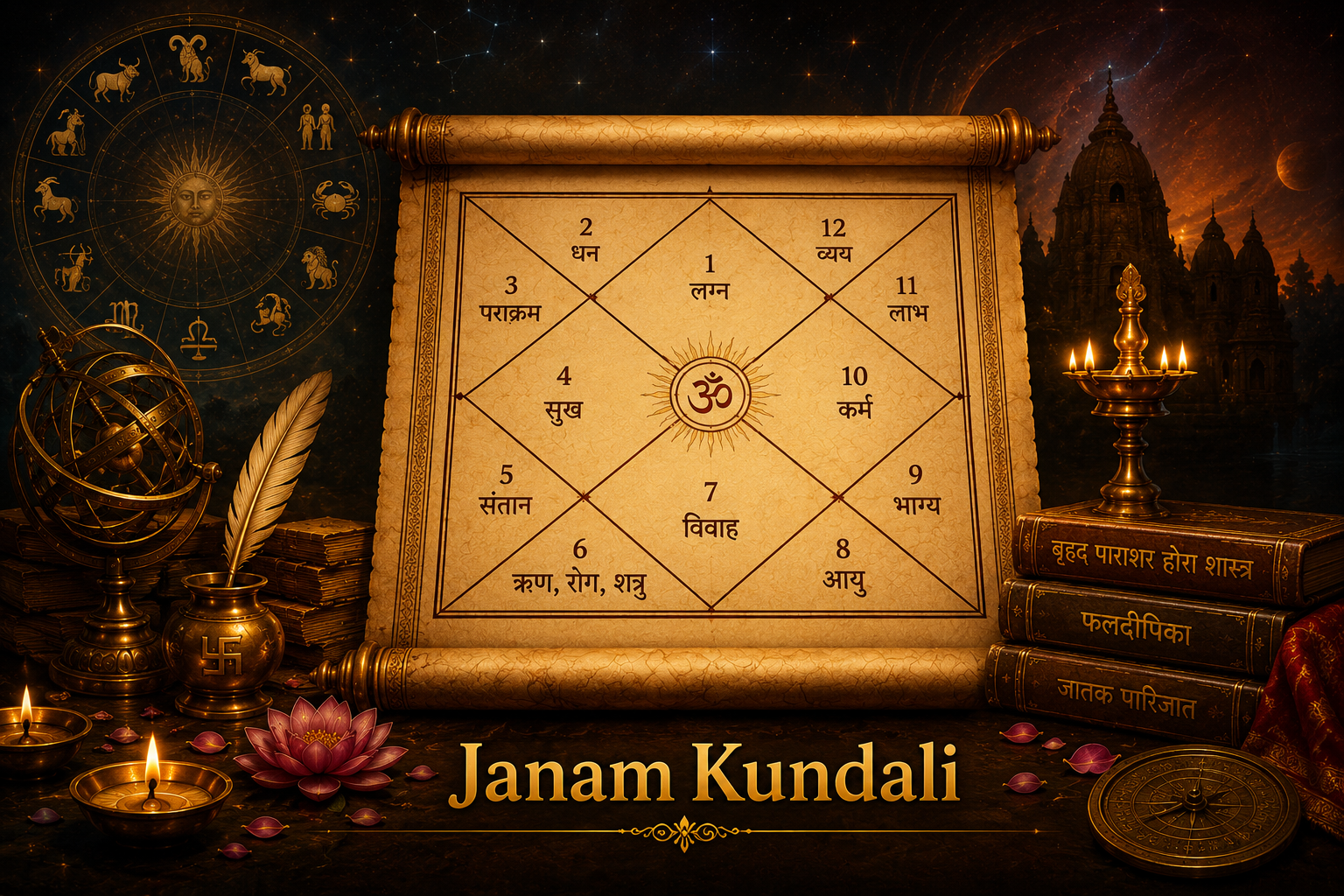
Table of contents
In Vedic astrology, the Janam Kundali, or birth chart, is one of the most detailed tools available for understanding a life's structure. It maps the exact positions of the Sun, Moon, and planets at the precise moment you were born.
Generating one online is now instant. Making sense of what it actually shows you is where most people get stuck.
Here's what a proper Kundali report covers, why birth data accuracy is non-negotiable, and where a free report's genuine limits are.
What Does a Janam Kundali Actually Show?
Traditionally, the Kundali is treated as a record of accumulated karma, the planetary configuration at birth reflecting the specific conditions a person was born into. Practically, it functions as a structured way to understand strengths, likely challenges, and timing across a lifetime, used historically for everything from marriage timing to understanding recurring career or health patterns.
What Are the Core Sections of a Proper Report?
A genuinely useful Kundali report goes well beyond a Sun-sign summary. It generally covers four pillars.
Base charts. The Lagna (Ascendant) chart represents the physical self and overall life trajectory. The Chandra (Moon) chart covers emotional landscape and subconscious patterns. The Navamsha (D9) chart adds further depth, particularly relevant to marriage and long-term chart strength, since it's often used to confirm whether a planet's apparent strength in the main chart genuinely holds up under closer analysis.
Dasha timing. The Vimshottari Dasha system is what separates genuine predictive timing from general character analysis. The Mahadasha describes the overarching theme of a longer stretch of life, while the Antardasha adds shorter-term texture within it.
Yoga analysis. This identifies specific planetary combinations associated with particular strengths, Raj Yogas connected to authority and leadership, Dhana Yogas connected to financial stability, among many others.
Dosha evaluation. This flags specific combinations traditionally associated with friction or difficulty, Manglik Dosha (relationship-related) or Kaal Sarp Dosha (periods of intense difficulty, often tied to transformation) being commonly discussed examples.
Why Is Birth Data Accuracy So Important?
A frequent source of frustration with online Kundali reports is a reading that simply doesn't resonate, and this is almost always traceable to imprecise birth data.
Since the Earth rotates 360 degrees every 24 hours, the horizon shifts roughly one degree every four minutes. A birth time off by even ten or fifteen minutes can shift the Ascendant enough to change the entire house structure, altering how career, health, and relationship indicators are read throughout the chart.
Location matters just as much. Two people born at the exact same moment in different parts of the world will have different Ascendants, since the calculation depends on the local horizon at that specific latitude and longitude. Getting the most out of a free Kundali means using your exact recorded birth time and location, not an approximation.
Is a Horoscope the Same as a Kundali?
No, and this is a genuinely common point of confusion. A sun-sign horoscope is a broad generalisation shared by everyone born under the same sign, offering a general daily tone at best. A full Janam Kundali is entirely different: it considers all nine planets, twelve houses, and twenty-seven Nakshatras specific to your exact birth time and location, analysing the relationships between all of them together rather than looking at any single placement in isolation.
What Can a Free Report Do, and Where Does It Fall Short?
Free reports are mathematically precise. They accurately list Yogas, identify the current Dasha, and flag potential Doshas.
Where they tend to fall short is synthesis. A report might flag both wealth indicators and financial-strain indicators without weighing which planetary influence is actually stronger in that specific chart, since that judgment call is harder to automate than the underlying calculation. This is exactly where a human astrologer adds real value: applying cancellation rules (Bhanga) that can mitigate or nullify a flagged Dosha, and providing context on which remedies, if any, are actually appropriate for a specific chart. A free report is a strong starting point, best treated as a foundation to build on rather than a complete final answer for complex questions.
Should I Trust a Remedy Suggested Automatically by a Report?
Approach this carefully. Automated reports can correctly identify a weak or afflicted planet, but deciding whether a specific remedy, a gemstone, mantra, or ritual, genuinely suits your chart requires human judgement, not just a generic suggestion attached to a flagged placement. A remedy appropriate for one person's chart can be unhelpful or even counterproductive for another's, depending on whether the relevant planet is functionally beneficial or malefic for that specific ascendant. Confirm any suggested remedy with a qualified astrologer before acting on it, rather than proceeding purely on a computer-generated recommendation.
When to Get a Professional Reading Instead of Relying on the Report Alone
A free report is genuinely useful for a general orientation. A full consultation is worth it if:
Your report flags a Dosha and you want to know whether cancellation conditions actually apply in your specific case.
Your report shows conflicting signals (such as both wealth and financial-strain indicators) and you want them properly weighed against each other.
You're considering a specific remedy and want confirmation it genuinely suits your chart before acting on it.
Myth vs. Reality
Myth: A free Kundali report is mathematically unreliable.
Reality: Modern calculation engines are highly accurate for planetary positions. The genuine limitation is in synthesis and nuanced interpretation, not the underlying maths.
Myth: A sun-sign horoscope and a full Kundali are essentially the same thing.
Reality: A horoscope is a broad generalisation shared by millions. A Kundali is built entirely from your own exact birth time, location, and the relationships between all nine planets and twelve houses.
Myth: A flagged Dosha in your report is a fixed, unavoidable problem.
Reality: Many Doshas have documented cancellation conditions that can mitigate or nullify the concern, worth checking before assuming the worst.
Why Check This on DoPuja
Because birth time and location precision matter this much, UmasDoPuja's free Kundali tool uses the Swiss Ephemeris engine with NASA/JPL DE431 planetary data and correctly applied Lahiri Ayanamsa, calculating your base charts, current Dasha, Yogas, and Doshas from your exact birth details rather than an approximation.
For the synthesis a free report can't fully provide, weighing conflicting signals, checking cancellation conditions, and confirming whether a suggested remedy genuinely suits your chart, Talk to Astrologer connects you with a real astrologer for that context.
Why Trust This
The four-pillar structure described here, base charts, Dasha timing, Yoga analysis, and Dosha evaluation, reflects standard practice across classical Jyotish sources and current Vedic astrology reporting. The birth-time sensitivity described follows directly from the Earth's rotation rate, a verifiable astronomical fact, and the horoscope-versus-Kundali distinction reflects a genuinely common point of confusion worth addressing directly.
Frequently Asked Questions
Is a free Janam Kundali accurate?
Mathematically, yes. Modern calculation engines are highly accurate for planetary positions. The interpretation of those positions is where a human astrologer adds the most value beyond automated software.
Does my birth time really matter that much?
Yes, significantly. A difference of just a few minutes can shift your Ascendant and change your entire house structure. Use your exact recorded birth time for the most accurate reading.
Can a Kundali predict my future exactly?
No. Vedic astrology describes tendencies and timing through planetary cycles, not guaranteed specific events. It highlights probabilities and likely windows, supporting more informed decisions rather than certainty.
What should I do if my report shows a Dosha?
Don't panic. Many Doshas have documented cancellation conditions, and a professional reading can clarify whether they apply in your specific case before assuming the worst.
How often should I check my Kundali?
Not daily. It's most useful during major life transitions, a career change, a relationship decision, or a period calling for deeper reflection.
If needed, I can also create an SEO title, meta description, and comma-separated tags for this article.
Recommended articles
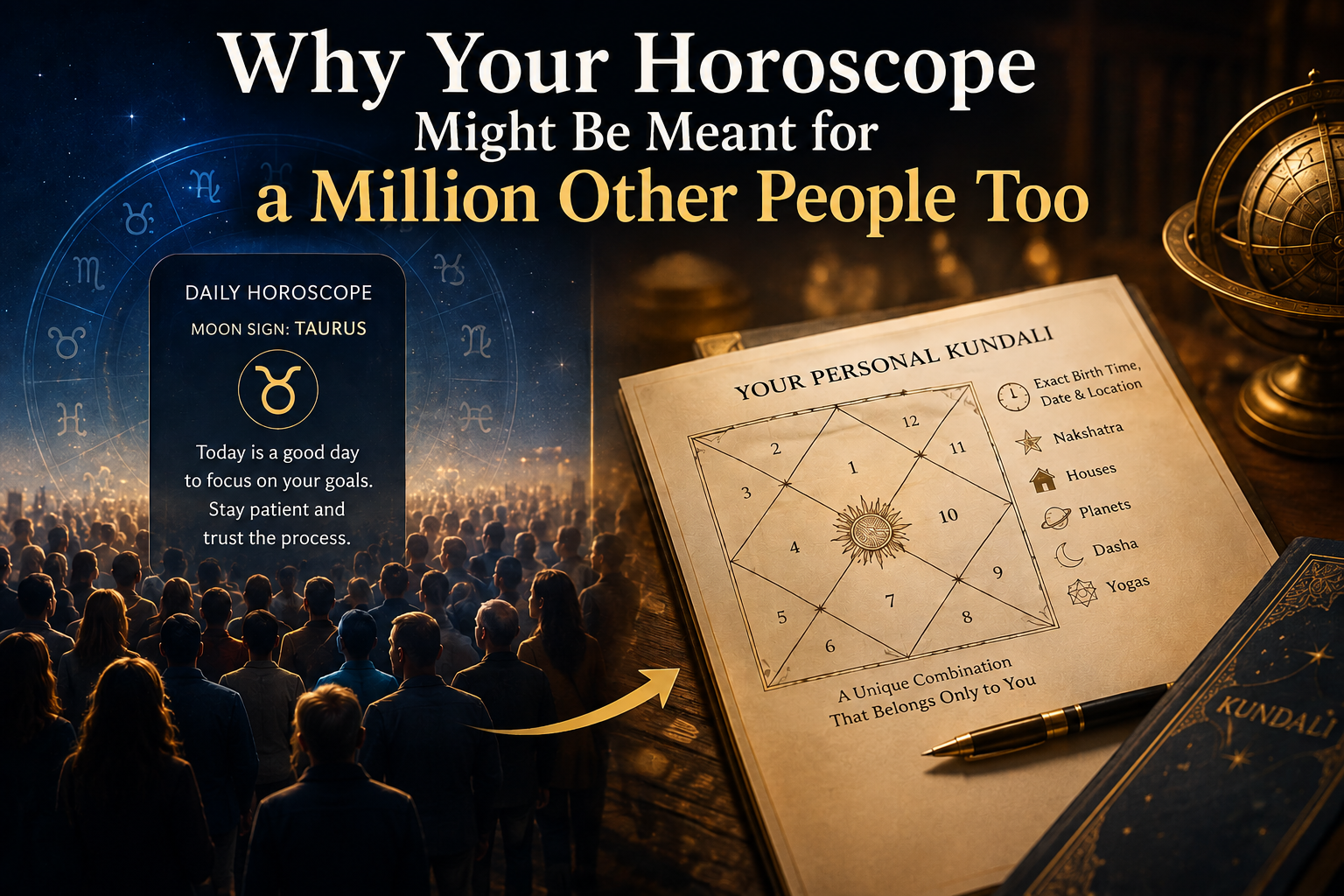
Why Your Horoscope Might Be Meant for a Million Other People Too
Discover why daily horoscopes are shared by millions, while a personalised Kundali reading uses your exact birth details, houses, Nakshatra, Dasha and unique chart combinations.
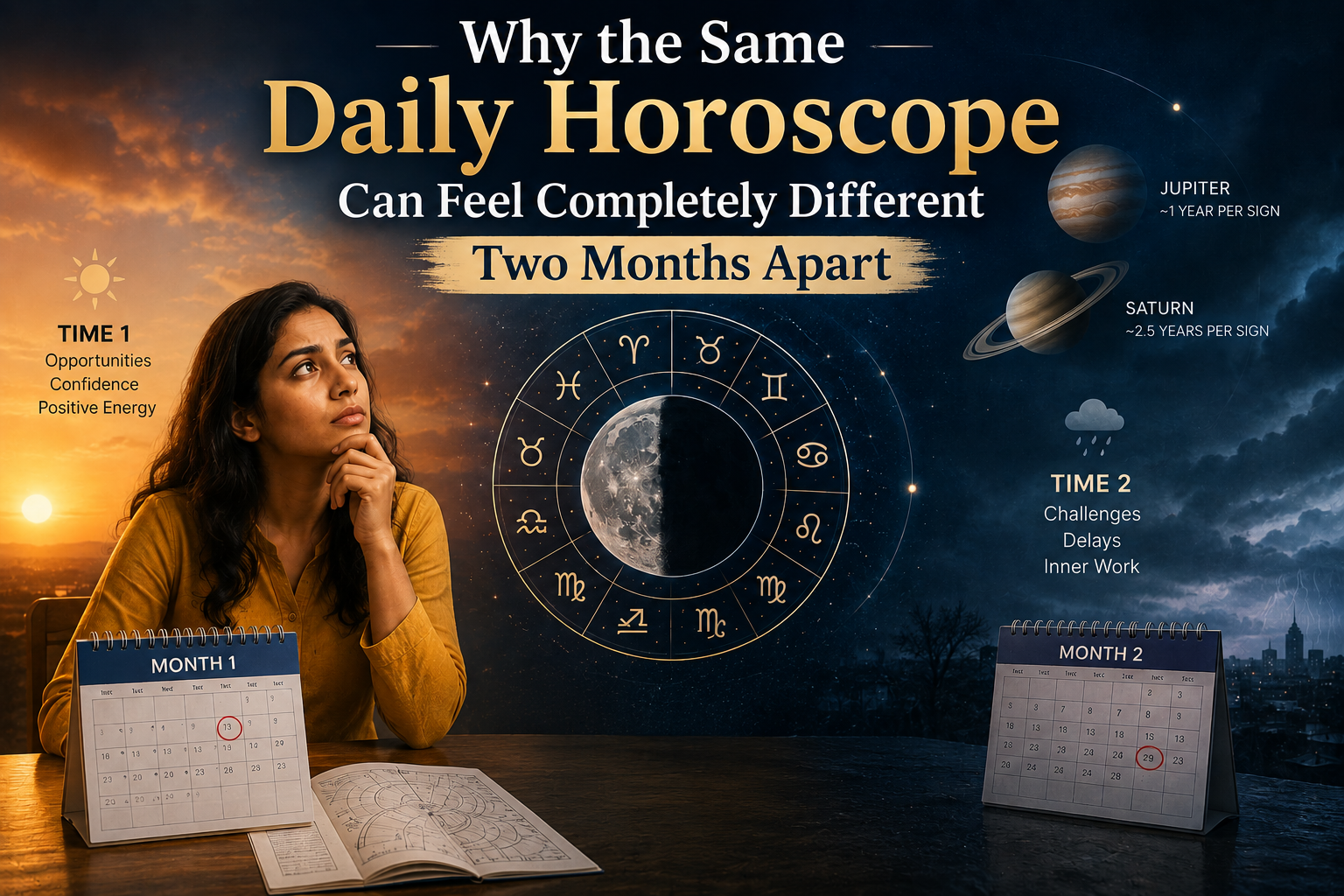
Why the Same Daily Horoscope Can Feel Completely Different Two Months Apart
Discover why the same daily Rashifal can feel different at different times. Learn how Moon transits, Jupiter, Saturn, Gochar Samyukti and Dasha shape daily predictions.
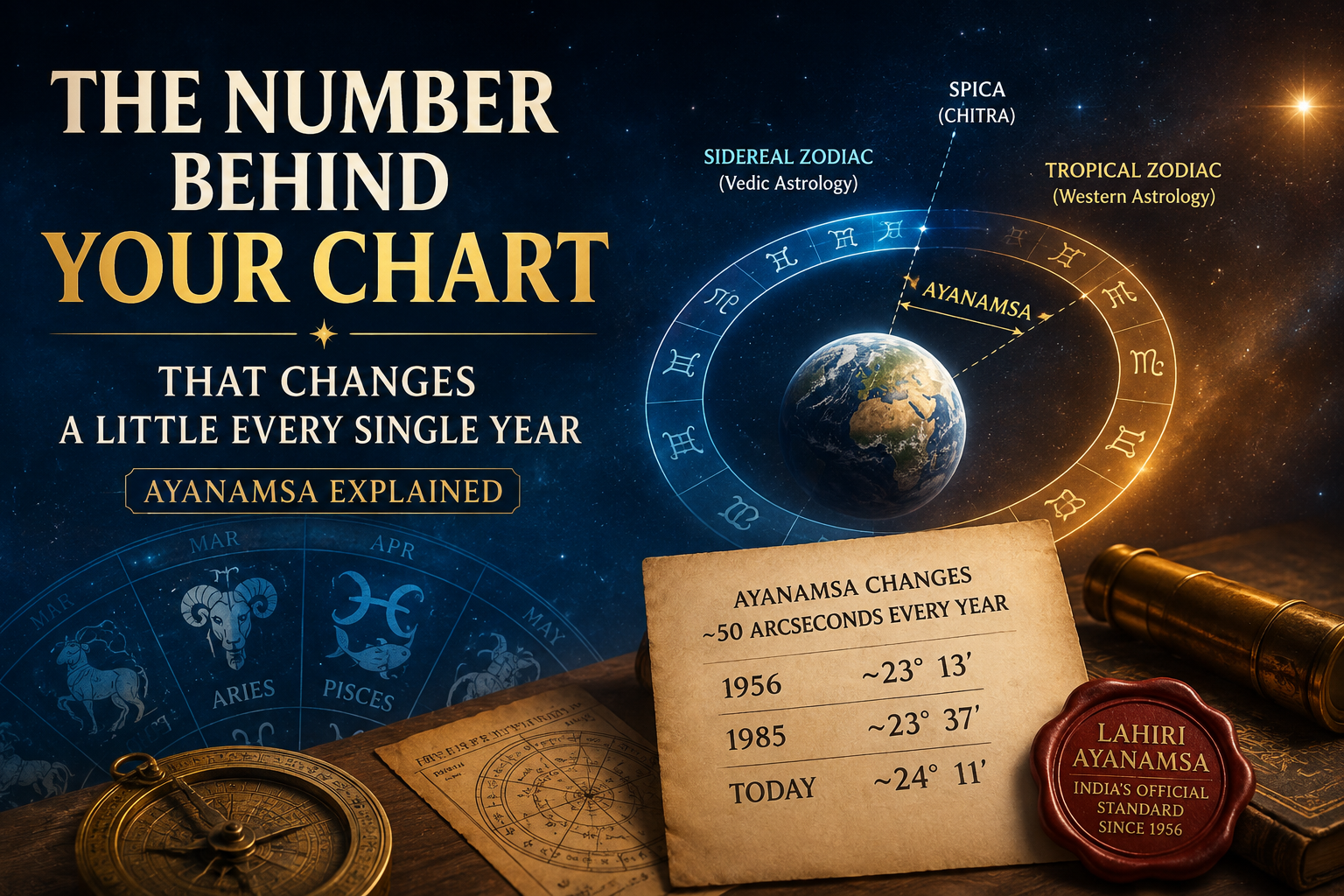
The Number Behind Your Chart That Changes a Little Every Single Year
Discover why Ayanamsa changes every year, how Lahiri Ayanamsa became the Vedic astrology standard, and why its precise value matters for accurate Kundali calculations.
Comments
Be the first to comment.