Kaal Sarp Dosha Explained: Meaning, Effects, and Remedies
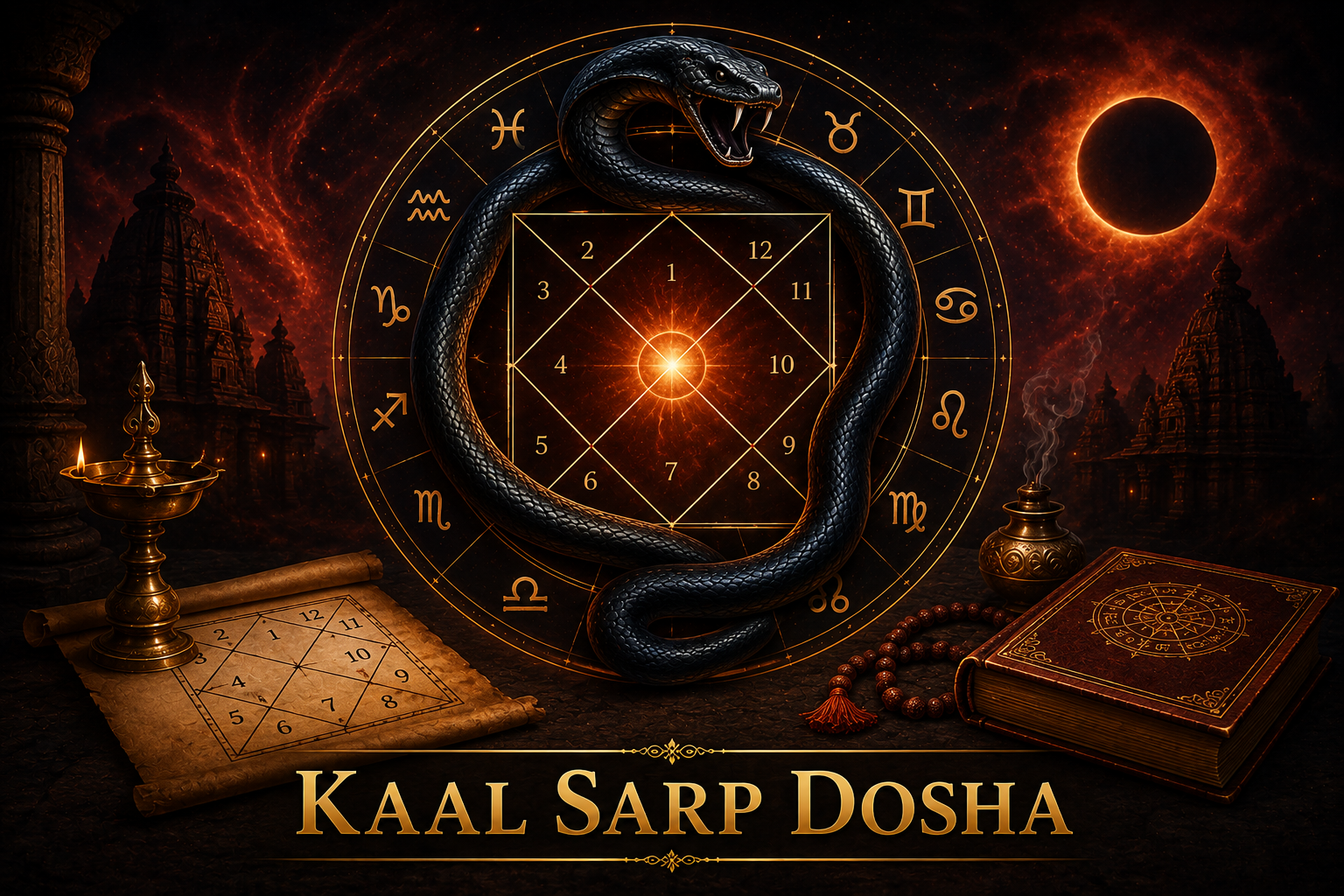
Table of contents
Kaal Sarp Dosha forms when all seven classical planets sit hemmed on one side of the Rahu-Ketu axis. There are 12 named types depending on which house Rahu occupies, each affecting different life areas. It's a genuine karmic configuration, not a curse, and many people with this placement go on to significant achievement once early obstacles are worked through.
Few configurations in Vedic astrology trigger as much fear as Kaal Sarp Dosha. Understanding it properly means moving past the fear-based framing and looking at what it actually involves.
What Is Kaal Sarp Dosha?
Kaal Sarp Dosha occurs when all seven classical planets, the Sun, Moon, Mars, Mercury, Jupiter, Venus, and Saturn, are hemmed on one side of the zodiac by the Rahu-Ketu axis. The name comes from Sanskrit: Kaal means time, Sarp means serpent, symbolically describing someone caught in the coils of a cosmic snake.
Rahu, the north node, represents desire, ambition, and forward-looking karma. Ketu, the south node, represents detachment and the karma of the past. Since Rahu and Ketu always sit exactly opposite each other, they form a fixed axis that channels the energy of every planet trapped between them.
What Does It Mean Spiritually?
Spiritually, this configuration is generally read as a genuine karmic mandate, a sign the individual has come into this life with a specific, intense lesson to work through. Rather than a curse, it's more often described as a pressure cooker: concentrating energy into specific life areas, and traditionally associated with significant transformation, often a shift from intense material focus toward deeper spiritual awareness over time.
Why Does It Create Such Intense Pressure?
The Rahu-Ketu axis always affects two opposite life areas at once. Rahu tends to create an intense, almost obsessive focus on the affairs of its house, while Ketu simultaneously creates a sense of loss or detachment in the exact opposite house. This constant polarity is what drives the dosha's characteristic intensity, and working through the tension between chasing and letting go is generally considered the core lesson involved.
What Are the 12 Types, and What Do They Affect?
Which specific life areas get pulled into this tension depends entirely on which house Rahu occupies. There are 12 recognised types:
Anant (Rahu in the 1st house, Ketu in the 7th) centres the tension on self-identity versus partnership.
Kulik (Rahu in the 2nd, Ketu in the 8th) centres on personal wealth versus shared or inherited resources.
Vasuki (Rahu in the 3rd, Ketu in the 9th) centres on personal effort and initiative versus higher belief and destiny.
Shankhpal (Rahu in the 4th, Ketu in the 10th) centres on domestic peace versus professional reputation.
Padma (Rahu in the 5th, Ketu in the 11th) centres on creativity and intellect versus social networks and gains.
Mahapadma (Rahu in the 6th, Ketu in the 12th) centres on daily work and competition versus retreat and spiritual withdrawal.
Takshak (Rahu in the 7th, Ketu in the 1st) is the reverse of Anant, centring on relationship dynamics and identity.
Karkotak (Rahu in the 8th, Ketu in the 2nd) centres on sudden transformation versus family wealth.
Shankhnaad (Rahu in the 9th, Ketu in the 3rd) centres on belief systems versus personal initiative.
Ghatak (Rahu in the 10th, Ketu in the 4th) centres on professional ambition versus home life.
Vishdhar (Rahu in the 11th, Ketu in the 5th) centres on material gains versus creative and emotional satisfaction.
Sheshnag (Rahu in the 12th, Ketu in the 6th) centres on foreign connections and solitude versus daily duty.
Is There a Difference Between a Birth Chart Version and a Temporary One?
Yes, and it's worth keeping these distinct. A version present in your actual birth chart is a permanent feature, most active during the Mahadasha or Antardasha of Rahu or Ketu specifically. A temporary version can also form through current planetary movement, a passing alignment that can activate latent patterns for a shorter window, rather than something built into your chart for life.
Myth vs. Reality
Myth: This configuration is entirely negative.
Reality: Some notable achievers are said to have had this configuration, and it's traditionally associated with an unusual capacity for focus and resilience, sometimes producing significant professional success once early obstacles are navigated.
Myth: Everyone with this dosha faces guaranteed failure.
Reality: Outcomes depend heavily on how well-placed Rahu and Ketu are, and on the rest of the chart, not the label alone.
Myth: The dosha can simply be "cured" and removed.
Reality: Traditional practice generally frames it as something to work with and harmonise over time, through spiritual practice and intentional living, not something eliminated outright.
What Remedies Are Traditionally Recommended?
Commonly cited practices include Rahu-Ketu Shanti Puja, mantra recitation specific to Rahu and Ketu, and consistent spiritual practices like meditation or service-oriented action. Specific gemstones, yantras, or talismans are also sometimes recommended, but as with every remedy discussed across our content, these should only be adopted after a proper chart reading confirms they're actually appropriate for your specific placement.
Note for the Uma's Aura team: any specific claims about how remedial items are sourced, energised, or verified for this particular dosha should be confirmed as current and accurate before publishing, rather than described in general terms we can't verify from here.
Common Mistakes to Avoid
A few patterns are worth avoiding: assuming every difficulty in life traces back to this one placement, searching for a quick fix without addressing the underlying pattern it points to, and ignoring other planetary positions in the same chart that may already soften the dosha's effects.
When to Get a Professional Reading Instead of Guessing
Given how much the real impact depends on which of the 12 types applies, and how well-placed Rahu and Ketu actually are, a full reading is worth it if:
You want to confirm which specific type applies to your chart and what it's likely to affect
You want to know whether your placement is genuinely severe or already softened by other chart factors
You're considering a specific remedy and want confirmation it suits your actual placement
Why Check This on DoPuja
Because Kaal Sarp Dosha depends on precisely confirming that all seven planets sit hemmed between Rahu and Ketu, and identifying exactly which house Rahu occupies, accurate calculation matters considerably here.
UmasDoPuja's Kundali tool uses the Swiss Ephemeris engine with NASA/JPL DE431 planetary data and correctly applied Lahiri Ayanamsa, checking every planet's exact position rather than approximating. For a full, personalised reading on which type applies to you and how your current Dasha interacts with it, Talk to Astrologer connects you with a real astrologer for that context.
Why Trust This
The core definition, the 12 named types and their associated house placements, and the natal-versus-temporary distinction described here are consistently documented across multiple independent classical and current Jyotish sources.
Frequently Asked Questions
Is Kaal Sarp Dosha a lifelong curse?
No. It's a karmic configuration highlighting specific life lessons and potential growth areas, not a fixed curse.
Can it be cured?
It's generally described as something to harmonise rather than cure outright, through spiritual practice and intentional living over time.
Does everyone with this dosha face failure?
No. Outcomes vary considerably depending on the specific type, planetary strength, and the rest of the chart.
How do I know which of the 12 types I have?
This requires a full chart reading confirming Rahu's exact house placement, not just a rough guess.
How can I learn more about my specific pattern?
A personalised consultation with a qualified astrologer gives far more specific insight than a generic description of your type alone.
Recommended articles

Why Does Nothing Seem to Work Out? Understanding Kaal Sarp Dosha
Wondering why repeated setbacks keep happening? Understand Kaal Sarp Dosha, its effects, Rahu-Ketu periods, traditional remedies, and what your Kundali reveals.

Feeling Stuck for Years? You Might Be in Sade Sati
Feeling stuck in career, finances, or energy? Learn what Sade Sati means, its three phases, Dasha's role, traditional remedies, and when it ends.

Struggling With Delayed Marriage? What Mangal Dosha Really Means
Struggling with delayed marriage because of Mangal Dosha? Learn what being Manglik really means, cancellation factors, traditional remedies, and when to seek a full Kundali reading.
Comments
Be the first to comment.