The 4th House in Astrology: Foundation of Your Inner Peace
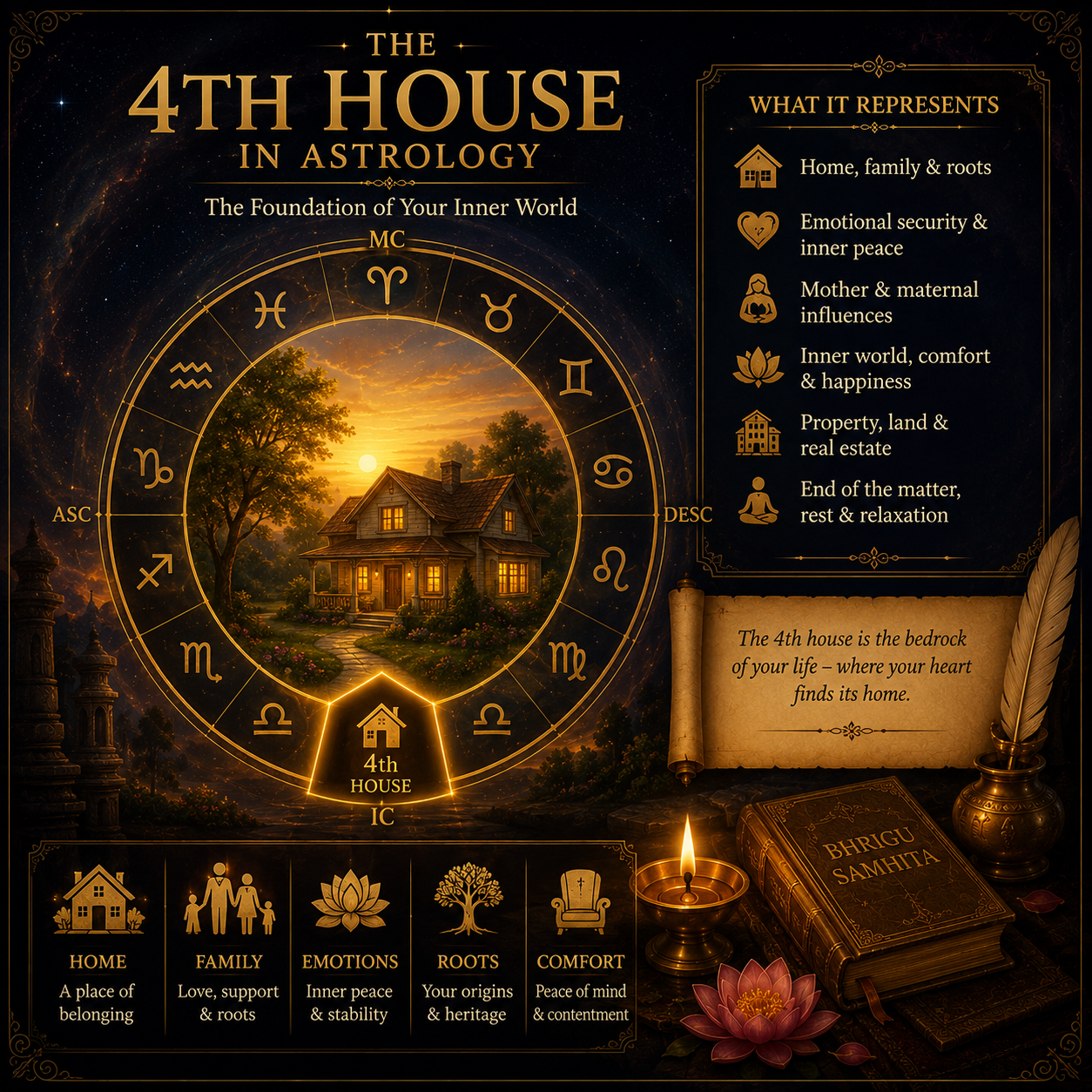
Table of contents
The 4th House is often described as the bedrock of the entire birth chart. It sits at a distinct point in the horoscope, traditionally representing the private, unexposed aspects of life. While the 10th House points toward public achievement and career, the 4th House represents what's left when that public role comes off. A quick note before we go further: this guide draws on both Western and Vedic astrology, since both traditions discuss this house, but they aren't identical systems. In Western astrology, this point is called the Imum Coeli, or IC, meaning the bottom of the sky. In Vedic astrology, or Jyotish, it's called Sukha Bhava, the house of happiness and comfort. The two systems calculate charts differently and don't always agree on every detail, but both traditions converge on the same broad theme: this house governs your private emotional world, not your public one.
Core Domains of the 4th House
The 4th House traditionally governs what exists beneath the surface of your public persona; physical living conditions, ancestral background, and your inner psychological state when you're genuinely alone.
Home and Ancestry
Your physical home is the most direct expression of this house. It's traditionally understood to cover your domestic environment, family roots, and the generational or cultural background you were born into, shaping your early sense of identity.
The Mother and Primary Caregiver
This house is traditionally the significator for the mother or primary caregiver. It's traditionally believed to reflect the quality of early nourishment and attachment, shaping how a person learns to give and receive love later in life.
Property and Fixed Assets
This house traditionally covers land, real estate, and family property, along with vehicles in some interpretations, tied to the broader theme of stability and security in how you move through the world.
Inner Peace and Happiness
Known as the house of Sukha in Vedic tradition, this domain is traditionally linked to your emotional baseline, your capacity to feel safe and settled in your own skin, independent of external circumstances.
The 4th House as a Kendra (Angular) House
Astrology traditionally organises the chart into houses of varying influence. The 1st, 4th, 7th, and 10th houses are known as Angular or Kendra houses, considered structurally significant pillars of the chart. The 4th House sits at the lowest point of this structure, traditionally described as the Nadir. Think of it as a foundation. Traditional interpretation holds that the 10th House of career and public recognition tends to feel more sustainable when supported by a stable 4th House, rather than standing alone. The 4th and 10th Houses are often discussed as a private-versus-public axis, what you show the world versus what you carry home afterwards.
Classical Interpretation: Foundational Education
Modern astrological interpretation often spreads learning themes across the 3rd, 5th, and 9th houses, but classical tradition placed particular emphasis on the 4th House for early education. In eras when formal schooling was less common, foundational literacy and early conditioning happened largely at home, which is part of why this house carries that association traditionally. This is traditionally tied to how readily a person absorbs early information, rather than higher academic achievement, which classical tradition generally attributes to other houses instead.
Myth vs. Reality
Myth: Professional success (10th House) is the same as personal happiness. Reality: Traditional interpretation holds these as related but distinct. A strong 10th House alongside a difficult 4th House is traditionally associated with achievement that doesn't feel personally satisfying.
Myth: A challenging 4th House means someone is destined to feel unsettled forever. Reality: Traditional astrology treats chart placements as tendencies to become aware of, not fixed sentences. Understanding a difficult placement is traditionally viewed as the starting point for conscious change, not confirmation that change is impossible.
Myth: The 4th House is only about the physical house you live in. Reality: While it does cover property, its broader traditional meaning centres on your psychological sense of home, your emotional resilience and inner sense of safety.
What Challenging or Supportive Placements Traditionally Suggest
If more intense planets like Saturn, Mars, or Rahu sit in this house, tradition associates this with a kind of early hyper-vigilance, sometimes linked to a strict or unsettled early environment that makes it harder to feel fully settled as an adult. Gentler placements, like Jupiter or the Moon, are traditionally associated with a more nurturing early environment and a stronger natural capacity for self-soothing. Traditional interpretation also links a neglected or difficult 4th House to strain elsewhere in the chart. The 7th House (relationships) is sometimes discussed as becoming a substitute search for the security the 4th House didn't provide, and the 10th House (career) as an external stand-in for internal peace that hasn't been established.
Why Is Uma's Aura's Approach Different?
At Uma's Aura, we look at the 4th House by combining classical Jyotish interpretation with genuine attention to your specific chart, rather than offering generic, one-size-fits-all readings. We're upfront that this is astrological interpretation, not clinical therapy, even when we're discussing emotionally significant themes like family and early attachment. If a consultation touches on genuinely difficult material, we'll always encourage pairing it with qualified therapeutic support where relevant, rather than positioning astrology as a substitute for that care.
Credibility and Authenticity: Why Trust This?
Our approach draws on years of study in classical Jyotish alongside Western astrological tradition, and we're transparent about where the two systems agree and where they differ, rather than blending them without explanation. We look at the specific placements in your actual chart rather than offering a generic reading that could apply to anyone. That said, astrology is a traditional interpretive practice, not an empirically validated science, and we think it's important to say that plainly rather than imply otherwise.
How Should You Use This Knowledge?
Start by identifying the sign on your 4th House cusp. A 4th House in Cancer, for instance, is traditionally associated with a need for deep emotional bonding, while a 4th House in Aquarius is traditionally linked to a preference for unconventional or more spacious living. Then look at which planets sit inside the house itself. Saturn there is traditionally associated with needing to actively build your own sense of structure and stability. The Moon there is traditionally linked to thriving through nurturing others and staying connected to your roots. Evaluating your 4th House traditionally calls for some patience, since it's associated with introspection rather than immediate answers. Many people find that starting with something concrete, decluttering a physical living space, for example, naturally supports the more internal work alongside it.
Common Mistakes to Avoid
Neglecting the Mother Significator
Traditional practice looks at the Moon and the 4th House ruler together, rather than in isolation, since ignoring this connection often misses the root of certain emotional patterns.
Focusing Only on the 10th House
Chasing career success without attention to the 4th House is traditionally considered a common path toward burnout.
Ignoring the 4th House Lord's Placement
Where the ruler of your 4th House sits elsewhere in the chart is traditionally believed to indicate where you're likely to find a sense of peace, whether that's through solitude, family, finances, or another area entirely.
Expert Tips for 4th House Harmony
Some traditions use specific colours or stones associated with your 4th House sign to bring balance to a living space, understood as a symbolic practice rather than a guaranteed fix. Intentional stillness, time alone without devices, is traditionally considered supportive for this house's themes, given its association with the private, unmasked self. Acknowledging your family history, even where it's been difficult, is traditionally viewed as a meaningful way to work with inherited patterns rather than being defined by them.
Frequently Asked Questions
What is the 4th House in astrology exactly?
It's an angular house traditionally governing home, family, the mother figure, private emotional life, and psychological foundation.
Does a difficult 4th House mean I'll always be unhappy?
No. Traditional astrology treats this as a placement to become aware of and work with, not a fixed outcome. Many people find real value in understanding these patterns consciously rather than repeating them unconsciously.
Is the 4th House only about the house I live in?
No, its traditional meaning is broader, centring on your psychological sense of home and emotional resilience, alongside its association with physical property.
How does the 4th House affect my career?
Traditional interpretation suggests that a stable 4th House supports sustainable 10th House (career) performance, since a lack of internal grounding is often linked to burnout regardless of external success.
What can I do to work with my 4th House?
Traditional suggestions include creating a calmer home environment, reflecting honestly on your relationship with early caregivers, and practising grounding activities like time in nature.
Recommended articles

Why Your Home Life and Inner Peace Come Down to One Planet
Discover how the Moon shapes your 4th house, home life, emotional peace, mother, and property matters, and how Mars can influence real estate and family harmony.

Why Some People Seem Naturally Lucky, and Whether You're One of Them
Discover why some people seem naturally lucky through Raj Yoga in Vedic astrology. Learn how the 1st house, Lagna lord, planetary strength, and multiple Raj Yogas shape success.

Why Some "Weak" Planets Are Actually Weaker Than Others
Discover how Paramocha degrees affect planetary weakness in Vedic astrology, why exact degree matters, and how it changes the strength of cancellation conditions.
Comments
Be the first to comment.