The 7th House in Vedic Astrology: Marriage, Business, and Destiny

Table of contents
The Core Domains of the 7th House
Traditionally, the 7th House is considered the primary sector for contractual, committed, and reciprocal relationships, extending well beyond romantic attraction into any area where a formal bond is formed with another person.
Marriage and Romantic Commitment
At its core, the 7th House traditionally governs a long-term partner or spouse, believed to reflect their general temperament, background, and the overall harmony of the relationship. Alongside the 8th and 12th Houses, it's traditionally linked to intimacy within a committed partnership.
Business Partnerships and Formal Contracts
The 7th House is equally considered the house of business in Vedic tradition. It's traditionally believed to reflect the reliability and nature of co-founders, joint venture partners, and commercial alliances, offering insight into whether a professional partnership is likely to flourish or run into difficulty.
Public Dealings and Foreign Commerce
This house traditionally relates to how you interact with the public. For those in consulting, diplomacy, or client-facing work, this house is traditionally considered relevant. Classical Jyotish texts also associate it with travel abroad and trade across distances.
Open Enemies and Litigation
While the 6th House traditionally represents hidden adversaries and debt, the 7th House deals with known, open opposition, direct competitors, opposing counsel, or public rivals.
The Maraka Aspect
In Vedic astrology, the 7th House is classified as a Maraka, or significant transformation, house. Because it sits as the 12th house (traditionally linked to loss) counted from the 8th house (traditionally linked to longevity), its rulers and occupants are traditionally associated with periods of major life transition or transformation, not necessarily anything to fear, but worth understanding as part of the tradition.
The 7th House as a Kendra (Angular House)
The 7th House is one of the four Kendra houses (1st, 4th, 7th, and 10th), traditionally considered structural pillars of the chart. The 1st–7th axis represents a traditional tension between self and other. The 1st House reflects the independent self, while the 7th House is traditionally described as a mirror, reflecting what you attract and, by extension, aspects of yourself you may not consciously see.
As a Kendra house, the 7th is traditionally understood as the point where feelings become concrete commitments. Where the 5th House covers romance more abstractly, the 7th House is traditionally where that romance takes a more legal, social, and stable form.
Kundali Matching and the Navamsa Chart
When astrologers perform Kundali matching, or Gun Milan, the 7th House is a central focus, examining compatibility between one person's 7th House and another's Lagna or Moon sign. Afflictions here, including a significant malefic presence sometimes called Manglik Dosha, are traditionally considered worth careful analysis rather than something to fear outright.
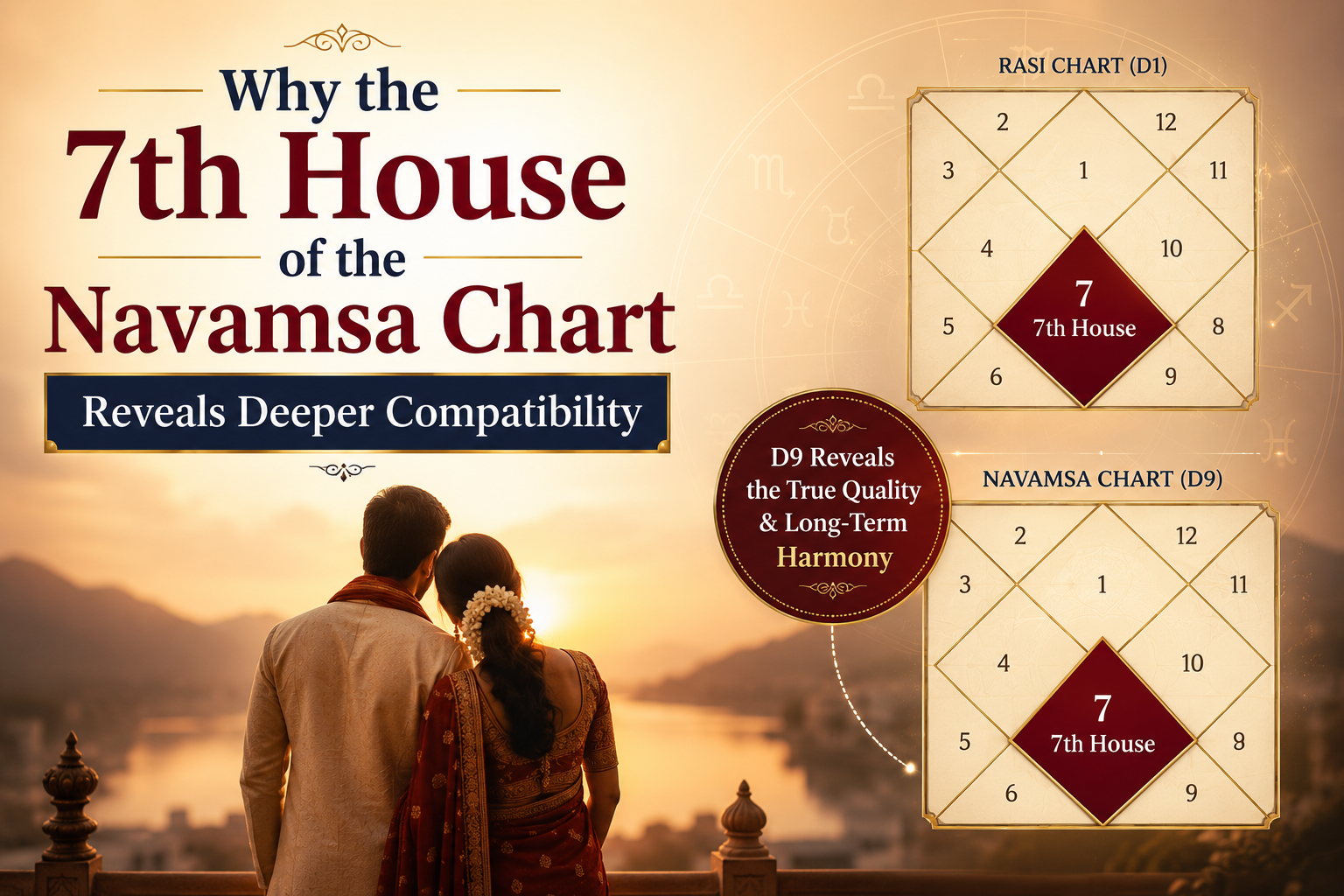
The Navamsa, or D9 chart, is traditionally considered especially important for marriage analysis. While the main birth chart (D1) shows baseline potential, the Navamsa is traditionally believed to reveal a deeper, longer-term picture of a relationship's evolution, particularly relevant for life after the early thirties.
Why the 7th House Governs Both Romance and Business
It's not considered coincidental in this tradition that marriage and business partnerships share a house. Both traditionally involve binding reciprocity: shared commitment, shared liability, and a need for balanced power dynamics. The principle of Bhavat Bhavam reinforces this connection: the 7th House is counted as the 10th house from the 10th house (career), traditionally positioning it as the environment that sustains professional standing over time.
What Does the 7th House Mean Spiritually?
Spiritually, the 7th House is traditionally understood as representing a union of opposites, the movement from individual identity toward a fuller sense of self achieved through relationship with others. It's traditionally associated with lessons in compromise and genuine give-and-take, learned specifically through the people closest to you.
What Are the Benefits of Understanding Your 7th House?
Traditionally, working with an awareness of your 7th House is believed to support:
Greater clarity in choosing partnerships that align with your values, romantic or professional.
Better awareness of your own projections onto partners, supporting more grounded relationships.
A traditional framework for understanding recurring patterns in business or romantic partnerships.
These are understood as traditional, symbolic frameworks for self-awareness, not guarantees of specific relationship or business outcomes.
Who Might This Be Relevant For?
Traditional 7th House analysis and any associated remedial guidance is generally considered relevant for those navigating recurring difficulty in partnerships, delays in marriage, or challenges in business collaboration. Any specific remedy, whether a gemstone, mantra, or ritual practice, should be tailored to your actual chart rather than applied generically.
A Note on Remedial Measures
Astrological remedies, including gemstones or specific practices associated with the 7th House, are traditionally recommended only after proper consultation. If your 7th House is already strong and well-placed, adding an unnecessary remedy could create imbalance rather than benefit. A qualified Vedic astrologer's guidance matters more here than general information.
If you do use a recommended gemstone or talisman, care is traditionally simple: clean it periodically with fresh water or sunlight exposure, and wear it with clear, conscious intent rather than as a passive accessory. Beyond any object, the "care" of your actual 7th House relationships is best supported through consistent self-reflection and honest communication with the people involved.
Why Is Uma's Aura's Approach Different?
At Uma's Aura, we combine classical Vedic methodology with clear, practical explanation, focused on helping you understand the actual reasoning behind a reading rather than offering vague, generic pronouncements. Our aim is to support informed self-understanding, not to create dependency on repeated readings or foster anxiety about your chart.
Credibility and Authenticity: Why Trust This?
This guide draws on classical Jyotish texts, including foundational works attributed to Sage Parashara, and centuries of established interpretive tradition. We aim to explain the reasoning behind each interpretation rather than presenting conclusions without context, and we're upfront that astrology is a traditional interpretive practice, not an empirically validated science.
Myth vs. Reality
Myth: A malefic planet in the 7th House guarantees a failed marriage. Reality: Traditional interpretation holds that this generally indicates a relationship may require more conscious effort or a less conventional approach, not that failure is predetermined.
Myth: Manglik Dosha means someone can never have a happy marriage. Reality: Traditional practice treats this as a placement requiring thoughtful analysis and, sometimes, specific remedial timing or compatibility matching, not a fixed sentence against relationship happiness.
Myth: The 7th House only concerns romantic partners. Reality: Traditionally, it covers all significant one-on-one formal relationships, including business partners, legal counsel, and open competitors.
Expert Tips
Traditional practice suggests reviewing the D9 chart before major relationship decisions, alongside the main birth chart. If the 7th House lord appears weak in the D1 chart, traditional remedies often focus on strengthening Venus, its significator. It's also worth remembering that your 7th House partner is traditionally considered a reflection of your own internal state, so personal growth is often discussed alongside partner compatibility, not as a separate concern.
Frequently Asked Questions
Can the 7th House predict the exact timing of marriage?
Traditional astrologers look at Dasha periods and transits in relation to the 7th House to identify generally favourable windows, but this is interpretive guidance, not a precise, guaranteed prediction.
Does Manglik Dosha mean I'll never have a happy marriage?
No. Traditional practice treats it as a placement requiring careful analysis, sometimes involving specific remedies or compatibility matching, rather than something that rules out relationship happiness.
Why is my business partner causing difficulty?
Traditional interpretation sometimes links friction with associates to specific transits affecting the 7th House. Looking at your chart alongside the partnership's timeline can offer a traditional framework for understanding the pattern, though real-world business and legal guidance matters just as much here.
Is the 7th House only about romantic partners?
No. It traditionally covers all formal one-on-one relationships, including business partners, legal counsel, and open competitors.
How do I work with a challenging 7th House?
Traditional approaches include self-awareness, honest communication, and sometimes specific remedial practices like mantras, always alongside real behavioural change rather than as a substitute for it.
Recommended articles

Why Some "Perfect" Relationship Placements Come With a Hidden Catch
Venus in the 7th house can bring love, attraction, and harmony, but classical Vedic astrology reveals subtle complications. Discover Karako Bhava Nashaya, Mars, and Mangal Dosha.

Struggling With Delayed Marriage? What Mangal Dosha Really Means
Struggling with delayed marriage because of Mangal Dosha? Learn what being Manglik really means, cancellation factors, traditional remedies, and when to seek a full Kundali reading.
Why the 7th House of the Navamsa Chart Reveals Deeper Compatibility
Discover how the Navamsa 7th house, Venus placement, Vargottama, and D9 chart comparison reveal deeper marriage compatibility beyond Guna Milan.
Comments
Be the first to comment.