The Number Behind Your Chart That Changes a Little Every Single Year
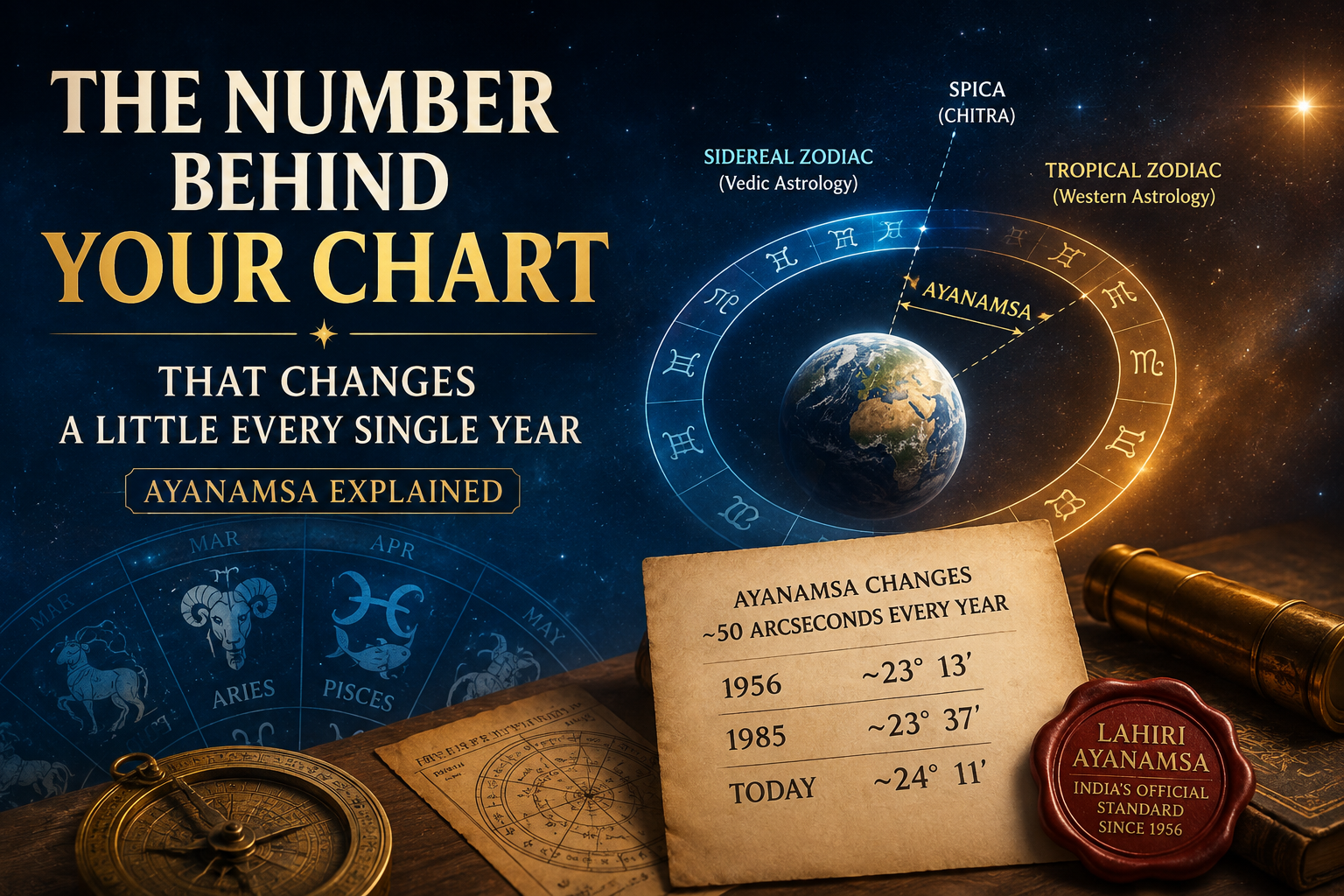
Table of contents
Most explanations of Ayanamsa stop at "it's the gap between two zodiac systems." The more useful story is why one specific version of that number became the standard, and why treating it as a single fixed figure is itself a source of real calculation error.
Why Does Vedic Astrology Use a Different Zodiac Than Western Astrology?
Western astrology uses the tropical zodiac, anchored to the seasons, the moment the Sun crosses the equator each spring always marks the start of Aries, regardless of which actual constellation the Sun appears in front of. Vedic astrology uses the sidereal zodiac instead, anchored to the real, observable positions of the fixed stars themselves.
Because the Earth's axis slowly wobbles over long timescales, a phenomenon called precession, these two systems have gradually drifted apart from each other over the centuries. The gap between them at any given moment is called the Ayanamsa.
Why Did Lahiri Specifically Become the Standard Version?
This has a genuinely traceable, non-arbitrary history. In 1952, the Government of India formed the Calendar Reform Committee, chaired by the physicist Meghnad Saha, specifically to unify India's many regional calendar systems into one standardised national calendar. N.C. Lahiri, an astronomer working on positional astronomy, contributed the specific calculation this committee ultimately adopted.
The committee's report was submitted in 1955, and the recommendation was formally accepted for the national Panchang from 1956 onwards. This specific version anchors its zero point to the star Spica, called Chitra in Sanskrit, placed at exactly 0 degrees Libra, which is why it's also called the Chitrapaksha Ayanamsa. Since then, it's become the default used across the overwhelming majority of Vedic astrology software and calculation tools.
Why Isn't Ayanamsa Just One Fixed Number?
This is the detail most casual explanations skip entirely, and it's genuinely important for accuracy. Because precession is a continuous, ongoing process, the Ayanamsa itself grows steadily over time, by roughly 50 arcseconds every year, which works out to about one full degree approximately every 72 years.
This means the actual value has shifted meaningfully across recent history. Around 1956, when the standard was first adopted, the figure sat close to 23 degrees and 13 minutes. By the mid-1980s, it had grown to roughly 23 degrees and 37 minutes. As of the current period, it sits at approximately 24 degrees and 11 minutes. That's nearly a full degree of drift across seven decades.
Why Does This Small, Gradual Drift Actually Matter for Chart Accuracy?
Here's the practical consequence worth understanding clearly. A calculation tool needs to compute the correct Ayanamsa value for the specific year someone was actually born, not apply today's current figure uniformly to every chart regardless of birth date. Using the wrong year's value for an older chart could introduce an error approaching a full degree in some cases, more than enough to shift a Nakshatra Pada, and in some cases enough to shift which sign a planet appears to occupy near a boundary.
This is exactly why the underlying calculation engine matters so much, not just which Ayanamsa a tool claims to use, but whether it correctly computes that Ayanamsa's specific value for the exact date in question, rather than treating it as a static, one-size-fits-all number.
When to Get a Professional Reading Instead of Trusting a Generic Tool
Given how much this specific technical detail can affect accuracy, particularly for older charts, a proper calculation is worth confirming if:
Your birth year is several decades in the past and you want to confirm the tool used the correct Ayanamsa value for that specific year
You've seen different results across different platforms and want to understand whether an Ayanamsa calculation difference explains it
You want confirmation that your Nakshatra Pada, which shifts with even modest degree differences, has been calculated correctly
Myth vs. Reality
Myth: Ayanamsa is a single fixed number used the same way for every chart.
Reality: It grows continuously due to precession, roughly one degree every 72 years, so the correct value depends on the specific birth year being calculated.
Myth: Lahiri became the standard purely by popularity or tradition.
Reality: It has a specific, traceable history, adopted through a formal government committee decision in the 1950s specifically to standardise India's national calendar.
Myth: A small Ayanamsa difference between tools is never significant.
Reality: For older charts especially, using an outdated or incorrectly computed value can shift a Nakshatra Pada or, near a sign boundary, even the sign itself.
Why Check This on DoPuja
Because Ayanamsa needs to be calculated correctly for your exact birth year, not applied as a single static figure, accurate calculation matters here.
UmasDoPuja's Kundali tool uses the Swiss Ephemeris engine with NASA/JPL DE431 planetary data and correctly applied Lahiri Ayanamsa, computed precisely for your specific birth date rather than a generic modern figure. For a full, personal reading that accounts for this level of precision, Talk to Astrologer connects you with a real astrologer for that context.
Why Trust This
The Calendar Reform Committee's history, its 1955 report and 1956 adoption, the Chitrapaksha anchor point, and the approximately 50 arcsecond annual precession rate are consistently documented across multiple independent astronomical and Vedic astrology sources, including historical reference tables showing the value's actual progression across recent decades.
Frequently Asked Questions
Why does Vedic astrology use a different zodiac than Western astrology?
Vedic astrology uses the sidereal zodiac, anchored to the actual fixed stars, while Western astrology uses the tropical zodiac, anchored to the seasons. These two systems have drifted apart over centuries due to precession.
How did Lahiri Ayanamsa become the official standard?
Through a formal Government of India committee, the Calendar Reform Committee, which submitted its recommendation in 1955 and saw it adopted for the national Panchang from 1956 onwards.
Does the Ayanamsa value stay the same every year?
No. It grows by roughly 50 arcseconds annually due to ongoing precession, working out to about one full degree approximately every 72 years.
How much has the value actually changed since it was first adopted?
It's grown from roughly 23 degrees 13 minutes around 1956 to approximately 24 degrees 11 minutes today, nearly a full degree of difference.
Can using the wrong year's Ayanamsa value actually change my chart?
Yes, particularly for older charts. It can shift a Nakshatra Pada, and near a sign boundary, potentially even the sign a planet appears to occupy.
Recommended articles

Why Your Horoscope Might Be Meant for a Million Other People Too
Discover why daily horoscopes are shared by millions, while a personalised Kundali reading uses your exact birth details, houses, Nakshatra, Dasha and unique chart combinations.
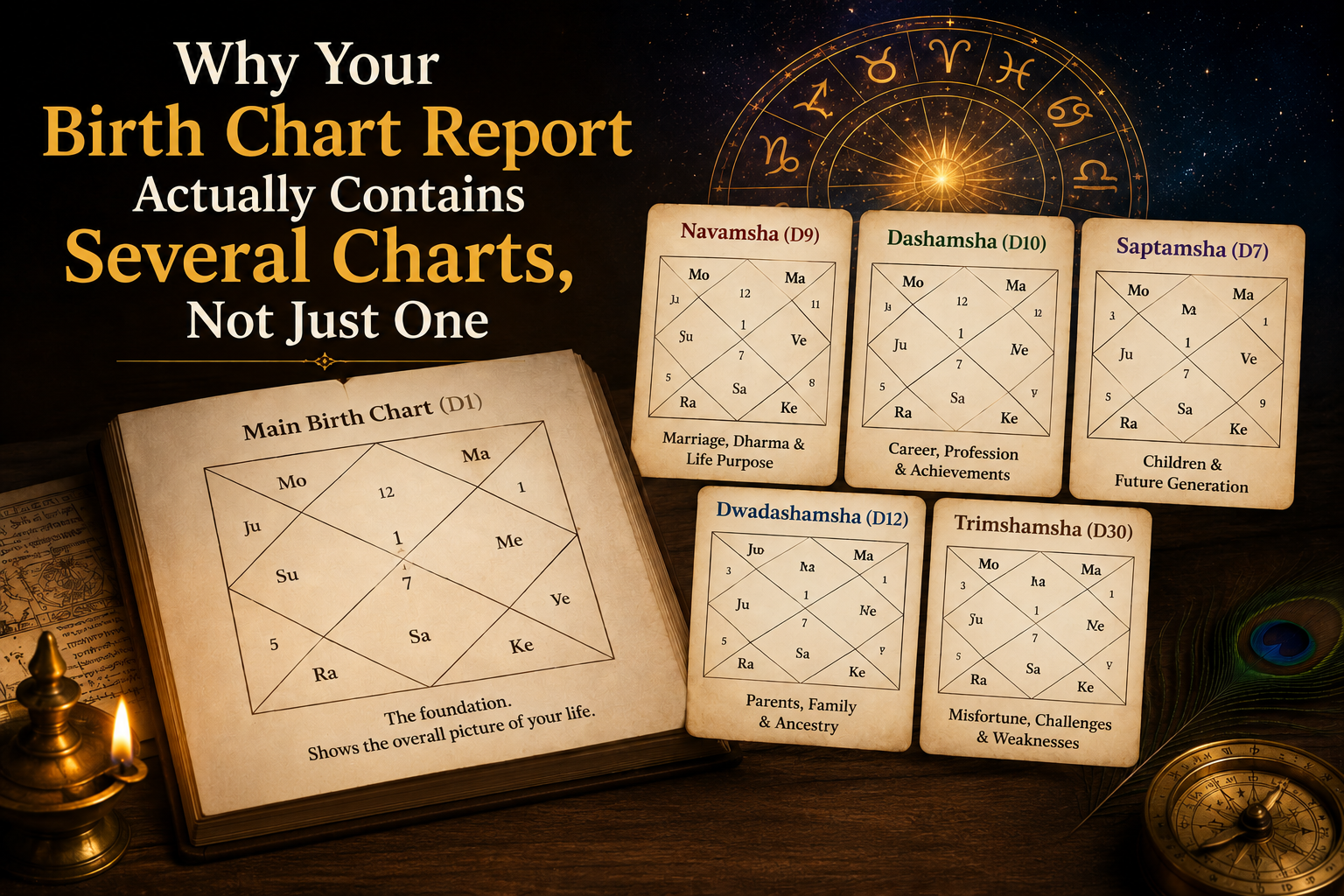
Why Your Birth Chart Report Actually Contains Several Charts, Not Just One
Discover why a detailed Kundali report includes divisional charts like Navamsha, Dashamsha, and Saptamsha, how they refine your birth chart, and why Dasha timing matters.

Why Your Home Life and Inner Peace Come Down to One Planet
Discover how the Moon shapes your 4th house, home life, emotional peace, mother, and property matters, and how Mars can influence real estate and family harmony.
Comments
Be the first to comment.