
Tithi Explained: Meaning, Types & Importance in Hindu Panchang
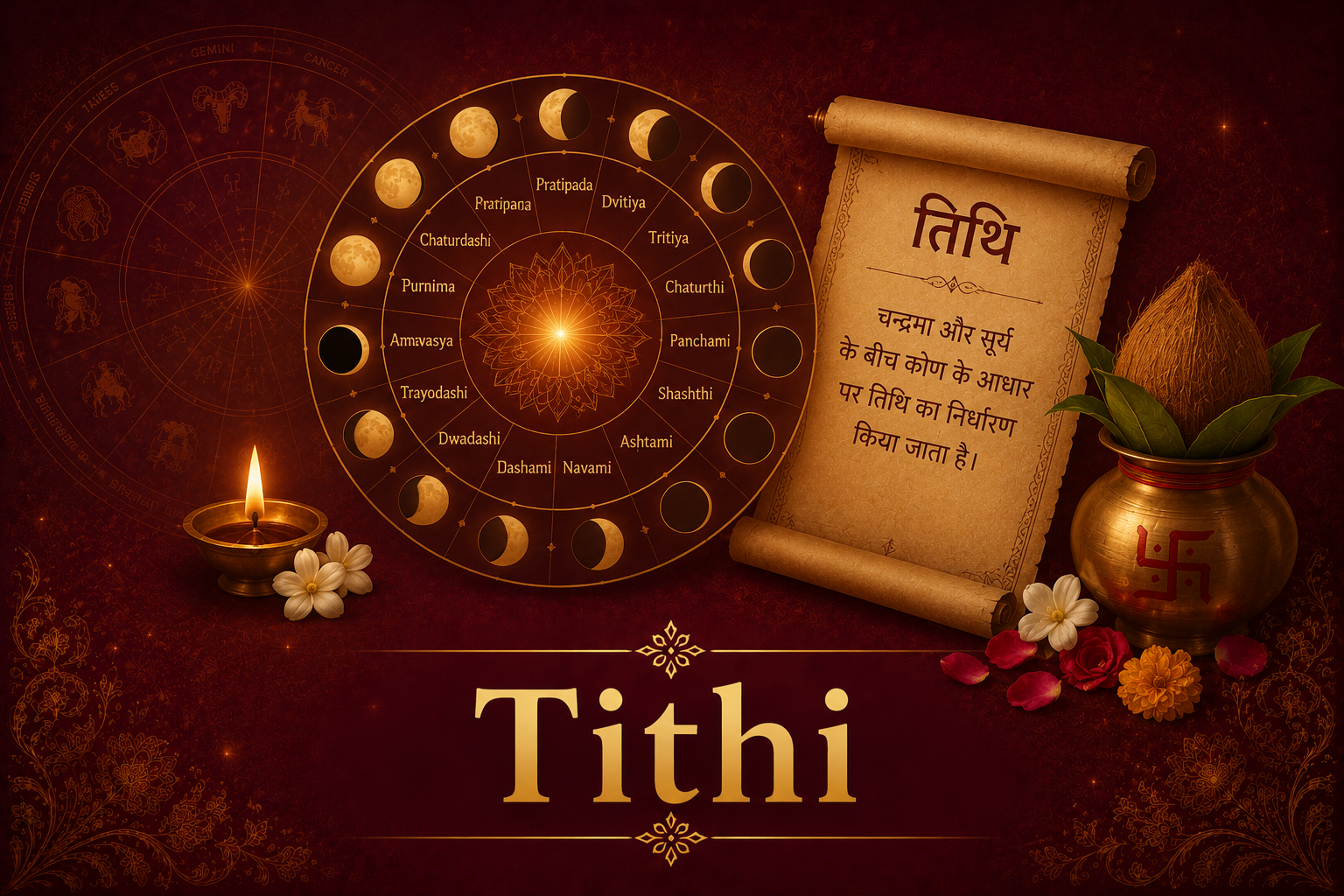
Table of contents
TL;DR: A Tithi is the time for the Moon-Sun angular distance to increase by 12 degrees, giving 30 Tithis per lunar month across two fortnights. These fall into five recurring categories—Nanda, Bhadra, Jaya, Rikta, and Purna—each suited to different activities. Rikta Tithis are not simply unlucky; they're unsuited to new beginnings but genuinely good for closure-related tasks. A Tithi's exact timing shifts by location, so a generic printed table only gives an approximate picture.
Of the five elements that make up a Panchang, Tithi is arguably the most consulted. Almost every Hindu festival, fast, and ritual is fixed by Tithi rather than by the solar date on a standard calendar.
Understanding what a Tithi actually is, and why some carry more weight than others explains a great deal about why the Hindu calendar behaves so differently from the Gregorian one most of us use day to day.
What Is a Tithi?
A Tithi is defined precisely. It is the time it takes for the angular distance between the Moon and the Sun to increase by 12 degrees. Since a full circle is 360 degrees, this works out to exactly 30 Tithis in one complete lunar month, roughly 29.5 days.
Because 12 degrees of lunar-solar separation doesn't always take the same number of hours—the Moon's speed varies slightly during its orbit—a Tithi's duration on the clock varies too. Sometimes it runs under 24 hours, sometimes a little over.
This is why Panchang tables always list a precise start and end time for each Tithi, rather than treating it as a fixed calendar day.
What Are Shukla Paksha and Krishna Paksha?
The 30 Tithis in a lunar month are split evenly into two fortnights, called Pakshas.
Shukla Paksha
Shukla Paksha, the bright fortnight, begins the day after Amavasya and runs through to Purnima, as the Moon's visible light grows progressively from a sliver to full brightness.
This fortnight is generally associated with growth, expansion, and new beginnings.
Krishna Paksha
Krishna Paksha, the dark fortnight, begins the day after Purnima and runs back to Amavasya, as the Moon's light gradually diminishes.
It's generally associated with introspection, completion, and release.
Each Paksha contains 15 Tithis, numbered Pratipada through Chaturdashi, followed by either Purnima or Amavasya as the fifteenth Tithi, depending on which fortnight you're in.
What Is the Five-Way Tithi Classification?
Beyond the 30 individual Tithis, a second layer of classification groups them into five recurring categories, each tied to a governing element. This pattern repeats identically across both fortnights.
| Category | Tithis | Element | Best Suited For |
|---|---|---|---|
| Nanda | 1st, 6th, 11th | Fire | Weddings, journeys, joyful beginnings |
| Bhadra | 2nd, 7th, 12th | Earth | Foundations, contracts, significant purchases |
| Jaya | 3rd, 8th, 13th | Space | Legal disputes, exams, competitive undertakings |
| Rikta | 4th, 9th, 14th | Water | Closure, clearing debts, specific deity worship |
| Purna | 5th, 10th, 15th | Air | Finalising commitments, spiritual rituals |
Nanda Tithis
Nanda Tithis are associated with joyful beginnings and celebration, traditionally favourable for weddings, journeys, house construction, and any occasion meant to launch something with energy and enthusiasm.
Bhadra Tithis
Bhadra Tithis are associated with stability and practical groundwork, traditionally favoured for laying foundations, signing contracts, and significant purchases, since Earth's steady quality is believed to support lasting value.
Jaya Tithis
Jaya Tithis are associated with victory and triumph, traditionally excellent for legal disputes, examinations, and any situation where overcoming an obstacle is the goal.
They're specifically less suited to activities requiring peaceful compromise, since the underlying energy favours contest over conciliation.
Rikta Tithis
Rikta literally means "empty" or "diminished." This is the category most often mischaracterised as simply bad luck, worth correcting directly.
Rikta Tithis aren't malefic in a blanket sense. They're specifically unsuited to general auspicious ceremonies and new ventures, but genuinely favourable for closure-oriented tasks, clearing debts, and specific deity worship aligned with these particular Tithis.
"Not right for starting something new" is a very different claim from "unlucky."
Purna Tithis
Purna Tithis are associated with completion and fulfilment, traditionally favoured for finalising commitments and spiritual rituals.
Worth noting, the 15th Tithi is always classified as Purna, whether that's the full illumination of Purnima or the complete darkness of Amavasya, since completion describes the lunar cycle reaching its extreme in either direction, not brightness specifically.
Why Do Certain Tithis Suit Certain Rituals?
Once the five-way classification is understood, the underlying logic behind Muhurta selection becomes much clearer.
A wedding date calculator isn't randomly excluding certain Tithis. It's specifically avoiding Rikta days, since a wedding is meant to be a beginning, not a closure, and often favouring Nanda days instead.
A court filing benefits from Jaya's competitive, victory-oriented energy far more than Bhadra's steady, negotiation-focused quality would suit it.
This element-based logic is why Tithi checking isn't a single yes-or-no filter, but a genuine matching exercise between the nature of the activity and the nature of the day.
When to Get a Professional Reading Instead of Checking a Generic Table
Tithi is only one of the five Panchang elements, and a full Muhurat also checks Nakshatra, Yoga, Karana, and the weekday together.
A personalised consultation is worth it if you're planning a specific significant event, marriage, housewarming, or business launch, since each carries additional, event-specific rules covered in its own dedicated articles on this site.
Myth vs. Reality
Myth: Rikta Tithis are simply unlucky and should be avoided entirely.
Reality: They're specifically unsuited to new beginnings and general celebrations, but genuinely favourable for closure-related tasks and deity worship connected to those Tithis.
Myth: A Tithi always lasts exactly 24 hours, like a calendar day.
Reality: Because the Moon's orbital speed varies, a Tithi's actual duration fluctuates, sometimes shorter and sometimes longer than 24 hours.
Myth: Purnima and Amavasya belong to different classification categories.
Reality: Both are always classified as Purna, the 15th Tithi of their respective fortnight, since the classification tracks the cycle's completion point, not the Moon's visible brightness.
Why Check This on DoPuja
A Tithi's exact start and end time genuinely shift by location and date. A generic printed table only gives an approximate picture.
UmasDoPuja's Panchang tool uses the Swiss Ephemeris engine with NASA/JPL DE431 planetary data and correctly applies Lahiri Ayanamsa to calculate the precise Tithi active at any given moment for your specific location.
For a fuller Muhurat check that combines Tithi, Nakshatra, Yoga, and Karana for a specific event, Talk to Astrologer connects you with a real astrologer for that context.
Why Trust This
The Tithi definition, the Shukla and Krishna Paksha structure, and the five-way Nanda-Bhadra-Jaya-Rikta-Purna classification described here are consistently documented across classical Panchang literature and current astrological references.
The Rikta Tithi correction is included deliberately, since it's one of the more commonly oversimplified points in casual explanations of this system.
Frequently Asked Questions
How many Tithis are there in total?
Thirty per lunar month, 15 in Shukla Paksha and 15 in Krishna Paksha.
Is a Tithi the same length every time?
No. Since it's defined by a fixed 12-degree angular change rather than a fixed time period, a Tithi's actual duration fluctuates.
Which Tithi is best for starting something new?
Nanda Tithis are generally most favoured for joyful new beginnings, while Rikta Tithis are specifically the ones to avoid for this purpose.
Are Rikta Tithis always bad?
No. This is a common oversimplification. They're unsuited to new ventures and general celebrations, but genuinely useful for closure-oriented tasks and particular deity worship.
Why do Purnima and Amavasya both fall under Purna?
Because the five-way classification tracks the lunar cycle reaching its extreme point. Whether that's full brightness (Purnima) or complete darkness (Amavasya), both represent the 15th and final Tithi of their respective fortnight.
Recommended articles
Nadi Dosha in Matching: Why Same Nadi Raises Health Concerns
Learn why same Nadi is considered significant in Kundali matching, its Ayurvedic basis, progeny health concerns, Ayurgenomics, and modern scientific perspective.
Manglik Matching: What Happens When Only One Partner Is Manglik
Learn what happens when one partner is Manglik and the other isn't. Understand Manglik Dosha severity, cancellation rules, remedies, and marriage compatibility.

Ashtakoot Guna Milan The 36-Point System Behind Kundali Matching
Learn how Ashtakoot Guna Milan's 36-point Kundali matching system works, the eight kootas, Nadi and Bhakoot importance, Manglik Dosha, and score interpretation.
Comments
Be the first to comment.