Vastu, Planets and Griha Pravesh: What Decides a Good Housewarming Date

Table of contents
Most people know Griha Pravesh needs an auspicious date. Fewer understand why that date matters alongside, not instead of, the home's physical Vastu preparation, or why the homeowner's own chart adds a further layer beyond the general calendar.
How Do Vastu and Muhurta Actually Work Together?
These two systems address different things entirely, and understanding the distinction clarifies why both matter. Vastu Shastra is about the physical arrangement of the home itself, layout, orientation, and the placement of specific elements within the structure. Muhurta is about timing, choosing the specific moment considered most supportive for a significant action.
The connection between them is direct: the Griha Pravesh ceremony, performed at the chosen Muhurta, is specifically meant to awaken the Vastu Purusha, the presiding deity traditionally believed to preside over the physical structure. In other words, Vastu prepares the space, and Muhurta chooses the right moment to activate what that preparation has set up. Neither substitutes for the other, a perfectly Vastu-compliant home entered at a poor Muhurta, or a well-timed entry into a home with unaddressed structural concerns, are both considered incomplete versions of the same intention.
Why Does the Homeowner's Own Chart Matter Beyond the General Calendar?
A date that's generally auspicious for everyone isn't automatically the best date for a specific family, and this is where personal chart details come in.
The 4th house, governing property and domestic comfort, and its ruling planet should ideally be well-placed and free of affliction on the chosen date, since this house connects most directly to the home itself in the homeowner's own chart.
Jupiter's current transit ideally falls in a Kendra or Trikona position relative to the homeowner's natal Moon, considered supportive for a favourable, harmonious entry.
The transiting Moon's position matters too, specifically. If the Moon is currently transiting the 4th, 6th, 8th, or 12th house from the homeowner's own natal Moon at the time of entry, this specific window is generally advised against, since these placements are associated with emotional disturbance or instability during a period meant to establish settled, comfortable living.
Why Are Fixed Nakshatras Specifically Preferred?
Rohini, Uttara Phalguni, Uttara Ashadha, and Uttara Bhadrapada belong to the Sthira, or fixed, category within the broader classical sevenfold Nakshatra classification covered in more detail in our dedicated Nakshatra article. Sthira Nakshatras carry a grounded, stable quality, traditionally considered well suited to foundations and any commitment meant to last, which is exactly the intention behind moving into a new home.
This is worth being precise about, since not every source agrees on the exact list. We're specifically following the classical grouping of four Sthira Nakshatras rather than including additional stars sometimes loosely grouped alongside them in less careful sources, since maintaining a consistent, accurate classification matters more than a longer but less precise list.
Why Are Tithi and Yoga Checked Alongside Nakshatra, Not Instead of It?
This is worth explaining directly, since a Nakshatra check alone doesn't capture the full picture. Genuine muhurat selection, sometimes called Panchang Shuddhi, purification of the five Panchang limbs, checks Tithi, Nakshatra, Yoga, Karana, and weekday together, not any single element in isolation.
Favourable Tithis commonly cited for Griha Pravesh include the 2nd, 3rd, 5th, 7th, 10th, 11th, and 13th of Shukla Paksha, the waxing lunar fortnight. The day's Yoga should also be classified as auspicious, and Vishti Karana, also called Bhadra, is specifically avoided regardless of how favourable the Tithi and Nakshatra otherwise look. Each Panchang element captures a genuinely different dimension of the day's quality, which is why checking only one, however carefully, still leaves real gaps that a complete Panchang Shuddhi check closes.
When to Get a Professional Reading Instead of a Generic Date List
Given how many layers genuinely factor into this, general calendar accuracy, Vastu alignment, and the homeowner's specific chart, a full reading is worth it if:
You want your 4th house and Jupiter's current transit checked specifically against your own natal Moon, not just a generic favourable date
You want confirmation that the transiting Moon isn't currently in a difficult position relative to your own natal Moon on your preferred date
You're choosing between several generically favourable dates and want to know which one specifically suits your own chart best
Myth vs. Reality
Myth: Vastu and Muhurta are two separate, unrelated considerations for a housewarming.
Reality: They work together directly, Muhurta is specifically the timing meant to activate what Vastu preparation has already established in the physical space.
Myth: Any date with a generically favourable Nakshatra is automatically the right choice.
Reality: The homeowner's own chart adds a further layer, particularly the 4th house's condition and where the transiting Moon sits relative to their natal Moon, which a general Nakshatra check alone doesn't capture.
Myth: Checking the Nakshatra is sufficient on its own.
Reality: Genuine muhurat selection checks Tithi, Nakshatra, Yoga, Karana, and weekday together, since each element captures a different dimension of the day's quality.
Why Check This on DoPuja
Because genuine Griha Pravesh timing depends on the full Panchang together with the homeowner's specific chart, not a single generic factor, accurate calculation matters considerably here.
UmasDoPuja's Panchang tool uses the Swiss Ephemeris engine with NASA/JPL DE431 planetary data and correctly applied Lahiri Ayanamsa, checking Tithi, Nakshatra, Yoga, and Karana together for your specific location, alongside your own natal Moon and 4th house condition. For a personalised reading that accounts for your specific chart, Talk to Astrologer connects you with a real astrologer for that context.
Why Trust This
The Vastu-Muhurta relationship, the homeowner-chart checks including the 4th house, Jupiter's transit, and the transiting Moon's position, and the Sthira Nakshatra classification are consistently documented across multiple classical and current sources. On the exact Sthira Nakshatra list, we've maintained consistency with the classification used in our dedicated Nakshatra article, rather than including additional stars some less careful sources group alongside them.
Frequently Asked Questions
How exactly does Muhurta relate to Vastu Shastra?
Vastu governs the physical preparation of the home. Muhurta chooses the specific moment considered right to activate that space, traditionally described as awakening the Vastu Purusha. They work together, not as separate systems.
What specifically should I check in my own chart beyond the general calendar?
Your 4th house and its ruling planet's condition, Jupiter's current transit relative to your natal Moon, and whether the transiting Moon currently sits in a difficult position relative to your own natal Moon.
Why are Rohini and Uttara Phalguni specifically favoured for this ceremony?
They belong to the Sthira, or fixed, Nakshatra category, traditionally associated with grounded stability, fitting for a ceremony meant to establish lasting, comfortable living.
Is checking a favourable Nakshatra enough on its own?
No. Genuine muhurat selection checks Tithi, Nakshatra, Yoga, Karana, and weekday together, since each captures a different dimension of the day's overall quality.
What Tithis are generally considered favourable for Griha Pravesh?
The 2nd, 3rd, 5th, 7th, 10th, 11th, and 13th of Shukla Paksha are commonly cited, alongside an auspicious Yoga and avoidance of Vishti Karana specifically.
Recommended articles

Why the Same Daily Horoscope Can Feel Completely Different Two Months Apart
Discover why the same daily Rashifal can feel different at different times. Learn how Moon transits, Jupiter, Saturn, Gochar Samyukti and Dasha shape daily predictions.
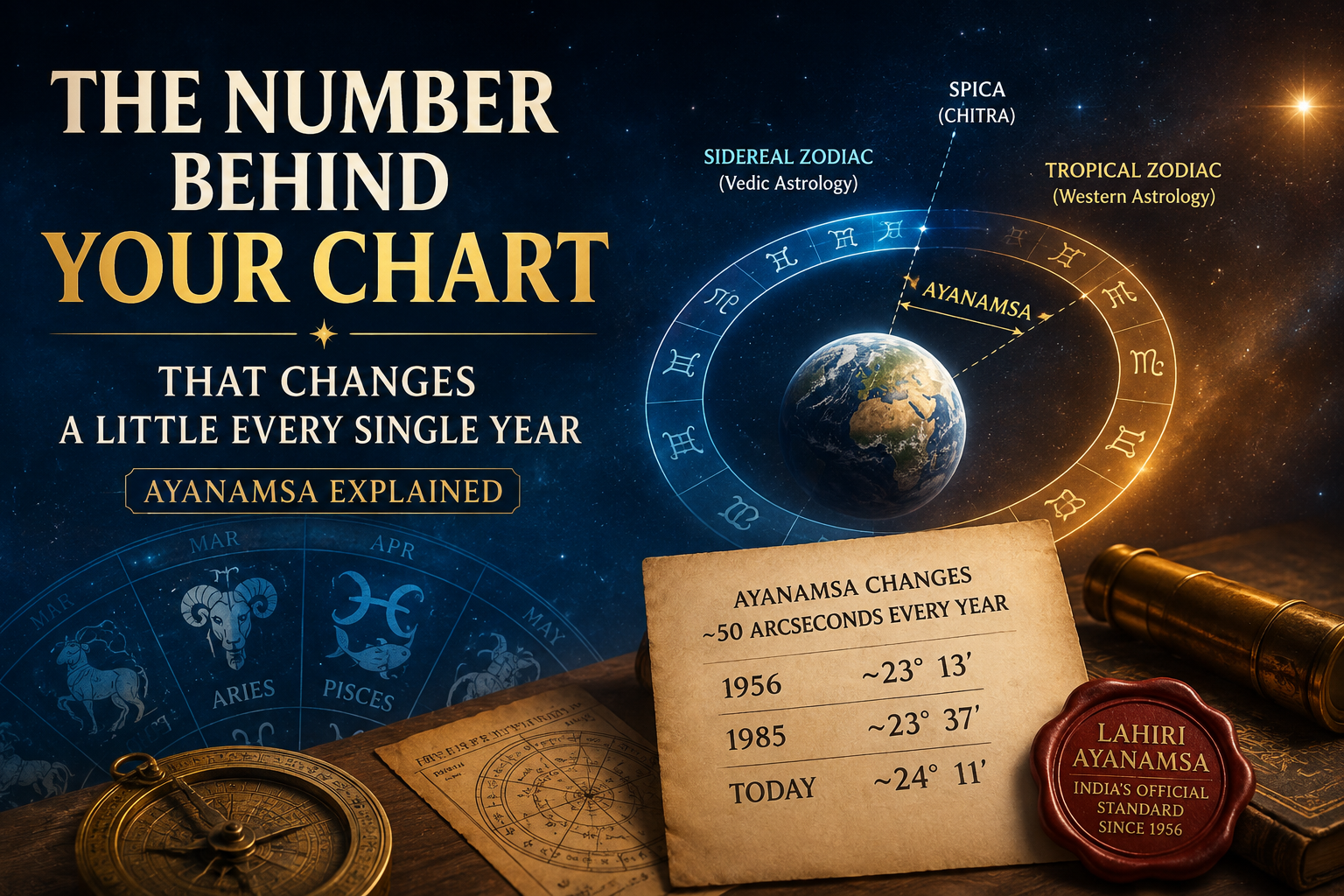
The Number Behind Your Chart That Changes a Little Every Single Year
Discover why Ayanamsa changes every year, how Lahiri Ayanamsa became the Vedic astrology standard, and why its precise value matters for accurate Kundali calculations.

Why Your Horoscope Might Be Meant for a Million Other People Too
Discover why daily horoscopes are shared by millions, while a personalised Kundali reading uses your exact birth details, houses, Nakshatra, Dasha and unique chart combinations.
Comments
Be the first to comment.