Venus and Jupiter: The Planets Behind Every Marriage Muhurat
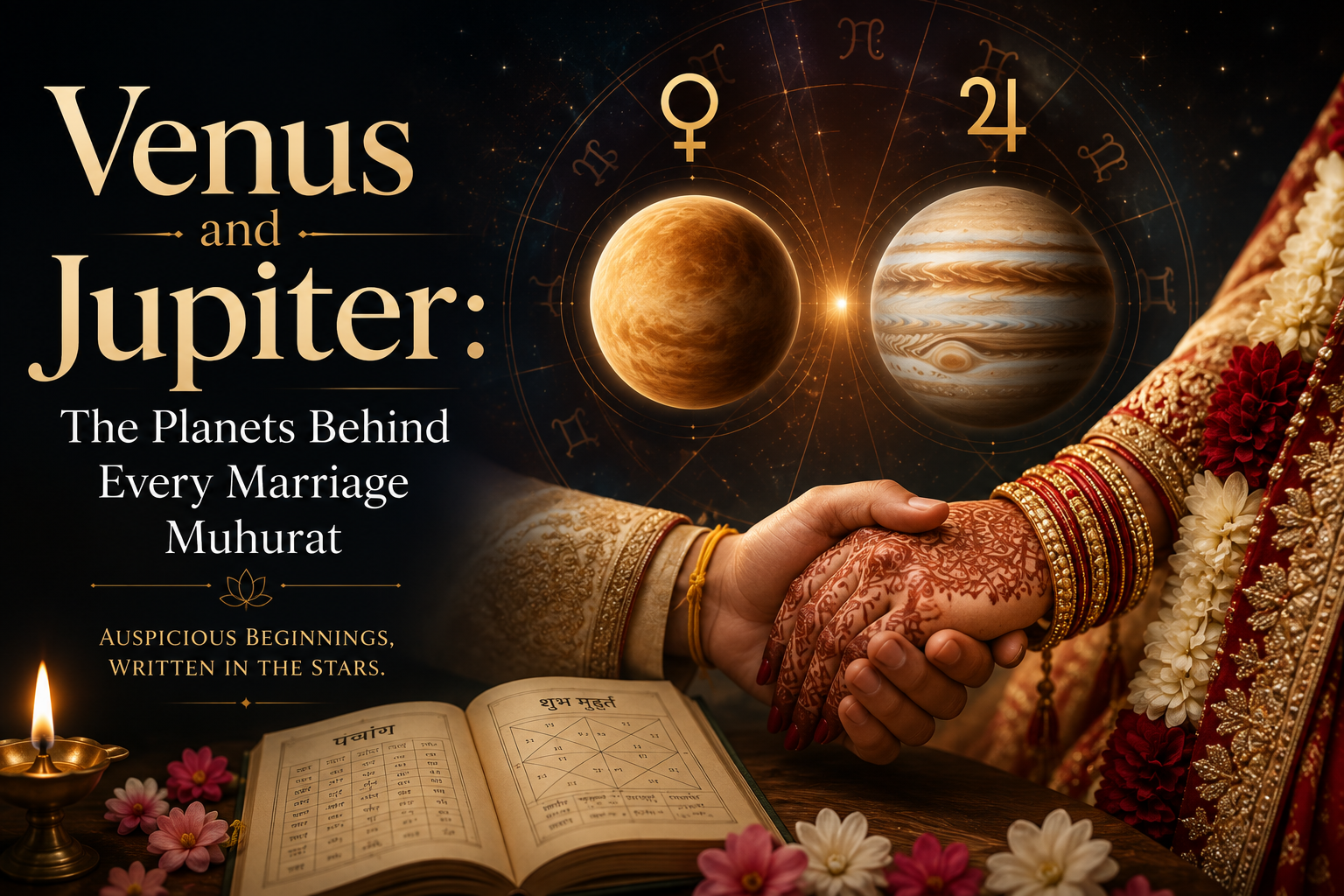
Table of contents
Every marriage muhurat calculation eventually comes back to the same two planets. Understanding why Venus and Jupiter specifically hold this central role explains most of the logic behind why certain months disappear from the wedding calendar entirely.
Why Are Venus and Jupiter Checked Before Anything Else?
Classical muhurat texts treat these two planets as the primary significators of marriage itself, not just supporting factors among many. The specific reasoning ties to gender-linked significations in the traditional framework: Jupiter is considered the significator of the husband as read from the bride's chart, while Venus is considered the significator of the wife as read from the groom's chart. Because of this, both planets are checked for strength and visibility before any other Panchang element is even considered, since a compromised Venus or Jupiter is treated as undermining the marriage's foundation regardless of how favourable the rest of the day looks.
Why Does Combustion Rule Out a Date?
When either planet sits too close to the Sun in degree, roughly within 11 degrees by most calculations, it's considered combust, too overwhelmed by solar brightness to be visibly active or capable of blessing the ceremony. Marriage during this window is avoided, along with a buffer of a few days before and after the exact combustion period in many traditions, since the planet's capacity is considered to fade gradually rather than switch off instantly.
Why Is Retrograde Motion Treated as a Separate Concern?
This is worth understanding as genuinely distinct from combustion, not the same issue under a different name. When Venus or Jupiter appears to move backwards through the zodiac from Earth's perspective, retrograde motion, traditional astrology holds that the planet's usual blessings are considered withheld during this period, independent of whether it's also combust. A date can be entirely clear of combustion and still be excluded because either planet is retrograde at the time. Both conditions are checked separately, and either one alone is generally enough to rule out a date.
Why Does the Bride and Groom's Individual Dasha Matter, Even on a Good Calendar Date?
A date that's clear of combustion, retrograde motion, and every other general Panchang concern still only tells half the story. The specific planetary period, or Dasha, each individual is running at the time of marriage carries real weight of its own. Marrying during a personally difficult Dasha for either partner is generally advised against, even when the public calendar date looks completely favourable, since the couple's own chart timing is considered just as significant as the shared, general auspiciousness of the day itself. This is part of why a personalised consultation typically adds real value beyond simply picking a date off a published list.
Do All Regions Weight Venus and Jupiter Equally?
Not entirely, and this is worth knowing if you've encountered guidance that seems to prioritise one planet more heavily than the other. Different regional and community traditions place somewhat different emphasis on Venus versus Jupiter within the broader framework, reflecting genuine variation in how specific lineages of muhurat practice have developed over generations, rather than a single universally agreed weighting applied identically everywhere. If your family's tradition seems to emphasise one planet's condition more strongly than general online guidance suggests, that's most likely a reflection of this regional variation rather than an error.
When to Get a Professional Reading Instead of Checking a Generic Calendar
Given how much this depends on the specific combination of combustion, retrograde status, individual Dasha timing, and regional tradition, a full reading is worth it if:
You want to confirm the exact combustion and retrograde status of Venus and Jupiter for your specific date and location
You want both partners' individual Dasha periods checked alongside the general calendar date
Your family's tradition emphasises one planet's condition more specifically, and you want that reflected properly in the final date selection
Myth vs. Reality
Myth: Combustion and retrograde motion are the same concern described two different ways.
Reality: They're treated as separate, independent conditions. A date can be clear of one and still excluded because of the other.
Myth: An astronomically clear calendar date is automatically the right choice for any couple.
Reality: The bride and groom's individual Dasha periods carry real weight of their own, a generically clear date can still be personally unfavourable for one partner specifically.
Myth: Every tradition weighs Venus and Jupiter identically.
Reality: Regional and community traditions genuinely vary in how much emphasis each planet receives, reflecting different lineages of muhurat practice rather than a single fixed standard.
Why Check This on DoPuja
Because Venus and Jupiter's exact combustion and retrograde status shift by date and depend on precise planetary calculation, not general approximation, accurate checking matters considerably here.
UmasDoPuja's Muhurta tool uses the Swiss Ephemeris engine with NASA/JPL DE431 planetary data and correctly applied Lahiri Ayanamsa, calculating Venus and Jupiter's exact position, combustion status, and retrograde motion precisely for your specific date. For a personalised check that also weighs both partners' individual Dasha periods, Talk to Astrologer connects you with a real astrologer for that context.
Why Trust This
The gender-linked significator framework, the combustion degree range, and the distinct treatment of retrograde motion described here are consistently documented across multiple classical and current muhurat sources. On regional variation in Venus versus Jupiter emphasis, we've described this as a genuine, acknowledged difference in tradition rather than asserting a specific geographic split we couldn't independently verify.
Frequently Asked Questions
Why are Venus and Jupiter checked before other Panchang factors for marriage?
They're considered the primary significators of marriage itself, Jupiter as husband-significator from the bride's chart, Venus as wife-significator from the groom's, so their condition is checked first.
Is a retrograde Venus or Jupiter the same problem as a combust one?
No, they're treated as separate, independent concerns. Either one alone is generally enough to exclude a date, even if the other condition is clear.
Does a good calendar date guarantee the marriage timing is right for both partners?
Not entirely. Each partner's individual Dasha period at the time of marriage carries real weight, a generically favourable date can still be personally difficult for one partner.
Why do different sources seem to prioritise Venus or Jupiter differently?
Regional and community traditions genuinely place different emphasis on each planet, reflecting different lineages of muhurat practice rather than one universally agreed weighting.
How close to the Sun does a planet need to be to count as combust?
Roughly within 11 degrees by most calculations, though exact figures vary slightly by source and calculation method.
Recommended articles

Struggling With Delayed Marriage? What Mangal Dosha Really Means
Struggling with delayed marriage because of Mangal Dosha? Learn what being Manglik really means, cancellation factors, traditional remedies, and when to seek a full Kundali reading.

Why Some "Perfect" Relationship Placements Come With a Hidden Catch
Venus in the 7th house can bring love, attraction, and harmony, but classical Vedic astrology reveals subtle complications. Discover Karako Bhava Nashaya, Mars, and Mangal Dosha.
Why the 7th House of the Navamsa Chart Reveals Deeper Compatibility
Discover how the Navamsa 7th house, Venus placement, Vargottama, and D9 chart comparison reveal deeper marriage compatibility beyond Guna Milan.
Comments
Be the first to comment.