Janam Kundali: A Simple Beginner’s Guide to Your Birth Chart

Table of contents
A janam kundali is a Vedic birth chart prepared from your date, time and place of birth. It is best used as a structured guide for reflection—not as a fixed promise about your future.
To begin, keep your birth details ready, identify the chart style, and learn the meaning of the lagna, houses, planets and signs one layer at a time. If your birth time is uncertain, treat fine details carefully.
What is a janam kundali?
Janam kundali, also called a birth chart or janma patrika, maps the positions of the Sun, Moon and planets at the time and place of birth in the Vedic astrology tradition. The chart is divided into twelve houses. Each house is read in relation to the rising sign, called the lagna.
A complete reading usually looks at several connected factors: the lagna, the Moon sign, planets in houses, planetary aspects, nakshatras and periods known as dashas. A single planet or one short online description cannot tell the whole story.
Keep these birth details ready
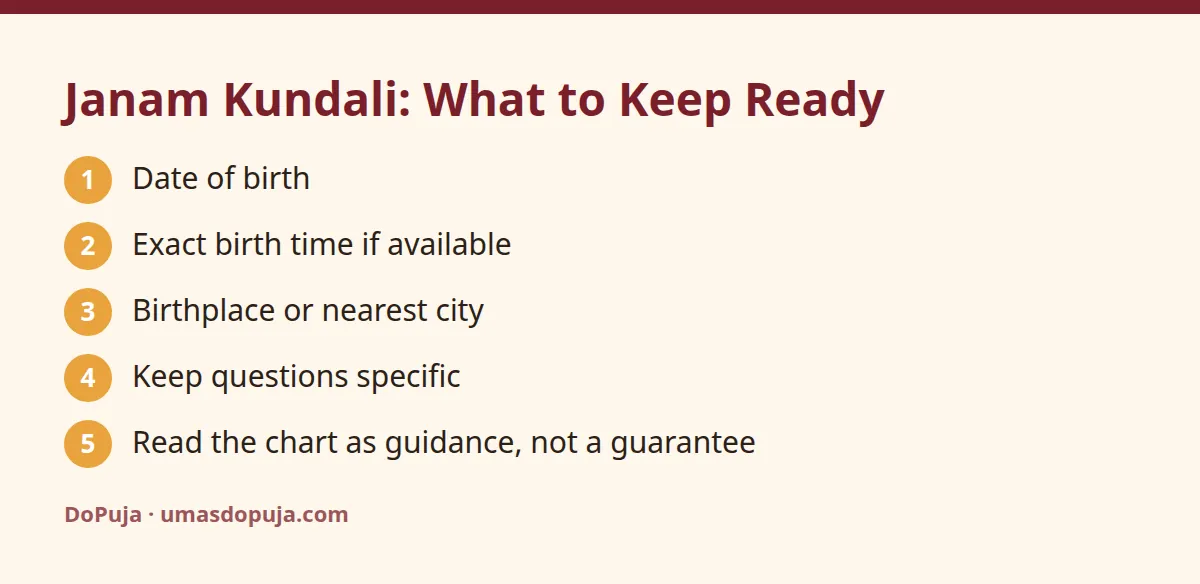
Accurate input makes a chart more useful. Check a birth certificate, hospital record or a close family record before entering the details.
- Date of birth: day, month and year.
- Time of birth: as exact as possible, including AM or PM.
- Place of birth: town/city and country, so the correct location can be used.
- Your question: for example, learning the chart basics, marriage matching or understanding a dasha.
Tip: A small difference in birth time can change the lagna or house positions. When the recorded time is uncertain, avoid treating a detailed prediction as certain.
How to read the basic parts of a birth chart
1. Start with the lagna
The lagna is the sign rising on the eastern horizon at birth. It sets the first house and the order of the remaining houses. In a beginner reading, note the lagna first and then see which sign falls in each house.
2. Learn the twelve houses
The houses describe broad areas of life. The first house relates to self and approach; the second to family and resources; the fourth to home; the seventh to partnerships; the tenth to work and public role. These are starting themes, not isolated verdicts.
Look at the planet in a house, the sign placed there, and the ruler of that house together. This prevents oversimplified conclusions.
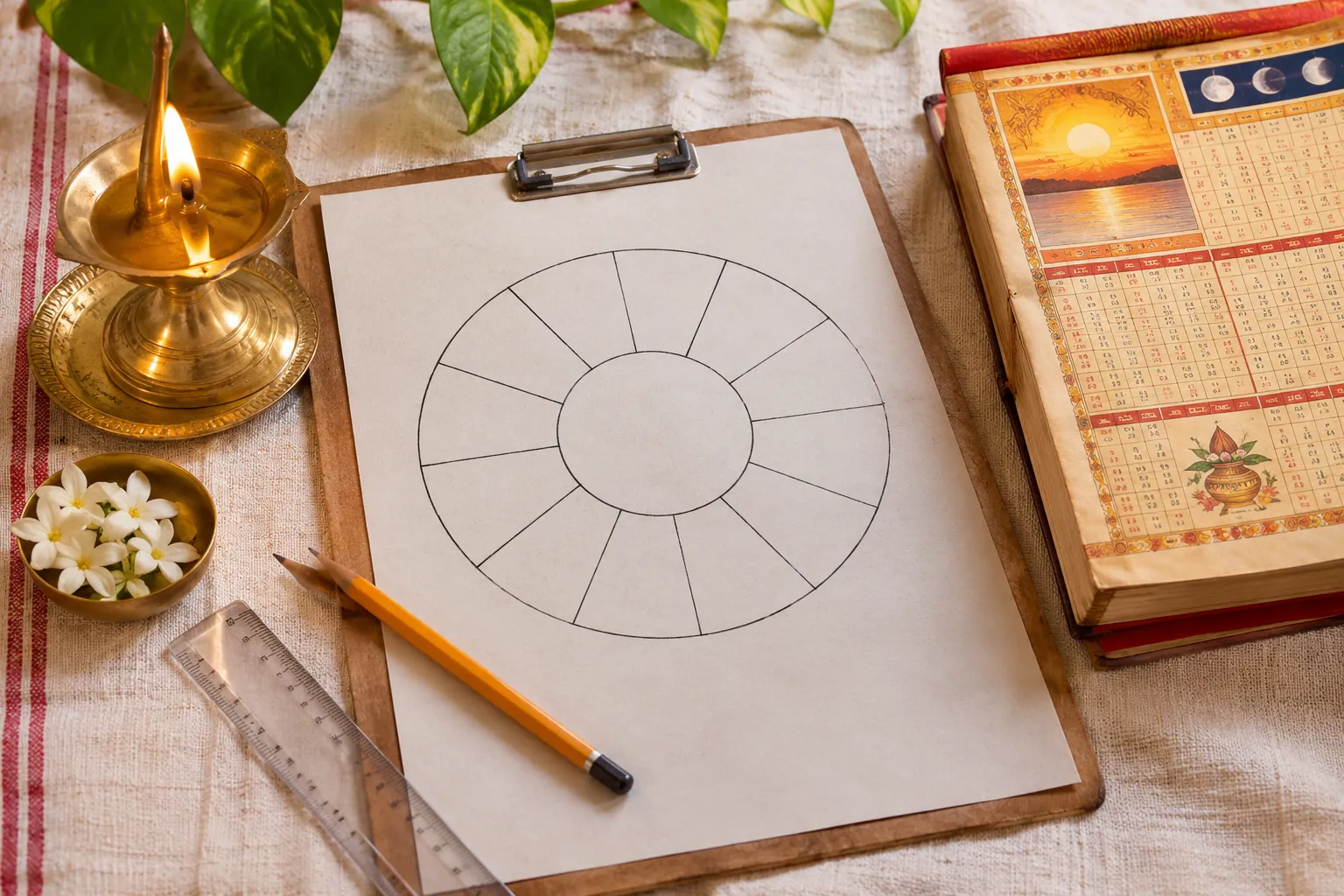
A birth chart is read step by step, beginning with the birth details and chart layout.
3. Notice planets and signs
Each planet is traditionally associated with certain themes. The sign gives the style in which that planet is expressed, while the house shows the life area where it is considered. For example, instead of reading only “Mars in a sign,” check its house, aspects and links with other planets.
4. Add the Moon sign and nakshatra
In Vedic practice, the Moon sign and nakshatra are often important for understanding mental habits, timing systems and matching. They add context to the lagna chart; they do not replace it.
A simple reading order for beginners
- Confirm the birth date, time and place.
- Find the lagna and the sign in the first house.
- Read the twelve houses as broad life areas.
- List which planets occupy each house.
- Check the Moon sign and nakshatra.
- Only then explore dashas, transits or a specific question.
Quick checklist
| Before you read | Why it helps |
|---|---|
| Use the most accurate birth time available | House positions depend on it. |
| Ask one clear question | It keeps the reading focused. |
| Read combinations, not one placement | Context matters in a chart. |
| Keep practical choices in your hands | A chart is guidance, not a substitute for decisions. |
Use a kundali with a balanced approach
A janam kundali can be meaningful for people who follow this tradition, but it should not replace medical, legal, financial or mental-health advice. Avoid anyone who uses fear, guaranteed claims or pressure to sell a remedy. A careful reading explains what is being considered and leaves room for your judgement.
For a guided starting point, use DoPuja’s kundali service. You can also read our Kundali in Telugu guide and the simple guide to doing puja at home.
FAQ
What details are needed for a janam kundali?
You need the date of birth, as accurate a birth time as possible, and the birthplace. These details are used to calculate the chart layout.
Can I read my janam kundali without knowing astrology?
Yes. Begin with the lagna, twelve houses, Moon sign and planets. Learn the basics gradually instead of trying to interpret every combination at once.
Is the birth time important?
Yes. The rising sign and house positions can change with time, so an uncertain birth time should be handled with care.
Does one planet decide my future?
No. Traditional chart reading considers multiple planets, houses, signs, aspects and timing factors together. Your actions and real-life circumstances also matter.
Where can I get a kundali online?
You can start with DoPuja’s online kundali page. For a puja or a traditional ceremony, you can also book a verified pandit through DoPuja.
Recommended articles
 DoPuja services
Kundali in Telugu: How to Read Your Janam Kundali
A simple guide to understanding a Telugu janam kundali, its houses, planets, signs and the questions to ask before seeking guidance.
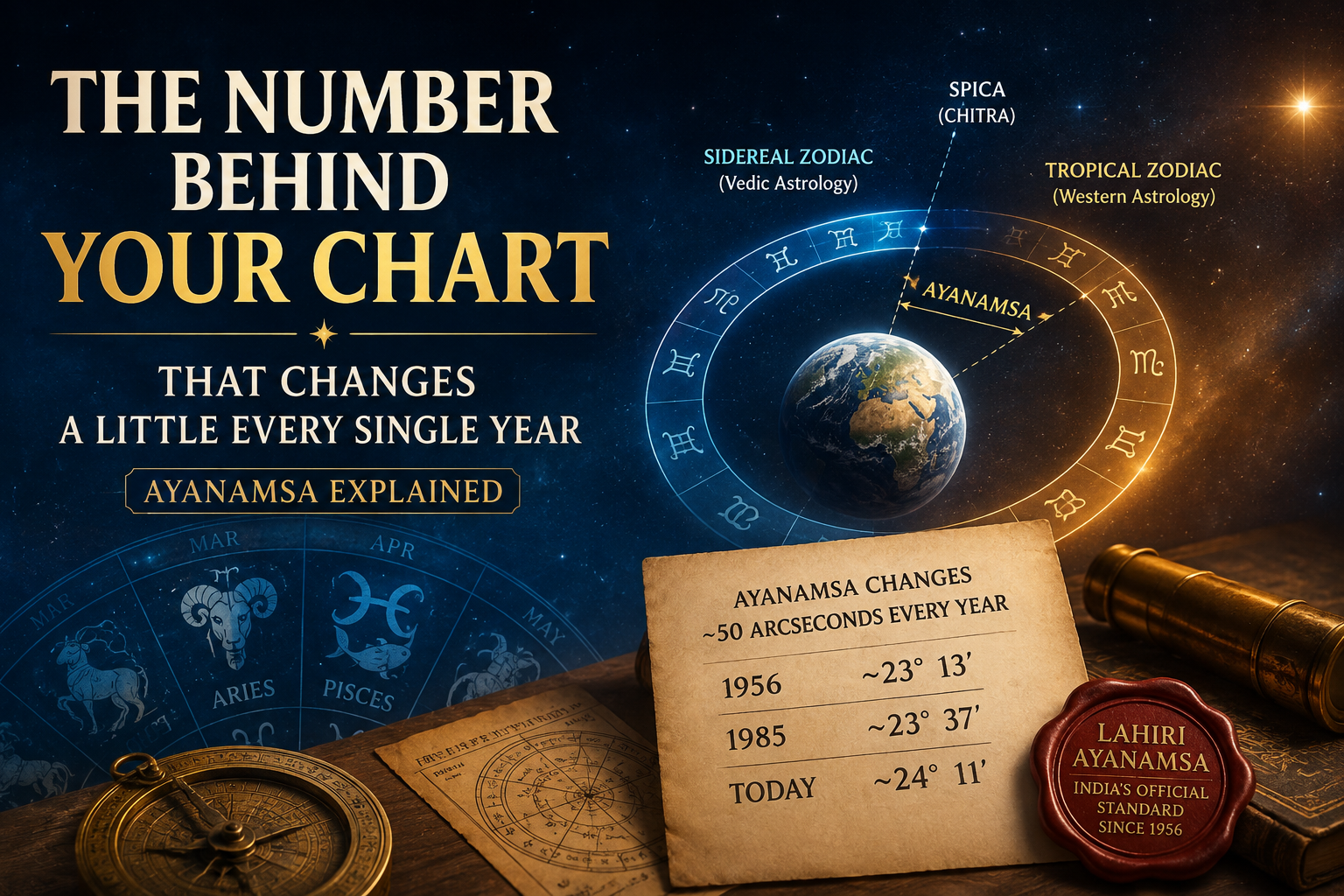
The Number Behind Your Chart That Changes a Little Every Single Year
Discover why Ayanamsa changes every year, how Lahiri Ayanamsa became the Vedic astrology standard, and why its precise value matters for accurate Kundali calculations.

Why Does Nothing Seem to Work Out? Understanding Kaal Sarp Dosha
Wondering why repeated setbacks keep happening? Understand Kaal Sarp Dosha, its effects, Rahu-Ketu periods, traditional remedies, and what your Kundali reveals.
Comments
Be the first to comment.