What Is Sade Sati? Understanding Saturn's 7.5-Year Cycle
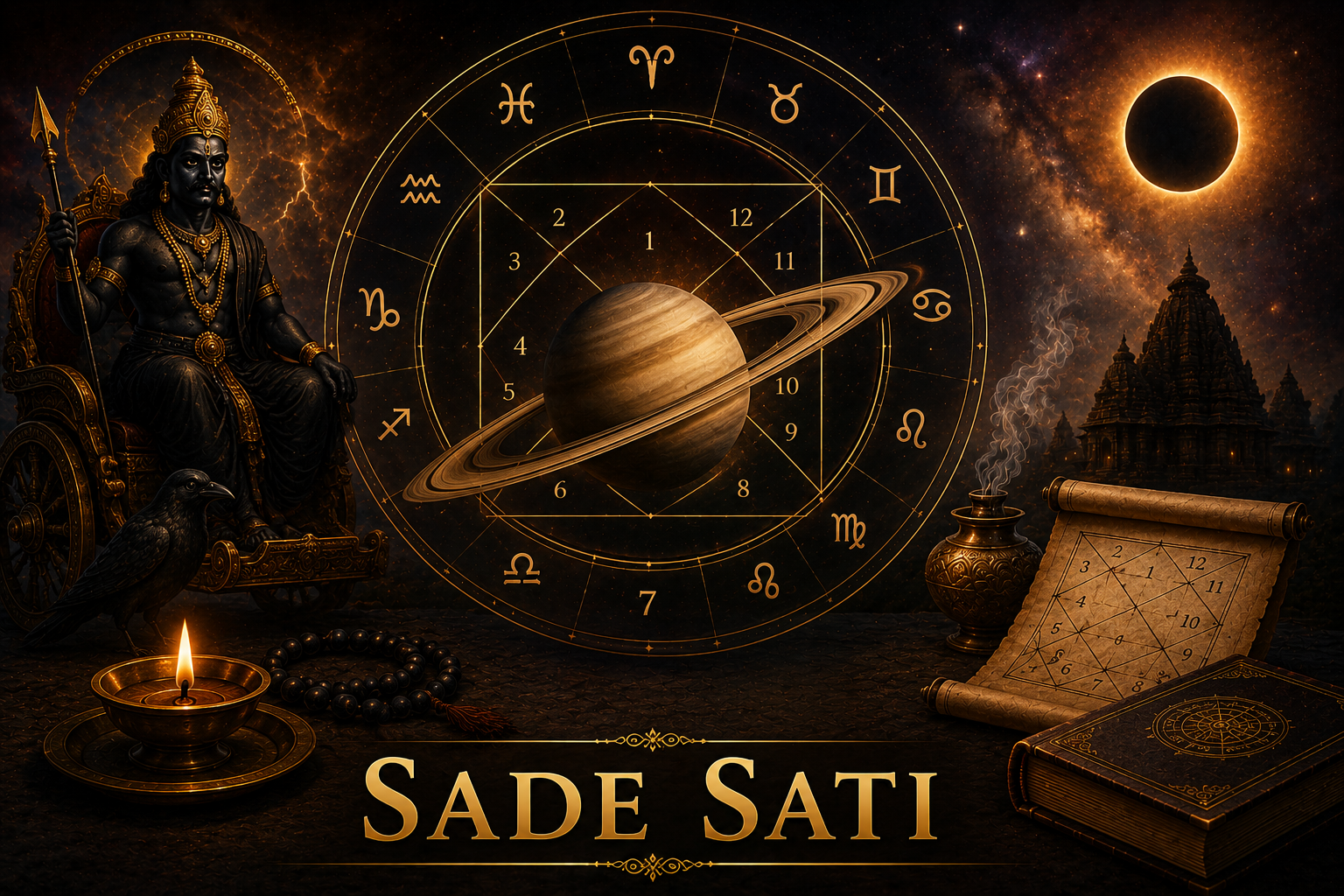
Table of contents
Few terms in Vedic astrology carry as much apprehension as Sade Sati. Translating to "seven and a half" literally, it refers to a significant period when Saturn transits three consecutive signs relative to your natal Moon.
Understanding it properly means looking past fear-based framing to the actual mechanics involved.
Why Does Your Moon Sign Matter, Not Your Sun Sign?
A common error in casual astrology content is assuming transits are calculated from your Sun sign, determined just by birth month. In Vedic tradition, Sade Sati is triggered exclusively by your natal Moon sign, or Janma Rashi.
The Moon represents the mind in Vedic astrology, governing emotions, psychological stability, and the lens through which daily reality is perceived. Saturn represents discipline, structure, and karmic lessons. When Saturn transits near your Moon, it's traditionally described as pressing directly on the subconscious mind, bringing deep-seated patterns to the surface and testing emotional resilience. Since the Sun operates on an entirely different cycle, Saturn transiting your Sun sign doesn't trigger this specific phenomenon.
What Are the Three Phases?
Sade Sati divides into three phases, each lasting roughly 2.5 years, since that's how long Saturn spends in each sign.
The rising phase occurs when Saturn transits the sign just before your Moon sign. This is often a preparation period, connected to unseen expenses, sleep quality, and a pull toward withdrawal. It's generally described as a clearing phase, stripping away structures that have already outlived their usefulness.
The peak phase occurs when Saturn transits directly over your Moon sign itself. This is generally considered the most intense stretch, centred on physical wellbeing, core identity, and mental resilience. It's often the most challenging phase, but also the one most associated with real personal growth.
The closing phase occurs when Saturn transits the sign just after your Moon sign. Pressure on the mind generally begins to ease here, though practical challenges around family and accumulated wealth tend to surface. It's typically a stabilising period, focused on resolving obligations and securing what's been built.
Is Sade Sati Always a Difficult Period?
No, and this is worth correcting directly. The transit isn't universally negative, it's better understood as a period of genuine restructuring. Whether it shows up as hardship or growth depends heavily on your natal Saturn's own dignity.
If your natal Saturn is well-placed, this period often functions more like an intensive training stretch, associated with real achievement, promotion, and long-term stability. For Taurus and Libra Ascendants specifically, Saturn acts as a Yogakaraka, a genuinely beneficial planet for that chart, meaning the transit often brings authority and steady gains through sustained effort rather than difficulty.
Which Moon Signs Are Currently Affected?
Saturn entered Pisces in March 2025 and remains there through 2026. This means:
Aries Moon signs are in the first, rising phase.
Pisces Moon signs are in the second, peak phase, generally considered the most intense of the three.
Aquarius Moon signs are in the third, closing phase.
If your Moon sign isn't one of these three, you're not currently in Sade Sati, regardless of what your Sun sign happens to be.
What Traditionally Helps During This Period?
Prioritise physical health. Since this transit is described as putting pressure on the mind through the Moon, the body is generally considered to absorb some of that stress. Regular movement and rest are commonly emphasised.
Accept a slower pace. Saturn is traditionally associated with patience rather than speed. Using this period to refine existing work, rather than forcing rapid new results, is a commonly cited approach.
Engage in service. Saturn is traditionally associated with the wider community, and acts of service, particularly toward elders or those in need, are commonly described as supportive practices during this period.
Common Mistakes to Avoid
A major mistake is reacting to generic horoscope content without checking your own natal Saturn's actual condition. Another is ignoring your current Mahadasha, your major planetary period, since a genuinely supportive Dasha can meaningfully soften Saturn's transit effects regardless of which Sade Sati phase you're in. Always look at the complete chart, not the Moon sign transit in isolation.
When to Get a Professional Reading Instead of Relying on Generic Predictions
Given how much this period's real effect depends on your specific natal Saturn and current Dasha, a full reading is worth it if:
You want to confirm your exact Moon sign and which phase currently applies to you
You want your natal Saturn's dignity checked, since this significantly shapes whether this period leans toward difficulty or growth
You're a Taurus or Libra Ascendant and want to understand how the Yogakaraka effect specifically applies to your chart
Why Check This on DoPuja
Because Sade Sati depends entirely on your precise natal Moon sign and your natal Saturn's exact dignity, not an approximation, accurate calculation matters considerably here.
UmasDoPuja's Kundali tool uses the Swiss Ephemeris engine with NASA/JPL DE431 planetary data and correctly applied Lahiri Ayanamsa, confirming your exact Moon sign and natal Saturn's condition rather than a rough guess. For a full, personalised reading on your current phase and how your Dasha interacts with it, Talk to Astrologer connects you with a real astrologer for that context.
Why Trust This
The three-phase structure, the Moon-sign trigger, and the Yogakaraka effect for Taurus and Libra Ascendants are consistently documented in both classical and contemporary Vedic astrology sources. The current transit signs (Aries, Pisces, and Aquarius as of 2026) reflect Saturn's confirmed position in Pisces since March 2025, verified against multiple independent sources for accuracy at the time of publishing, since this specific detail changes as Saturn moves and needs to stay current.
Frequently Asked Questions
How do I know if I'm currently in Sade Sati?
Check your natal Moon sign. As of 2026, Aries, Pisces, and Aquarius Moon signs are affected, corresponding to the rising, peak, and closing phases respectively.
Does Sade Sati affect everyone the same way?
No. Its effects depend heavily on your natal Saturn's placement, your current Mahadasha, and your Ascendant.
Can the effects of this transit be softened?
Traditional practices like regular meditation, service to others, and maintaining discipline in daily life are commonly cited as supportive during this period.
Is Sun sign used to determine Sade Sati?
No. It's calculated exclusively from your Vedic Moon sign, not your Sun sign.
What happens after the 7.5 years end?
Most traditions describe a period of relative relief following the transit, where lessons developed during the cycle begin producing more stable, tangible results.
Recommended articles

Feeling Stuck for Years? You Might Be in Sade Sati
Feeling stuck in career, finances, or energy? Learn what Sade Sati means, its three phases, Dasha's role, traditional remedies, and when it ends.
Why the Same Daily Horoscope Can Feel Completely Different Two Months Apart
Discover why the same daily Rashifal can feel different at different times. Learn how Moon transits, Jupiter, Saturn, Gochar Samyukti and Dasha shape daily predictions.

Why Your Horoscope Might Be Meant for a Million Other People Too
Discover why daily horoscopes are shared by millions, while a personalised Kundali reading uses your exact birth details, houses, Nakshatra, Dasha and unique chart combinations.
Comments
Be the first to comment.