Which of the 27 Yogas Bring Success, and Which Call for Caution
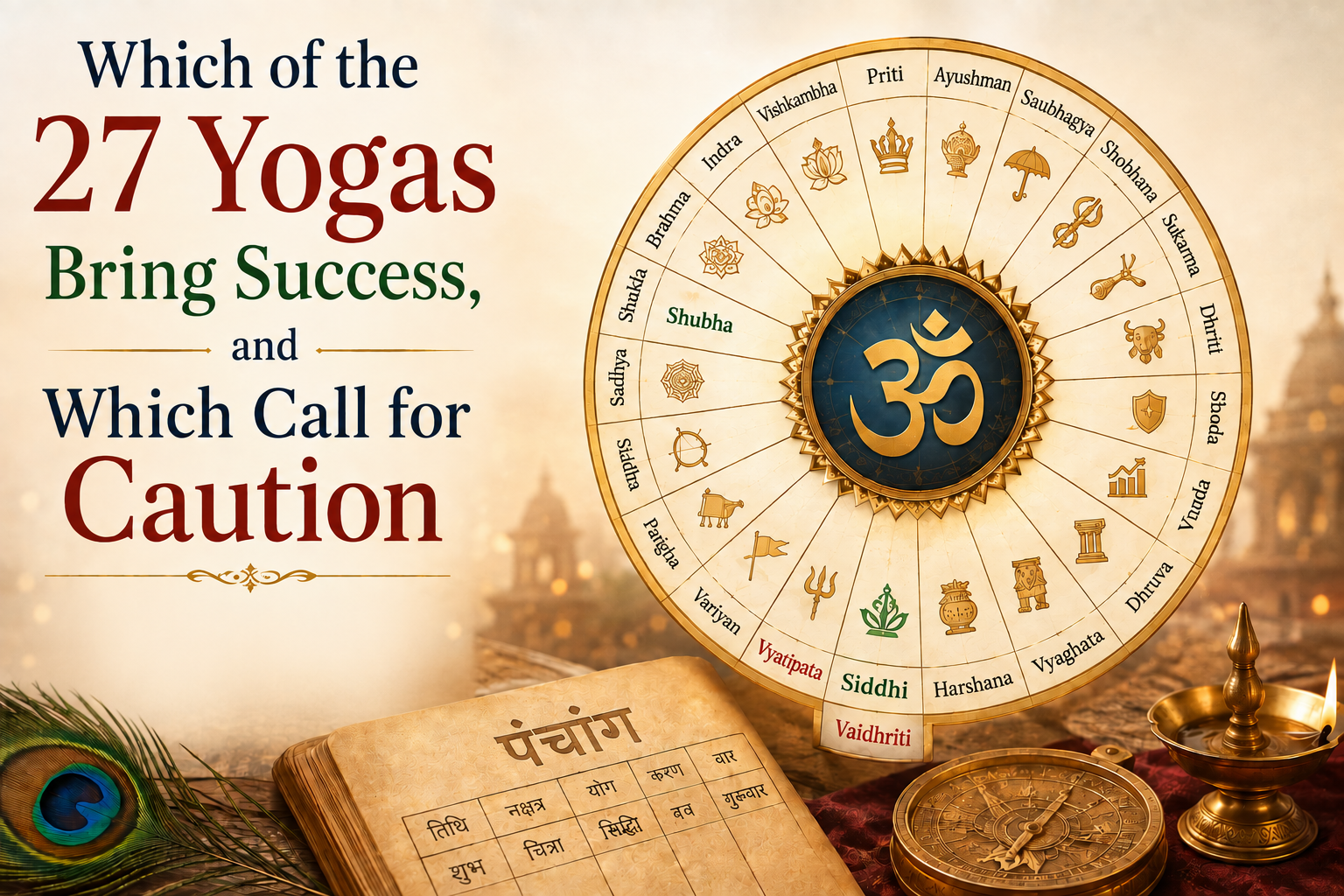
Table of contents
We've covered what Panchang Yoga actually is, the calculation, the confusion with physical yoga, and why it's the least understood Panchang limb, elsewhere on this site. This piece looks at specific named Yogas, which ones classical guidance favours, which call for genuine caution, and how they interact with the rest of the Panchang.
Which Yogas Are Classically Considered Most Favourable?
Siddhi, the sixteenth Yoga, is associated directly with success and accomplishment. Classical descriptions link it to focused, hardworking natives who achieve meaningful milestones, and it's generally considered well suited to any undertaking where sustained effort is expected to pay off.
Shubha, the twenty-third Yoga, is associated with general auspiciousness and positive development. The Muhurta Chintamani specifically ranks Shubha among the strongest Yogas available for any positive activity, and when it combines with an already favourable Tithi and Nakshatra, this is considered a particularly strong combination worth actively seeking out.
A Correction Worth Making: Is "Amrita" One of the 27 Yogas?
This is worth addressing directly, since it's a genuinely common point of confusion. "Amrita" doesn't appear among the standard 27 Panchang Yogas, Vishkambha, Priti, Ayushman, and so on through to Vaidhriti. What's likely being referenced is Amrit Siddhi Yoga, a separate and genuinely different auspicious combination formed from a specific weekday and Nakshatra pairing, not one of the 27 Nitya Yogas covered by this particular system at all. If you've encountered "Amrita Yoga" described alongside the 27, this distinction is almost certainly the source of that mix-up.
Which Yogas Call for Genuine Caution?
Vyatipata, the seventeenth Yoga, is considered inauspicious and associated with disturbance, sudden reversals, and unpredictable difficulty. It's worth noting the more balanced classical framing here: this Yoga is also associated with building genuine adaptability and resilience, since navigating its instability is considered to strengthen exactly those qualities over time.
Vaidhriti, the twenty-seventh and final Yoga, translates roughly to "lack of support," and is generally considered, alongside Vyatipata, one of the two most inauspicious Yogas in the entire cycle. Both are treated as near-total contraindications for new ventures, muhurats, and significant auspicious events specifically.
Can a Strong Tithi or Nakshatra Actually Offset a Difficult Yoga?
Yes, and this connects to a broader principle worth understanding properly. Even when the day's Yoga looks genuinely unfavourable, a strong Tithi and Nakshatra can meaningfully soften its overall weight in a full muhurat assessment. This works in both directions, just as a favourable Yoga combining with a strong Tithi and Nakshatra creates the kind of triple auspiciousness experienced muhurta practitioners specifically look for, a difficult Yoga paired with genuinely strong support elsewhere in the Panchang isn't treated as an automatic disqualification either.
Why Is Yoga Never Read on Its Own?
This is the core principle tying everything above together. Genuine muhurat selection, sometimes called Panchang Shuddhi, checks Tithi, Nakshatra, Yoga, Karana, and weekday together as a combined picture, not any single element in isolation. Yoga adds a real, specific layer, but it was never intended to function as a standalone verdict, checking it alone and stopping there misses exactly the kind of context that determines whether a particular day is actually well suited to a specific undertaking.
When to Get a Professional Reading Instead of Checking Yoga Alone
Given how much a single Yoga's real weight depends on the rest of the day's Panchang, a full reading is worth it if:
Your preferred date shows a difficult Yoga like Vyatipata or Vaidhriti, and you want to know whether the rest of the Panchang genuinely offsets it
You've encountered "Amrita Yoga" somewhere and want clarity on whether it applies to your specific situation or refers to the separate Amrit Siddhi combination
You want a full Panchang Shuddhi check for a significant event, not just the day's Yoga in isolation
Myth vs. Reality
Myth: A single difficult Yoga automatically rules out an entire day.
Reality: A strong Tithi and Nakshatra can meaningfully offset it, since genuine assessment weighs all the Panchang elements together, not Yoga alone.
Myth: "Amrita Yoga" is one of the 27 classical Panchang Yogas.
Reality: It doesn't appear among the standard 27. What's usually meant is Amrit Siddhi Yoga, a separate weekday-and-Nakshatra combination entirely.
Myth: Vyatipata and Vaidhriti mean nothing but misfortune.
Reality: Classical framing also associates navigating Vyatipata's instability with genuinely building adaptability and resilience, not purely negative qualities.
Why Check This on DoPuja
Because a single Yoga's real significance depends on the rest of that day's Panchang, not the Yoga alone, accurate calculation matters here.
UmasDoPuja's Panchang tool uses the Swiss Ephemeris engine with NASA/JPL DE431 planetary data and correctly applied Lahiri Ayanamsa to calculate Tithi, Nakshatra, Yoga, and Karana together for your specific location, not any single element in isolation. For a fuller muhurat check for a specific significant event, Talk to Astrologer connects you with a real astrologer for that context.
Why Trust This
The characteristics of Siddhi, Shubha, Vyatipata, and Vaidhriti described here are consistently documented across multiple classical and current Panchang sources, including the Muhurta Chintamani's specific ranking of Shubha. The clarification on Amrita versus Amrit Siddhi Yoga addresses a genuine, verifiable point of confusion rather than repeating an unverified name as though it belonged to the standard 27-Yoga system.
Frequently Asked Questions
What is Siddhi Yoga generally associated with?
Success and accomplishment, particularly for undertakings where sustained, focused effort is expected to pay off over time.
Is Amrita Yoga one of the 27 Panchang Yogas?
No. It doesn't appear in the standard list. It's most likely confused with Amrit Siddhi Yoga, a separate combination based on weekday and Nakshatra pairing.
Why are Vyatipata and Vaidhriti considered the most inauspicious Yogas?
Both are associated with disturbance and lack of support, respectively, and are generally treated as near-total contraindications for starting new ventures or significant auspicious events.
Can a good Tithi make up for a difficult Yoga?
It can meaningfully offset it. Genuine muhurat assessment weighs Tithi, Nakshatra, Yoga, and Karana together, not any single element as a standalone verdict.
Why shouldn't I just check the day's Yoga on its own?
Because it's only one of five Panchang elements, and checking it alone misses the broader context that actually determines whether a day suits a specific undertaking.
Recommended articles
Why Does Nothing Seem to Work Out? Understanding Kaal Sarp Dosha
Wondering why repeated setbacks keep happening? Understand Kaal Sarp Dosha, its effects, Rahu-Ketu periods, traditional remedies, and what your Kundali reveals.

Why Your Horoscope Might Be Meant for a Million Other People Too
Discover why daily horoscopes are shared by millions, while a personalised Kundali reading uses your exact birth details, houses, Nakshatra, Dasha and unique chart combinations.

How Rahu Kaal Timing Changes With Sunrise Every Single Day
Learn why Rahu Kaal timing changes every day with sunrise, sunset, seasons, and location. Understand seasonal variations, latitude differences, and precise Panchang calculations.
Comments
Be the first to comment.