Ashtakoot Guna Milan The 36-Point System Behind Kundali Matching
Table of contents
Before two families finalise a marriage in Hindu tradition, one number often gets checked first: the Guna Milan score, a figure out of 36 that summarises how compatible two birth charts appear on paper.
It's the single most recognisable output of Vedic Kundali matching. It's also one of the most frequently misunderstood, treated by some as a final verdict when it was never designed to function that way.
Here's what the 36 points actually measure, why some categories carry far more weight than others, and what the score can and can't, tell you on its own.
What Are the Eight Kootas That Make Up the Score?
Ashtakoot means "eight aspects" in Sanskrit. The system, rooted in the Brihat Parashara Hora Shastra tradition, evaluates compatibility across eight dimensions, each drawn primarily from the two partners' Moon Nakshatras rather than their Sun signs.
This is worth flagging upfront, since it surprises people used to Western astrology. The Sun sign has essentially no role in this calculation.
| Koota | Points | What It Measures |
|---|---|---|
| Varna | 1 | Spiritual and temperamental compatibility |
| Vashya | 2 | Mutual influence and attraction |
| Tara | 3 | Health, wellbeing, and longevity prospects |
| Yoni | 4 | Physical and intimate compatibility |
| Graha Maitri | 5 | Mental and intellectual rapport |
| Gana | 6 | Temperament category match |
| Bhakoot | 7 | Financial prosperity and family welfare |
| Nadi | 8 | Health compatibility and genetic factors for progeny |
Varna
Varna is the lowest-weighted koota, rooted in the classical four-tier classification assigned to each Moon sign, and is considered a relatively minor factor on its own.
Vashya
Vashya measures how naturally one partner tends to hold sway over the other, and whether that influence sits in reasonable balance.
Tara (Dina Koota)
Tara, also called Dina Koota, evaluates health and longevity prospects based on the relationship between both partners' birth Nakshatras.
Yoni
Yoni assesses physical and intimate compatibility. All 27 Nakshatras map to one of 14 animal symbols, and the harmony between the two partners' assigned animals shapes this score.
Graha Maitri
Graha Maitri compares the planetary lords of each partner's Moon sign, asking how naturally the two minds are likely to understand one another.
Gana
Gana classifies each Nakshatra as Deva, Manushya, or Rakshasa. Compatibility is strongest when both partners share the same or a naturally harmonious category.
Bhakoot
Bhakoot, also called Rashi Koota, assesses financial prosperity and overall relative influence between the two Moon signs. A 6th–8th or 2nd–12th positional relationship between the partners' Moon signs is flagged as Bhakoot Dosha.
Nadi
Nadi is the highest-weighted koota in the entire system. Each Nakshatra belongs to one of three Nadi categories—Aadi, Madhya, or Antya. If both partners share the same Nadi, this scores zero and triggers what's classically considered the most serious defect in the whole system.
Why Does Nadi Carry the Most Weight?
Nadi's 8-point allocation, nearly a quarter of the total 36 points, reflects how seriously classical astrology treats the underlying concern. Shared constitutional type between partners, rooted in an Ayurvedic framework connecting the three Nadis to Vata, Pitta, and Kapha, was traditionally believed to affect the health and vitality of future children.
This is exactly why a same-Nadi result gets flagged so prominently, and why checking the classical cancellation conditions matters so much before treating that flag as final.
Bhakoot, at 7 points, is the second most heavily weighted koota and carries comparable seriousness in practice. Nadi and Bhakoot together represent 15 of the 36 total points. Astrologers generally treat afflictions in these two categories as more consequential than a similar deficit spread across lower-weighted kootas like Varna or Vashya.
How Should You Read the Total Score?
Once all eight kootas are scored and summed, tradition offers a general benchmark
| Score | Interpretation |
|---|---|
| 18 or above | Conventional minimum workable threshold |
| 25 or above | Generally regarded as a very good match |
| 32 or above | Considered excellent, rare in practice |
These thresholds are conventions, not rigid cutoffs worded identically in every classical source. Different astrologers and family traditions apply some flexibility around these numbers, particularly when a below-threshold score is driven by lower-weighted kootas rather than Nadi or Bhakoot specifically.
Is the Score the Final Word on Compatibility?
This is the single most important thing to understand about Guna Milan, and it's the point most casual explanations skip. A raw score out of 36 is meant to be a starting filter for further conversation, not a standalone verdict.
Manglik Dosha
Manglik Dosha is evaluated completely separately. It depends on Mars's house placement in each chart, not on any Moon Nakshatra comparison, and doesn't factor into the 36-point total at all, even though it's frequently checked alongside Guna Milan.
Cancellation Conditions
Classical cancellation conditions apply to several kootas. Gana Dosha, for instance, can be nullified if the two partners' sign lords are classical friends. A low score on one koota doesn't automatically mean the underlying concern is unaddressed once cancellation conditions are checked.
Dasha Periods
Individual dasha periods matter too. A couple with a strong Guna Milan score marrying during a personally difficult dasha for either partner faces a different practical picture than the raw number alone suggests.
Birth Time Accuracy
Birth time accuracy directly affects the outcome. Even a 30-minute error in recorded birth time can shift the Nakshatra pada and meaningfully change several koota scores.
Why Do Some Reports Show More Than Eight Categories?
Ashtakoot is the system most commonly used in North Indian tradition.
South Indian tradition frequently uses a more elaborate framework called Dashakoot (ten aspects), which incorporates everything in Ashtakoot plus four additional categories:
Mahendra
Vedha
Rajju
Sthree Deergha Koota
If you've encountered matching reports referencing more than eight categories, this regional variation is likely why.
When to Get a Professional Reading Instead of Reading the Score Alone
Given how much nuance sits behind the headline number, a full matching consultation is worth it if:
Your total falls below 18, or close to it, and you want to know whether cancellation conditions apply to the specific kootas driving that result.
Nadi or Bhakoot specifically show affliction, since these carry more real weight than a similar deficit elsewhere.
You want Manglik status and current dasha periods checked alongside the Ashtakoot score for a fuller picture.
Myth vs Reality
Myth: A score below 18 means the couple shouldn't marry.
Reality: Cancellation conditions, the source of the deficit, and factors entirely outside the 36-point system—like Manglik status and dasha timing—all matter alongside the raw number.
Myth: All eight kootas matter equally.
Reality: Nadi and Bhakoot together represent nearly half the total score and are generally treated as more consequential than lower-weighted kootas like Varna.
Myth: This is based on the same Sun sign astrology used in the West.
Reality: Ashtakoot matching is built almost entirely on each partner's Moon Nakshatra, which is why the system can feel unfamiliar to those used to Western horoscope compatibility.
Why Check This on DoPuja?
Most of the Ashtakoot calculation hinges on precise Moon Nakshatra placement. Even a small birth-time error can shift several koota scores.
UmasDoPuja's Kundali Matching uses the Swiss Ephemeris engine with NASA/JPL DE431 planetary data and correctly applied Lahiri Ayanamsa, calculated from real sunrise and sunset for your specific location. Your Nakshatra placement is fixed precisely, not approximated.
Our reports also check Manglik status, Nadi and Bhakoot cancellation conditions, and dasha overlap alongside the raw 36-point score, rather than stopping at the headline number. For a full, personalised walkthrough of your specific match, Talk to Astrologer connects you with a real astrologer for that context.
Why Trust This?
The eight-koota framework, point weightings, and scoring conventions described here are consistently documented across classical sources rooted in the Brihat Parashara Hora Shastra tradition.
Where minor variation exists, specifically in the exact numeric thresholds some traditions use for "very good" versus "excellent" tiers, we've presented the most commonly cited convention while noting that flexibility exists in how different astrologers apply it.
Frequently Asked Questions
Is 18 points a passing score or a bare minimum?
It's conventionally treated as the minimum workable threshold, not a strong endorsement. Scores of 25 and above are generally considered notably better matches.
Does Guna Milan use Sun sign or Moon sign?
Almost entirely Moon Nakshatra. This is a key difference from Western Sun-sign-based compatibility systems.
If we score low on Nadi specifically, is the match automatically off?
Not automatically. Classical cancellation conditions exist and should be checked before treating a Nadi flag as final.
Is Manglik Dosha included in the 36-point total?
No. It's assessed entirely separately, based on Mars's house placement in each chart, though it's commonly checked alongside Guna Milan for a complete picture.
Recommended articles
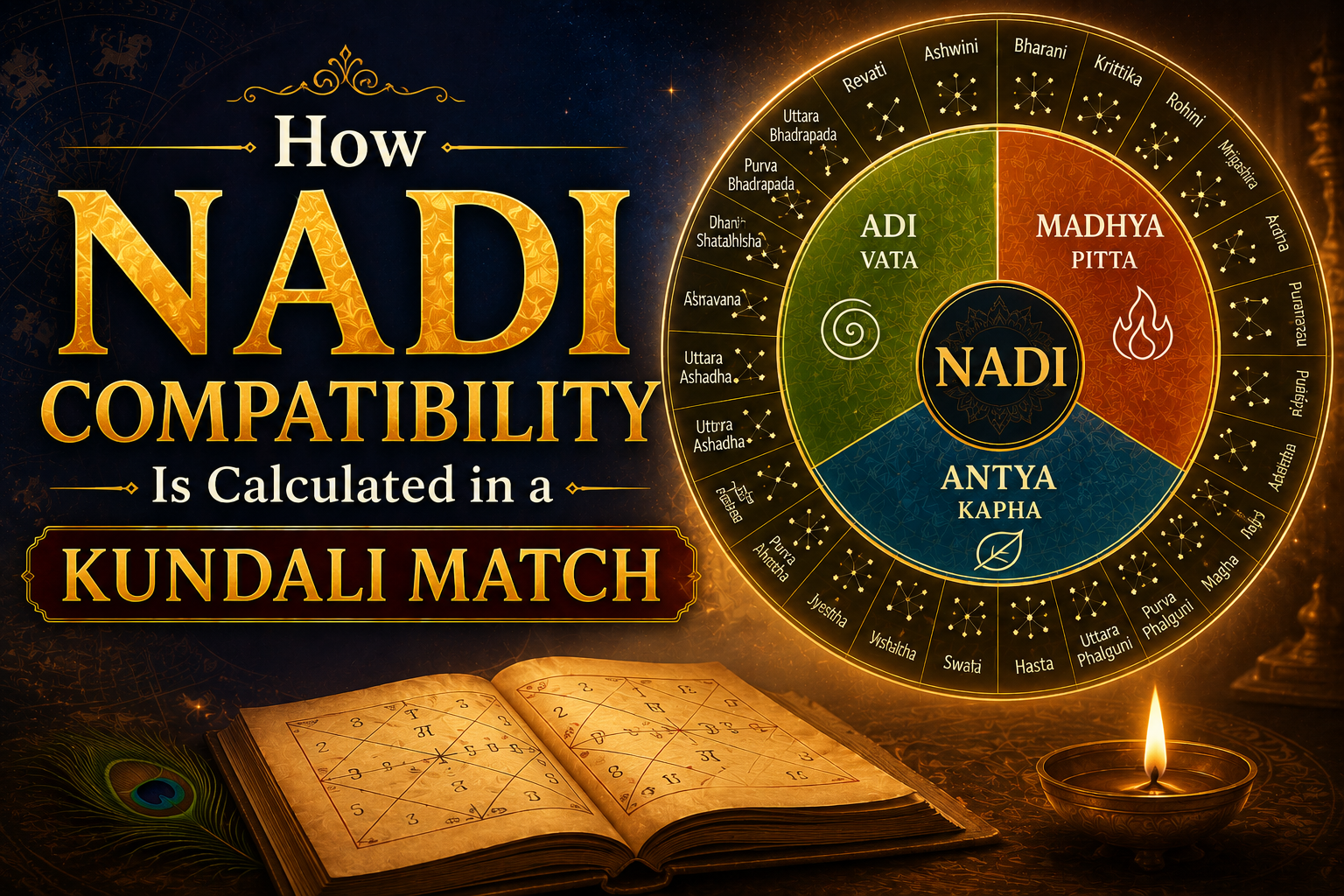
How Nadi Compatibility Is Calculated in a Kundali Match
Learn how Nadi compatibility is calculated in Kundali matching, from birth Nakshatra and Nadi groups to Nadi Dosha, Pada exceptions, and compatibility rules.
Moon Sign and Nakshatra: The Core of Ashtakoot Compatibility
Understand how Moon Sign and Nakshatra drive Ashtakoot compatibility, including Tara, Gana, Bhakoot, Nadi, scoring, doshas, and cancellation rules.
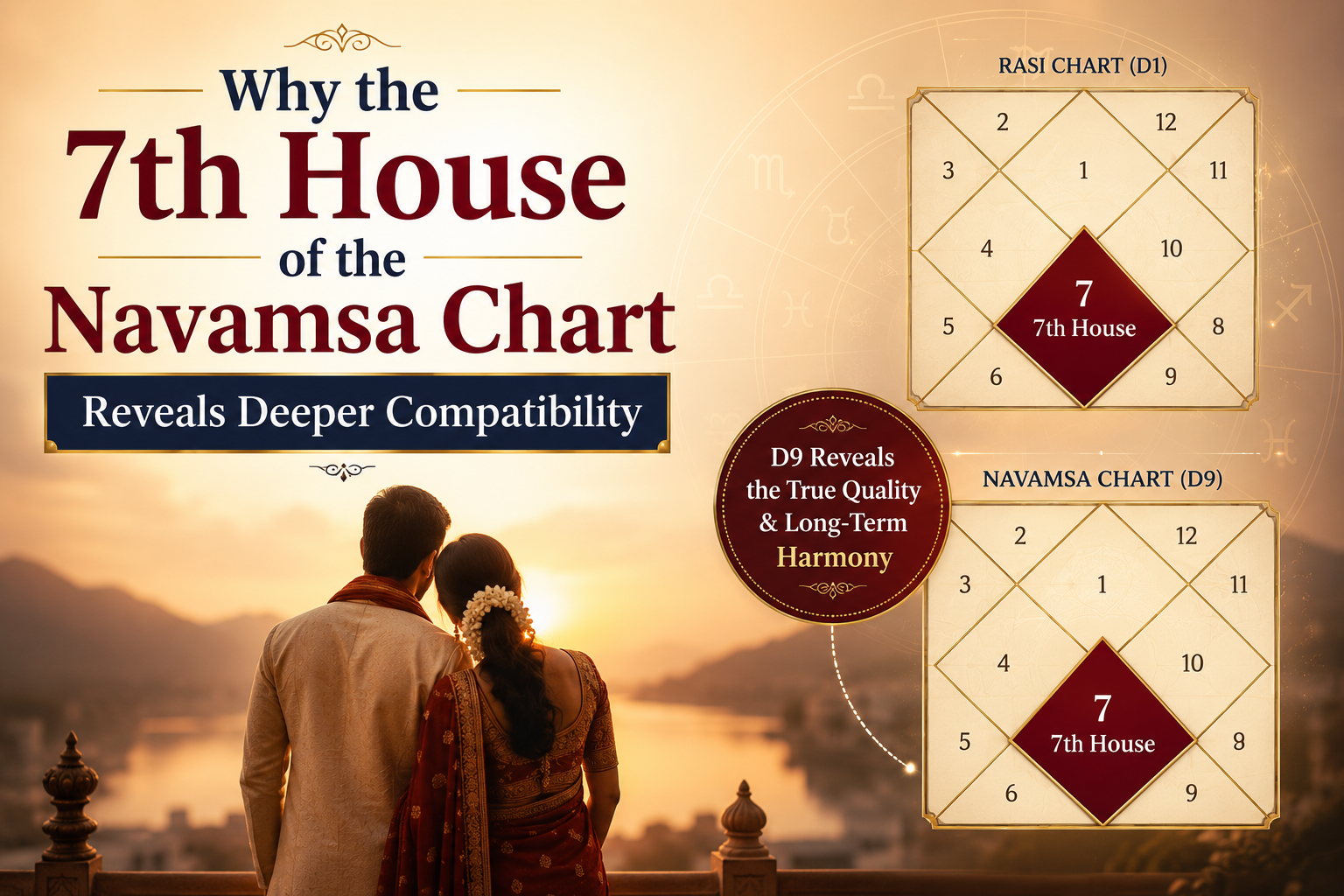
Why the 7th House of the Navamsa Chart Reveals Deeper Compatibility
Discover how the Navamsa 7th house, Venus placement, Vargottama, and D9 chart comparison reveal deeper marriage compatibility beyond Guna Milan.
Comments
Be the first to comment.