Daily Nakshatra Explained: How Today's Star Shapes Your Day
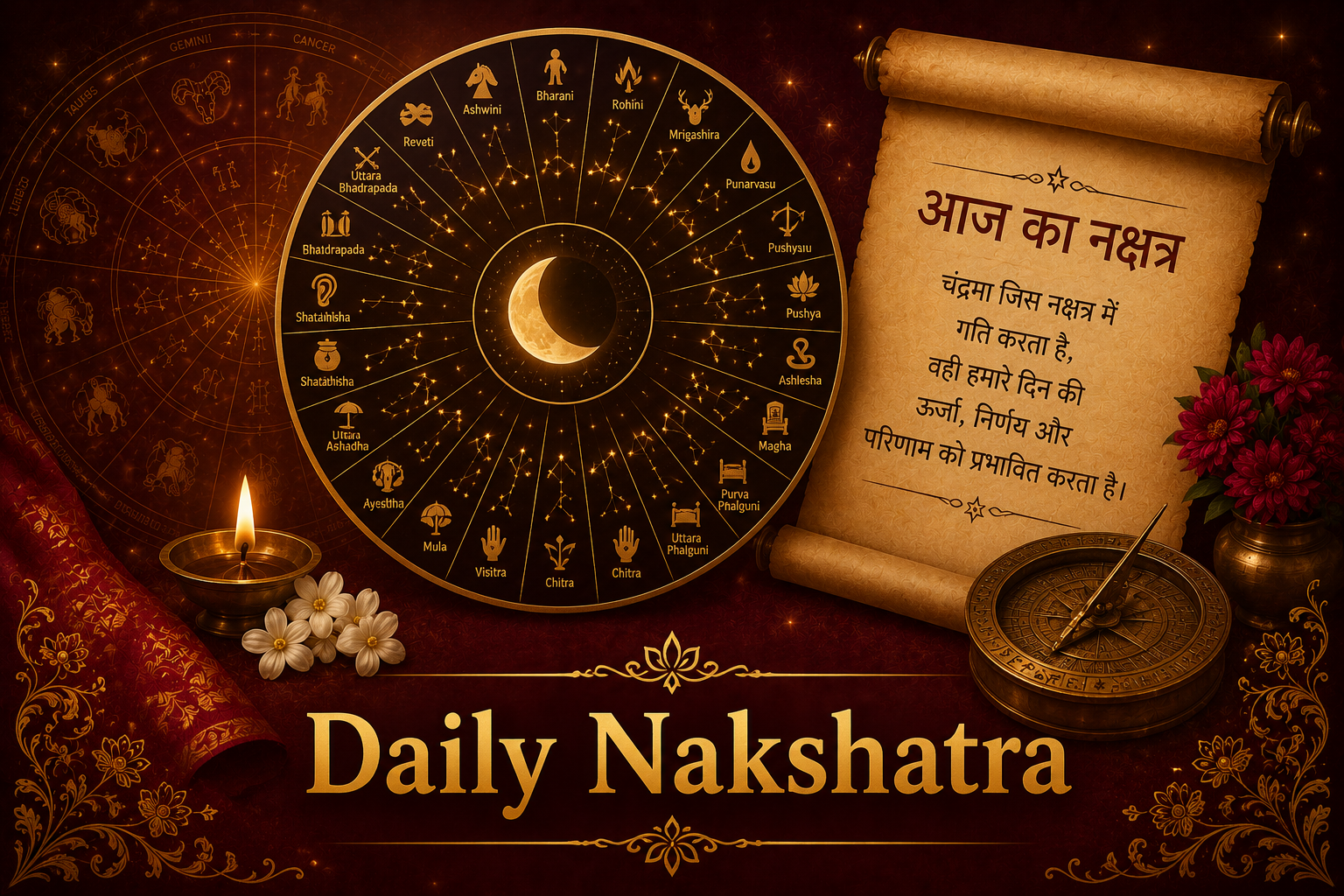
Table of contents
Understanding the Daily Nakshatra
In Vedic astrology, time is never viewed as an empty backdrop against which life unfolds. Every moment carries its own distinct quality, and understanding these changing rhythms is considered an important part of making informed decisions.
Among the many timing systems used in Vedic astrology, the Nakshatra, or lunar mansion, operates on the shortest and most practical timescale. While your Birth Nakshatra remains fixed throughout your life, the Daily Nakshatra changes approximately every 24 hours as the Moon moves through the zodiac.
This daily movement provides a constantly shifting energetic backdrop that traditional astrology uses to understand the overall character of a particular day.
In this article, we'll explain what the Daily Nakshatra is, how it differs from your Birth Nakshatra, what the seven classical Nakshatra categories mean, and why terms like "fierce" or "sharp" should never be mistaken for "bad."
What Is the Daily Nakshatra?
The zodiac in Vedic astrology is divided into 12 zodiac signs, which are further subdivided into 27 Nakshatras, each measuring 13°20' of celestial longitude.
The Sun takes approximately one year to travel through all 27 Nakshatras.
The Moon, however, moves much faster, completing its journey through all 27 Nakshatras in about 27.3 days. As a result, the Moon spends roughly one day in each Nakshatra before moving into the next.
The Nakshatra occupied by the Moon at any given moment is known as the Daily Nakshatra.
Since the Moon is traditionally associated with the mind, emotions, perception, and daily experience, the Nakshatra it occupies is believed to influence the overall tone and quality of the day.
Because the Moon's movement doesn't align neatly with midnight, the Daily Nakshatra can change at any hour, making exact timing important when consulting a Panchang.
Birth Nakshatra vs. Daily Nakshatra
Although both are based on the Moon's position, the Birth Nakshatra and Daily Nakshatra serve entirely different purposes.
Your Birth Nakshatra is calculated using your exact birth date, time, and place. Once determined, it never changes. It forms an important part of your birth chart and is used in areas such as:
Kundali matching
Naming ceremonies
Mahadasha calculations
Personality analysis
Traditional remedial practices
The Daily Nakshatra, on the other hand, is simply the Nakshatra through which the Moon is currently transiting. Since the Moon changes Nakshatras roughly every day, the Daily Nakshatra changes continually.
It describes the general quality of the day's timing, rather than your individual nature.
However, classical astrology also recognises that people respond differently to the same Daily Nakshatra.
This relationship is measured through Tara Bala, which compares today's Nakshatra with your Birth Nakshatra. As a result, two people experiencing the same Daily Nakshatra may find it affects them differently depending on their individual charts.
The Seven Classical Nakshatra Categories
Rather than treating each of the 27 Nakshatras separately for everyday timing, traditional Muhurta texts classify them into seven behavioural groups based on their natural temperament.
These categories appear in classical works such as the Muhurta Chintamani and are widely used when selecting auspicious timing.
1. Sthira (Fixed)
Nakshatras:
Rohini
Uttara Phalguni
Uttara Ashadha
Uttara Bhadrapada
Sthira Nakshatras represent stability, permanence, and endurance.
They are traditionally considered favourable for:
Purchasing property
Laying foundations
Marriage ceremonies
Long-term contracts
Business formation
Permanent commitments
Whenever something is intended to last for many years, Sthira Nakshatras are generally preferred.
2. Chara (Movable)
Nakshatras:
Punarvasu
Swati
Shravana
Dhanishta
Shatabhisha
Chara Nakshatras carry movement, flexibility, and progress.
They are traditionally associated with:
Travel
Vehicle purchases
Relocation
Business trips
Beginning journeys
Activities involving change
If an undertaking involves movement rather than permanence, Chara Nakshatras are often considered suitable.
3. Ugra (Fierce)
Nakshatras:
Bharani
Magha
Purva Phalguni
Purva Ashadha
Purva Bhadrapada
Ugra Nakshatras possess intense, forceful, transformative energy.
Traditionally they are associated with:
Litigation
Competitive situations
Demolition
Removing obstacles
Assertive negotiations
Situations requiring courage
Because of their intense nature, they are generally considered less appropriate for peaceful celebrations, weddings, or artistic pursuits.
4. Kshipra (Swift)
Nakshatras:
Ashwini
Pushya
Hasta
Kshipra means quick, efficient, and responsive.
These Nakshatras are traditionally favoured for:
Commerce
Business transactions
Medical treatment
Short-term investments
Buying and selling
Activities requiring speed
Whenever timely action matters more than permanence, Kshipra Nakshatras are often recommended.
5. Mridu (Tender)
Nakshatras:
Mrigashira
Chitra
Anuradha
Revati
Mridu Nakshatras are gentle, harmonious, and nurturing.
They are considered suitable for:
Relationships
Marriage discussions
Artistic work
Social gatherings
Education
Creative pursuits
Diplomacy
Activities that benefit from patience, cooperation, and emotional warmth are traditionally aligned with Mridu energy.
6. Tikshna (Sharp)
Nakshatras:
Ardra
Ashlesha
Jyeshtha
Mula
Tikshna Nakshatras possess sharp, penetrating, and decisive qualities.
Traditionally they are associated with:
Ending unhealthy situations
Surgery
Breaking harmful habits
Research
Deep investigation
Focused intellectual work
They are generally not preferred for celebrations or activities intended to cultivate harmony.
7. Misra (Mixed)
Nakshatras:
Krittika
Vishakha
Misra literally means "mixed."
These Nakshatras combine multiple qualities rather than strongly expressing one particular temperament.
They are generally regarded as suitable for:
Routine responsibilities
Administrative work
Everyday tasks
Flexible schedules
General-purpose activities
Rather than strongly favouring a specific kind of work, Misra Nakshatras provide balanced conditions for ordinary daily life.
Are Fierce or Sharp Nakshatras Actually Unlucky?
One of the biggest misconceptions surrounding Daily Nakshatras is that Ugra and Tikshna days should always be avoided.
Classical astrology does not make this claim.
No Nakshatra is considered inherently good or bad.
Instead, each category supports a different type of activity.
A useful comparison is that of fire.
Fire can destroy a forest, but it can also sterilise surgical instruments, forge steel, and clear land for new growth. Its value depends entirely on how it is used.
The same principle applies to Ugra and Tikshna Nakshatras.
Their energy is naturally suited to situations requiring decisiveness, removal, confrontation, or transformation.
They simply aren't considered the ideal timing for celebrations, romance, or peaceful social occasions.
Using the Daily Nakshatra in Practice
Understanding the Daily Nakshatra is less about avoiding particular days and more about aligning your activities with the prevailing quality of time.
For example:
Planning a wedding, signing a long-term lease, or beginning a lifelong commitment traditionally aligns well with a Sthira Nakshatra.
Scheduling travel, relocating, or purchasing a vehicle often suits a Chara Nakshatra.
Conducting difficult negotiations, legal proceedings, or addressing long-standing conflicts may be better supported by an Ugra Nakshatra.
Completing business transactions or beginning medical treatment can benefit from the quick, efficient nature of Kshipra Nakshatras.
Creative collaborations, relationship discussions, and artistic work traditionally harmonise with Mridu Nakshatras.
Ending unhealthy habits, carrying out surgery, or undertaking intensive research is often associated with Tikshna Nakshatras.
Of course, life rarely allows every important decision to wait for the "perfect" day.
Classical guidance therefore recommends thoughtfulness and intention, not fear or postponement. If an activity must take place on a less-than-ideal Nakshatra, it is generally approached with greater awareness rather than avoided altogether.
When a Personal Muhurta Matters
The seven-category system offers an excellent overview of the day's general character, but it represents only one component of traditional Muhurta.
A complete Muhurta analysis also considers:
Tithi
Yoga
Karana
Vara (weekday)
Tara Bala
Planetary positions
Your individual birth chart
For significant life events such as marriage, Griha Pravesh, starting a business, or major financial commitments, astrologers typically evaluate all these factors together instead of relying solely on the Daily Nakshatra.
Myth vs Reality
| Myth | Reality |
|---|---|
| Ugra and Tikshna Nakshatras are unlucky. | They are designed for specific kinds of activities involving transformation, confrontation, or decisive action. |
| The Daily Nakshatra affects everyone equally. | Individual experience also depends on Tara Bala and the birth chart. |
| Doing the "wrong" activity guarantees failure. | Classical astrology recommends greater care and intention, not panic or cancellation. |
Why Check the Daily Nakshatra?
Because the Moon changes Nakshatras at varying times throughout the day, simply knowing the calendar date isn't enough.
A properly calculated Panchang provides:
The current Nakshatra
Its start and end time
Local timing adjustments
Other Muhurta factors such as Tithi and Yoga
When combined with your Birth Nakshatra, it can also determine your Tara Bala, giving a more personalised understanding of how the day's energy interacts with your own chart.
Why Trust This Classification?
The seven-category classification of Nakshatras—Sthira, Chara, Ugra, Kshipra, Mridu, Tikshna, and Misra—is documented across respected classical Muhurta texts, including the Muhurta Chintamani, with similar classifications referenced in traditional works such as the Narada Purana.
While modern astrologers may vary in their interpretation, the underlying grouping of the Nakshatras remains remarkably consistent across traditional sources.
Frequently Asked Questions
Can my Birth Nakshatra ever change?
No. Your Birth Nakshatra is permanently determined by the Moon's position at your exact time and place of birth.
Does the Daily Nakshatra change every day?
Yes. The Moon spends approximately one day in each Nakshatra, causing the Daily Nakshatra to change roughly every 24 hours.
Are some Nakshatras unlucky?
No. Traditional astrology views every Nakshatra as appropriate for certain activities. The key is matching the activity to the nature of the day.
Does today's Nakshatra affect everyone in the same way?
Not necessarily. While the general quality of the day is shared, individual experiences also depend on Tara Bala and the broader birth chart.
How can I find today's Nakshatra?
You can consult a reliable Panchang or an accurate astrological calculation tool that displays the Moon's current Nakshatra along with its start and end times for your location.
Why are Nakshatras called "lunar mansions"?
The term reflects the Moon's journey through 27 equal divisions of the sky. The Moon appears to "reside" in each Nakshatra for about one day before moving on to the next, much like travelling through a sequence of celestial mansions.
Recommended articles
Feeling Stuck for Years? You Might Be in Sade Sati
Feeling stuck in career, finances, or energy? Learn what Sade Sati means, its three phases, Dasha's role, traditional remedies, and when it ends.
Why Does Nothing Seem to Work Out? Understanding Kaal Sarp Dosha
Wondering why repeated setbacks keep happening? Understand Kaal Sarp Dosha, its effects, Rahu-Ketu periods, traditional remedies, and what your Kundali reveals.
Struggling With Delayed Marriage? What Mangal Dosha Really Means
Struggling with delayed marriage because of Mangal Dosha? Learn what being Manglik really means, cancellation factors, traditional remedies, and when to seek a full Kundali reading.
Comments
Be the first to comment.