How Mercury's House Placement Shapes Its 17-Year Dasha
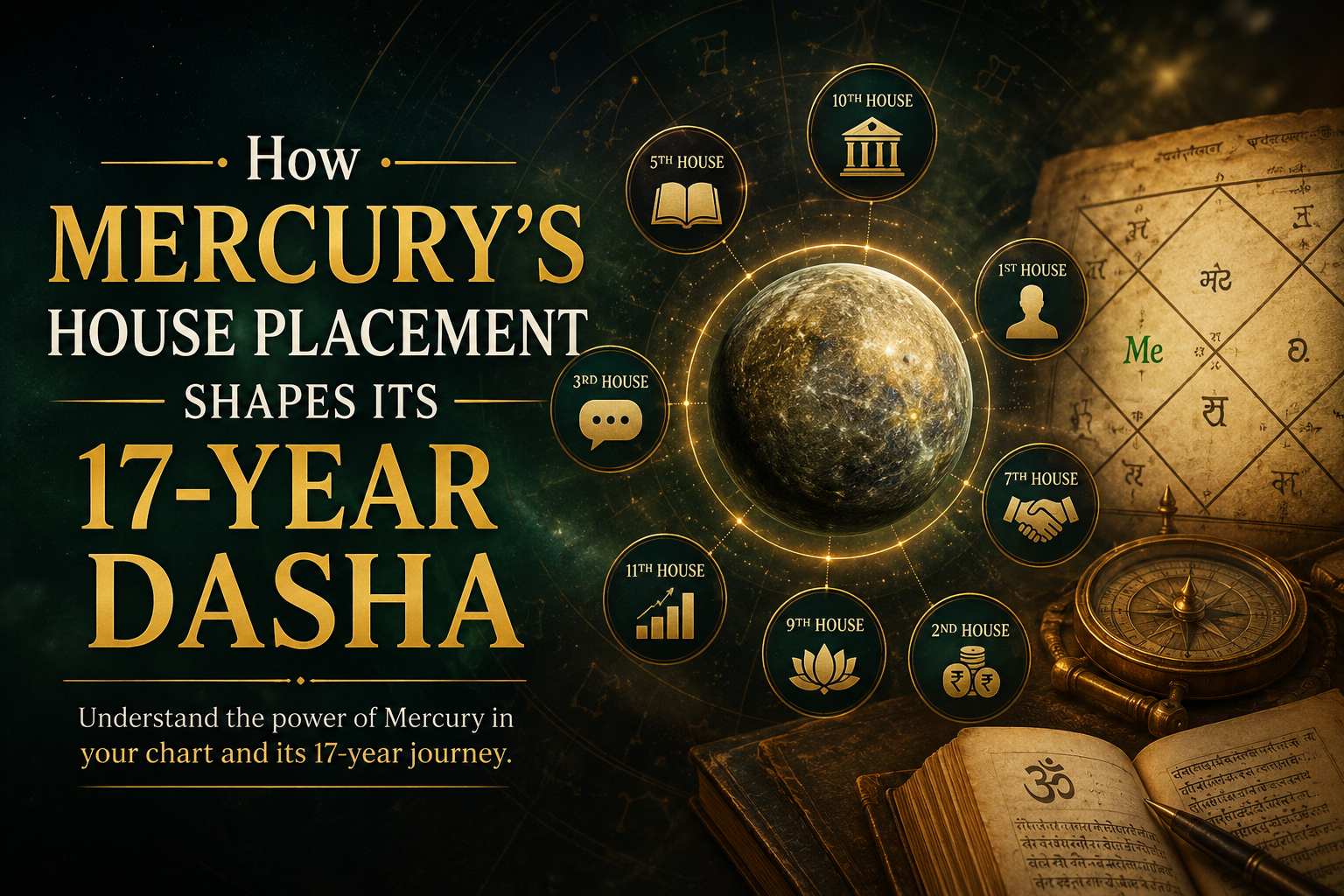
Table of contents
We've covered the general shape of Mercury Mahadasha elsewhere on this site, its 17-year duration (genuinely the fourth-longest, not the second as commonly claimed), its unusually impressionable nature depending on planetary company, and the Neech Bhanga cancellation available for a debilitated Mercury. This piece goes deeper into house placement, the Sun-Mercury relationship specifically, and why Mercury's dual rulership makes this dasha genuinely variable from chart to chart.
How Different Are Exaltation in Virgo and Debilitation in Pisces?
Mercury exalted in Virgo during its own Mahadasha tends to bring sharp, methodical, detail-oriented clarity, the kind of precise thinking Mercury is known for at its strongest. Mercury debilitated in Pisces tends to bring a more diffuse expression instead, ideas and communication that struggle to find crisp form, sometimes leaning toward overthinking or difficulty following through on stated plans.
Why Do the 3rd, 5th, and 10th Houses Favour Business and Communication?
These three houses align directly with Mercury's own natural significations, communication in the 3rd house, intelligence and creativity in the 5th, and career in the 10th, so a Mercury placed here tends to express its themes with less friction than elsewhere.
There's a specific technical detail worth knowing when Mercury lands in the 10th house particularly. If Mercury is in its own sign or exalted while occupying this house, it forms Bhadra Yoga, one of the five classical Pancha Mahapurusha Yogas, the same family of combinations that includes Ruchaka Yoga for Mars and Hamsa Yoga for Jupiter. This is generally considered the peak expression of Mercury's placement, associated with real distinction and standing built through career specifically during this dasha.
Does a Close Sun Conjunction Really Reduce Mercury's Clarity?
Generally, yes, though it's worth being more precise than the popular version of this claim. When Mercury sits close to the Sun, the classical concept of combustion describes Mercury's own clarity as being somewhat overwhelmed by the Sun's brightness, generally associated with reduced confidence in communication or a harder time expressing ideas clearly during this dasha.
It's worth adding a nuance here that's often missing from quick explanations: this effect isn't considered uniformly negative regardless of exact degree or house context. Several more detailed sources note that combustion's specific impact varies depending on which houses Mercury governs for a given ascendant, and at extremely tight degree separations, some traditions describe a different, less straightforwardly negative dynamic than looser combustion produces. The safest general takeaway is that a close Sun conjunction deserves a proper check of the exact degree involved, rather than an automatic assumption of difficulty.
Why Does Mercury's Dual Rulership Make Such a Difference?
This is genuinely the most underappreciated factor shaping how different two people's Mercury Mahadasha can look. Since Mercury rules both Gemini and Virgo, and these two signs sit a fixed distance apart in the zodiac, which two houses Mercury actually governs depends entirely on your specific ascendant, and the resulting combination varies enormously.
For a Taurus ascendant, Mercury rules the 2nd and 5th houses, forming a wealth-and-children combination, generally associated with financial accumulation connected to communication skills and success involving children.
For a Sagittarius ascendant, Mercury rules the 7th and 10th houses, combining business partnership with career, generally considered a strongly favourable period for career advancement built through partnership.
For a Capricorn ascendant, Mercury rules the 6th and 9th houses, combining service with dharma, generally associated with intelligent, analytical service work, sometimes in healthcare or scholarly publishing specifically.
The underlying point: "Mercury Mahadasha" isn't one uniform experience. The specific pair of houses it governs for your ascendant shapes the dasha's actual theme as much as, or more than, Mercury's sign or house placement alone.
When to Get a Professional Reading Instead of a Generic House Check
Given how much this period depends on the specific combination of sign, house, Sun proximity, and which two houses Mercury actually rules for your ascendant, a full reading is worth it if:
- Your Mercury sits in the 10th house and you want to confirm whether it's genuinely forming Bhadra Yoga
- You have a close Sun-Mercury conjunction and want the exact degree checked rather than assuming automatic difficulty
- You want to understand which specific two houses Mercury governs for your ascendant, since this shapes the dasha's real theme considerably
Myth vs. Reality
Myth: Mercury's house placement matters less than its sign.
Reality: Both matter considerably, and a well-dignified Mercury in a Kendra house, particularly the 10th, can form Bhadra Yoga, a genuinely significant combination in its own right.
Myth: Any Sun-Mercury conjunction produces the same degree of reduced clarity.
Reality: The effect varies by exact degree, house context, and which houses Mercury rules for the ascendant, not a uniform outcome regardless of specifics.
Myth: Mercury Mahadasha means roughly the same thing for everyone.
Reality: Because Mercury rules two different signs, the specific pair of houses it governs varies by ascendant, genuinely shaping the dasha's real theme from chart to chart.
Why Check This on DoPuja
Because this period's real character depends on the specific combination of sign, house, Sun proximity, and which two houses Mercury actually rules for your ascendant, not any single factor alone, accurate calculation matters considerably here.
UmasDoPuja's Kundali tool uses the Swiss Ephemeris engine with NASA/JPL DE431 planetary data and correctly applied Lahiri Ayanamsa, calculating your Mercury's exact house, sign, degree separation from the Sun, and house lordships precisely rather than approximating. For a full, personalised reading on how your specific Mercury placement is likely to shape this seventeen-year period, Talk to Astrologer connects you with a real astrologer for that context.
Why Trust This
The exaltation and debilitation contrast, the Bhadra Yoga formation conditions, and the ascendant-specific house-pairing examples described here are consistently documented across multiple classical and current Vedic astrology sources. On the Sun-Mercury conjunction specifically, we've presented a more precise picture than the uniformly negative popular version, noting that exact degree and house context genuinely shape the outcome.
Frequently Asked Questions
What is Bhadra Yoga, and how does it relate to Mercury's house placement?
It forms when Mercury sits in its own or exalted sign within a Kendra house, particularly the 10th, one of the five classical Pancha Mahapurusha Yogas, generally associated with real career distinction during this dasha.
Does a Sun-Mercury conjunction always weaken this dasha?
Generally, it reduces clarity to some degree, but the exact impact varies by degree separation and which houses Mercury governs for your ascendant, not a uniform effect.
Why does Mercury Mahadasha look so different for different people?
Because Mercury rules both Gemini and Virgo, the specific pair of houses it governs depends on your ascendant, meaningfully shaping the dasha's actual theme.
Which houses are generally best for Mercury during this dasha?
The 3rd, 5th, and 10th houses align directly with Mercury's own natural significations, communication, intelligence, and career, respectively.
Is a debilitated Mercury in the 10th house automatically bad for career?
Not necessarily. A Neech Bhanga cancellation can apply here, sometimes converting into a strong Neech Bhanga Raja Yoga specifically within the career house.
Recommended articles

Why Does Nothing Seem to Work Out? Understanding Kaal Sarp Dosha
Wondering why repeated setbacks keep happening? Understand Kaal Sarp Dosha, its effects, Rahu-Ketu periods, traditional remedies, and what your Kundali reveals.

Why the Same Daily Horoscope Can Feel Completely Different Two Months Apart
Discover why the same daily Rashifal can feel different at different times. Learn how Moon transits, Jupiter, Saturn, Gochar Samyukti and Dasha shape daily predictions.
The Number Behind Your Chart That Changes a Little Every Single Year
Discover why Ayanamsa changes every year, how Lahiri Ayanamsa became the Vedic astrology standard, and why its precise value matters for accurate Kundali calculations.
Comments
Be the first to comment.