Karana Explained: The Overlooked Limb of the Panchang
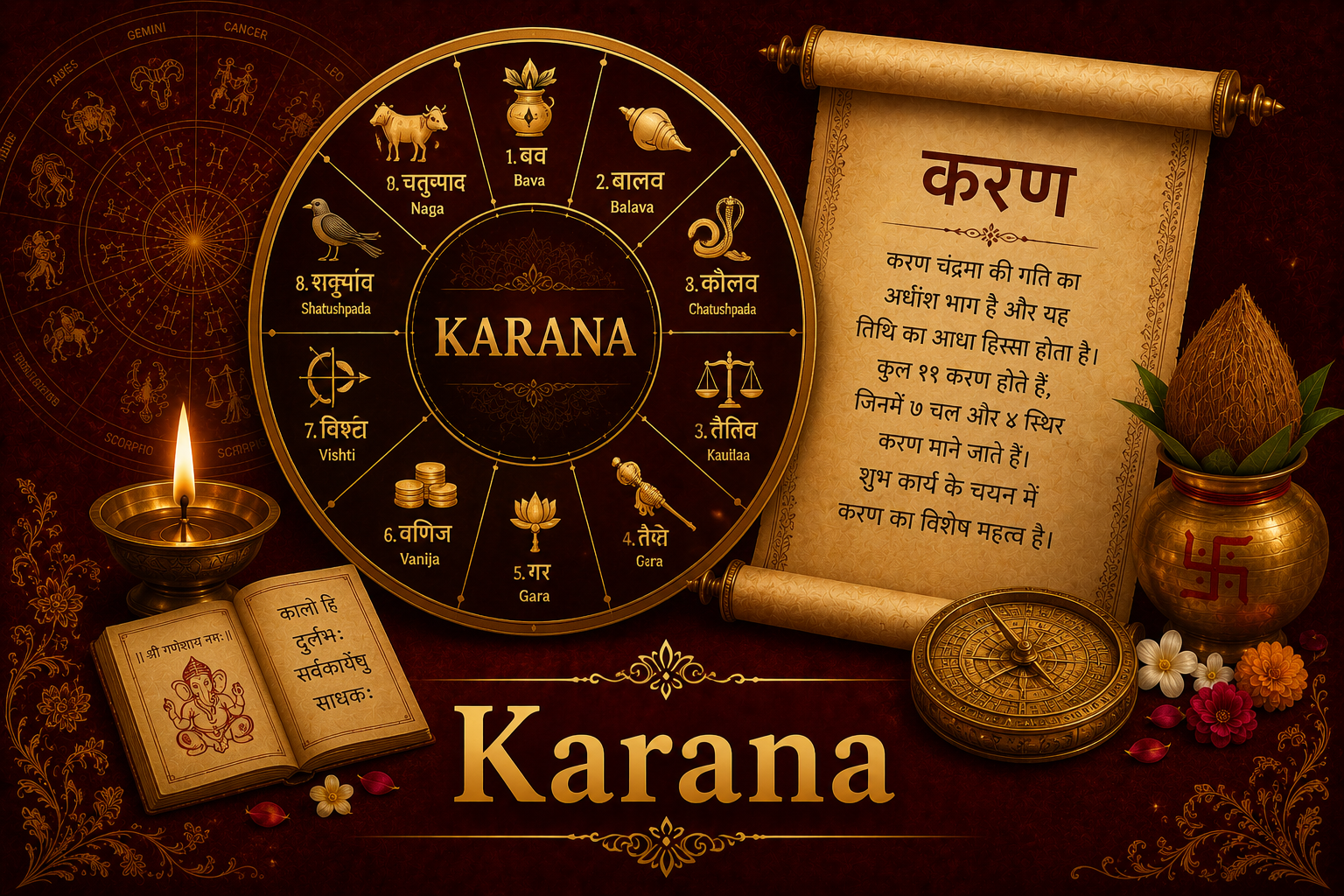
Table of contents
Introduction
Most people checking a Panchang focus on Tithi and Nakshatra. There's a third timing layer that gets far less attention despite offering genuinely finer detail: Karana. Here's what it actually measures, the 11 named types and what each is traditionally suited for, and two common associations worth correcting since they're frequently mixed up.
What Is a Karana?
The Panchang has five limbs: Vara (weekday), Tithi (lunar day), Nakshatra (lunar mansion), Yoga (Sun-Moon combination), and Karana. A Tithi is defined as the time for the Sun-Moon angular separation to increase by 12 degrees. A Karana is exactly half of that, 6 degrees of separation. Since a lunar month contains 30 Tithis, it contains 60 Karanas. In practical terms, while a Tithi lasts roughly 24 hours, a Karana typically lasts between 9 and 15 hours, giving it noticeably finer granularity than the other limbs.
What Are the 11 Named Karanas?
There are 11 named Karanas, but 60 total occurrences per month, since 7 of the 11 repeat multiple times while 4 occur only once, clustered around the new moon.
The 7 Movable (Chara) Karanas
Bava, associated with Indra, is traditionally considered suitable for beginning work, business, and general undertakings.
Balava, associated with Brahma, is traditionally favoured for education, learning, and matters requiring patience.
Kaulava, associated with Mitra, is traditionally suited to friendship, partnerships, and alliance-building.
Taitila, associated with Aryaman, is commonly cited for commerce and intellectual work, though specific activity guidance varies somewhat between sources.
Gara, associated with Bhoomi (the earth), is traditionally suited to construction, planting, and other grounded, foundational work.
Vanija, associated with Lakshmi, is traditionally considered excellent for trade and financial transactions.
Vishti, also called Bhadra, associated with Yama, is the one Karana consistently flagged as unsuitable for new beginnings, traditionally reserved instead for closing matters, ending things, or defensive action.
The 4 Fixed (Sthira) Karanas
Shakuni is generally considered less favourable for new beginnings, with some traditions associating it with strategic or analytical work.
Chatushpada, meaning "four-legged," is traditionally associated with animal-related activities and matters connected to livestock, reflecting the name's literal meaning.
Naga, meaning serpent, is traditionally associated specifically with serpent-deity worship rather than a generic catch-all for hidden or esoteric work.
Kimstughna occurs precisely at the transition from the dark to the bright lunar fortnight, and is traditionally associated with that same quality of shifting from one state to another.
Why Does Karana Matter for Muhurta?
Karana's practical relevance sits mainly in Muhurta, the practice of selecting auspicious timing for significant activities. Where Tithi and Nakshatra give a general sense of a day's quality, Karana adds a finer layer within that same day, since each Tithi contains two Karanas with potentially different suitability. This is why a day with a generally favourable Tithi and Nakshatra can still have an hour-by-hour distinction worth checking, particularly if Vishti Karana falls within an otherwise good day.
A Common Mistake: The "Do Nothing" Misreading of Vishti
This is worth correcting directly, since it's the most common misunderstanding around Karana. Hearing that Vishti (Bhadra) should be avoided leads some people to assume they should pause all activity during that window entirely. That's not what the guidance says. The caution specifically concerns starting new, significant, long-term undertakings. Routine work, daily chores, and ongoing responsibilities aren't affected. Vishti is actually considered a reasonable window for tasks matching its own nature—ending something, closing accounts, or defensive action—rather than a period to be avoided altogether.
When to Get a Professional Reading Instead of a Generic Table
For significant events—marriage, a business launch, or a major purchase—Karana is best checked alongside Tithi and Nakshatra together rather than in isolation, since a generally favourable day can still contain a less suitable hour. Our dedicated articles on marriage, business launch, and other specific muhurats cover those event-specific rules in full.
Myth vs. Reality
Myth: All Karanas are equally auspicious, or you need a perfect alignment to do anything.
Reality: The system specifically categorises different energies for different purposes. Even Vishti has a genuine use, just not for new beginnings.
Myth: Vishti Karana means you should stop all activity.
Reality: The caution applies specifically to starting new, long-term ventures. Routine tasks and ongoing work continue as normal.
Myth: Chatushpada relates to ancestral rituals.
Reality: The name literally means "four-legged," and it's traditionally associated with animal-related matters, not ancestor worship.
Why Check This on DoPuja
Because Karana shifts roughly twice within a single Tithi, and its exact timing depends on precise planetary longitude, a generic weekly table only gives an approximate picture. UmasDoPuja's Panchang tool uses the Swiss Ephemeris engine with NASA/JPL DE431 planetary data and correctly applied Lahiri Ayanamsa to calculate the precise Karana active at any given moment, alongside Tithi, Nakshatra, and Yoga together. For a fuller muhurat check for a specific significant event, Talk to Astrologer connects you with a real astrologer for that context.
Why Trust This
The Karana definitions, deity associations for the seven movable Karanas, and the Vishti caution described here are consistently documented across classical Panchang sources. On the two fixed Karanas most often mischaracterised, Chatushpada and Naga, we've corrected the association back to what their names and classical sources actually indicate—animal-related matters and serpent worship, respectively—rather than the more generic modern reinterpretations sometimes found online.
Frequently Asked Questions
Is my birth Karana relevant to my personality?
Some traditions associate a person's birth Karana with elements of temperament and working style, similar to how Nakshatra is used, though this is a secondary consideration compared to the main birth chart factors.
How do I find my birth Karana?
It's calculated from your exact birth date, time, and location—the same details needed for a full Kundali.
Can I start a project during Vishti Karana if I have no choice?
Classical guidance suggests avoiding major new long-term commitments specifically during this window where possible, though routine and unavoidable tasks aren't restricted.
Is Karana more important than Tithi?
They serve different purposes. Tithi gives the broader daily context, while Karana adds finer detail within that day. A complete Muhurta check considers both together.
How often should I check the Karana?
For significant events, check it specifically for that date and time. For general awareness, checking occasionally alongside Tithi is sufficient for most people.
Recommended articles

Which Karana Actually Suits Business, Trade, and Financial Decisions
Discover which Karana is best for business, trade, contracts, and financial decisions. Learn why Vanija is preferred, when to choose Taitila, Bava, or Garaja, and why Vishti should be avoided.

Why Certain Nakshatras Suit Travel While Others Suit Stability
Discover how Chara, Sthira, Ugra, Kshipra, Mridu, Tikshna, and Misra Nakshatras can guide everyday decisions like travel, commitments, negotiations, errands, and routines.

Feeling Stuck for Years? You Might Be in Sade Sati
Feeling stuck in career, finances, or energy? Learn what Sade Sati means, its three phases, Dasha's role, traditional remedies, and when it ends.
Comments
Be the first to comment.