Marriage Muhurat 2026: How to Choose the Right Wedding Date

Table of contents
Choosing a wedding date in Hindu tradition has never just been about finding a weekend that works for the guest list. It's a calculated process, Panchang Shuddhi, that checks the lunar day, the star, the planetary combination, and several other factors before a date earns the label "auspicious." Here's what that process actually checks, why entire months get ruled out some years, and what the 2026 calendar looks like.
The Factors That Actually Get Checked
A genuine marriage muhurat isn't picked from a printed list alone; it's calculated through what's called Panchang Shuddhi, a purification process that filters dates against several Panchang elements:
Tithi (lunar day). Certain Tithis are considered more favourable for marriage rituals than others, and this is checked alongside the other factors below, not in isolation.
Nakshatra (birth star of the day). Classical texts identify a specific set of Nakshatras as favourable for marriage; commonly cited examples include Rohini, Mrigashira, Magha, Uttara Phalguni, Hasta, and Swati, among others in the broader list of roughly eleven auspicious marriage Nakshatras.
Yoga. Certain Yogas are explicitly flagged as inauspicious for marriage in classical texts, including Vishkambha, Atiganda, Shula, Ganda, and Vyaghata. Marriage performed under one of these Yogas is traditionally believed to invite difficulty for the couple, which is why these specific combinations are filtered out during date selection.
Rahu Kaal avoidance. As with other important undertakings, the daily Rahu Kaal window is avoided when setting the exact time for marriage rituals, not just the date.
A Factor Most People Don't Know About: Venus and Jupiter Combustion
This is worth explaining specifically because it directly explains why some months have zero available wedding dates in a given year. Classical texts, including the Muhurat Chintamani and Dharmasindhu, are explicit that marriage rituals should not be performed while Shukra Tara (Venus) or Guru Tara (Jupiter) are "Asta," meaning set or combust, too close to the Sun to be considered visible or astrologically active. Since Venus governs romantic harmony and Jupiter governs wisdom and long-term stability, both being considered essential to a strong marriage, their combustion periods are treated as unsuitable for beginning married life. This single factor, more than any other, is why entire months can be entirely without marriage dates.
Why Certain Months Are Traditionally Avoided
Beyond planetary combustion, the Hindu calendar sets aside an entire extended stretch for a different reason: Chaturmas, the four-month period beginning on Dev Shayani Ekadashi and ending on Dev Uthani Ekadashi. During Chaturmas, Lord Vishnu is traditionally considered to be in a period of cosmic rest, and no auspicious ceremonies, including weddings, are performed during this window. This is why late July through October is consistently marked as unavailable for marriage across the Hindu calendar most years, regardless of what the Tithi or Nakshatra of a specific date might otherwise suggest.
The 2026 Marriage Muhurat Calendar, Month by Month
Based on Panchang calculations for 2026, here's the general shape of the year:
January 2026: No auspicious marriage dates are available this month, consistent with Venus's combustion period discussed above.
February 2026: One of the strongest months of the year, with a notably high number of auspicious dates spread across the month, including several dates in the first half and again in the final week.
March 2026: Auspicious dates are available but noticeably fewer than in February, concentrated mostly in the first half of the month.
April 2026: A solid number of auspicious dates return, spread across the middle and later part of the month.
May and June 2026: Both months are generally favourable, commonly chosen for their warmer, longer days, and are well-represented in most 2026 Panchang calculations.
July 2026: Availability narrows partway through the month, since Chaturmas begins on Dev Shayani Ekadashi, which falls in mid-July.
August, September, and October 2026: No auspicious marriage dates are available during these months, since they fall entirely within Chaturmas.
November and December 2026: Auspicious dates resume once Chaturmas ends at Dev Uthani Ekadashi, making the final stretch of the year favourable again for weddings.
It's worth being direct about a limitation here: exact date-by-date muhurat timings genuinely vary by location, since they're calculated from local sunrise, not a single national time. Two families in different cities checking "the same" date may see different exact auspicious windows. This is exactly why a location-specific calculation matters more than a generic printed list.
Why Both Families' Kundalis Matter, Not Just the Calendar
A date pulled from even the most accurate Panchang calendar only tells half the story. The other half comes from the couple's own charts. Before finalising any date, most families additionally check:
Ashtakoot Guna Milan, the 36-point compatibility system comparing both partners' birth charts
Individual dasha periods, since a wedding timed during a genuinely difficult personal dasha for either partner is generally advised against, even on an otherwise auspicious calendar date
Mangal Dosha and Nadi Dosha status, since these specific compatibility factors can influence which otherwise-auspicious dates are considered most suitable for a particular couple
This is the real reason experienced astrologers caution against simply picking a date off a published list without a personal chart review: the calendar identifies generically auspicious dates, but a specific couple's charts determine which of those generic dates is actually the best fit for them.
When to Get a Professional Reading Instead of Picking From a List
It's worth getting a full muhurat consultation rather than choosing directly from a general calendar if:
You want the exact auspicious time window for your specific city, since this shifts with local sunrise
You want your marriage date checked against both partners' individual dasha periods, not just the generic calendar
Either partner carries Mangal Dosha, Nadi Dosha, or another compatibility factor that should inform which date is genuinely best
Myth vs. Reality
Myth: Any date not falling on a weekday you dislike is fine for marriage.
Reality: A genuine muhurat requires checking Tithi, Nakshatra, Yoga, and planetary combustion together, not just calendar convenience.
Myth: Marriage dates are unavailable in certain months purely by tradition, with no real astronomical basis.
Reality: The absence of dates in months like January 2026 traces to a specific, checkable factor, Venus or Jupiter combustion, not arbitrary custom.
Myth: A published list of auspicious dates applies equally everywhere.
Reality: Exact muhurat timings are calculated from local sunrise and vary by city, so the same calendar date can have a different ideal time window in different locations.
Why Check This on DoPuja
Because auspicious marriage timing depends on precise, location-specific Panchang calculation alongside both partners' individual charts, generic printed date lists only tell part of the story. UmasDoPuja's Muhurta tools use the Swiss Ephemeris engine with NASA/JPL DE431 planetary data and correctly applied Lahiri Ayanamsa, giving you location-accurate Tithi, Nakshatra, and Yoga calculations rather than a one-size-fits-all list. Combine this with our Kundali Matching report to check both partners' compatibility and dasha timing before finalising a date. For a personalised walkthrough of the best dates for your specific family, Talk to Astrologer connects you with a real astrologer for that context.
Why Trust This
The Panchang Shuddhi framework described here, checking Tithi, Nakshatra, Yoga, and planetary combustion together, draws on classical muhurat texts including the Muhurat Chintamani and Dharmasindhu. The Chaturmas restriction and Venus/Jupiter combustion rules are consistently documented across multiple Panchang calculation sources for 2026. Where sources show minor variation, specifically in exact day-by-day date lists for certain months, this typically reflects differences in location-based calculation rather than a factual disagreement, reinforcing why a location-specific check matters more than relying on any single published list.
Why are there no marriage dates in January 2026?
This traces to Venus's combustion period during that month. Classical texts specifically prohibit marriage while Venus or Jupiter are combust, since both planets are considered essential to a strong, harmonious marriage.
Why is there no marriage date available for months like August through October 2026?
These months fall within Chaturmas, the four-month period when Lord Vishnu is traditionally considered to be in cosmic rest, during which no major auspicious ceremonies, including weddings, are performed.
Is a date from a general Panchang calendar guaranteed to work for my specific city?
Not automatically. Exact muhurat timings are calculated from local sunrise, so the ideal time window on a given date can differ from city to city.
Do we still need Kundali matching if we've already found an auspicious calendar date?
Yes. A generically auspicious date doesn't account for either partner's individual chart, dasha timing, or compatibility factors like Mangal Dosha or Nadi Dosha, all of which should inform the final date choice.
What happens if we want to marry during Chaturmas anyway?
Most traditional astrologers advise against it, though some families do proceed for practical reasons. If this applies to you, a personalised consultation is strongly recommended rather than relying on general guidance alone.
Recommended articles

Struggling With Delayed Marriage? What Mangal Dosha Really Means
Struggling with delayed marriage because of Mangal Dosha? Learn what being Manglik really means, cancellation factors, traditional remedies, and when to seek a full Kundali reading.

Why Some "Perfect" Relationship Placements Come With a Hidden Catch
Venus in the 7th house can bring love, attraction, and harmony, but classical Vedic astrology reveals subtle complications. Discover Karako Bhava Nashaya, Mars, and Mangal Dosha.
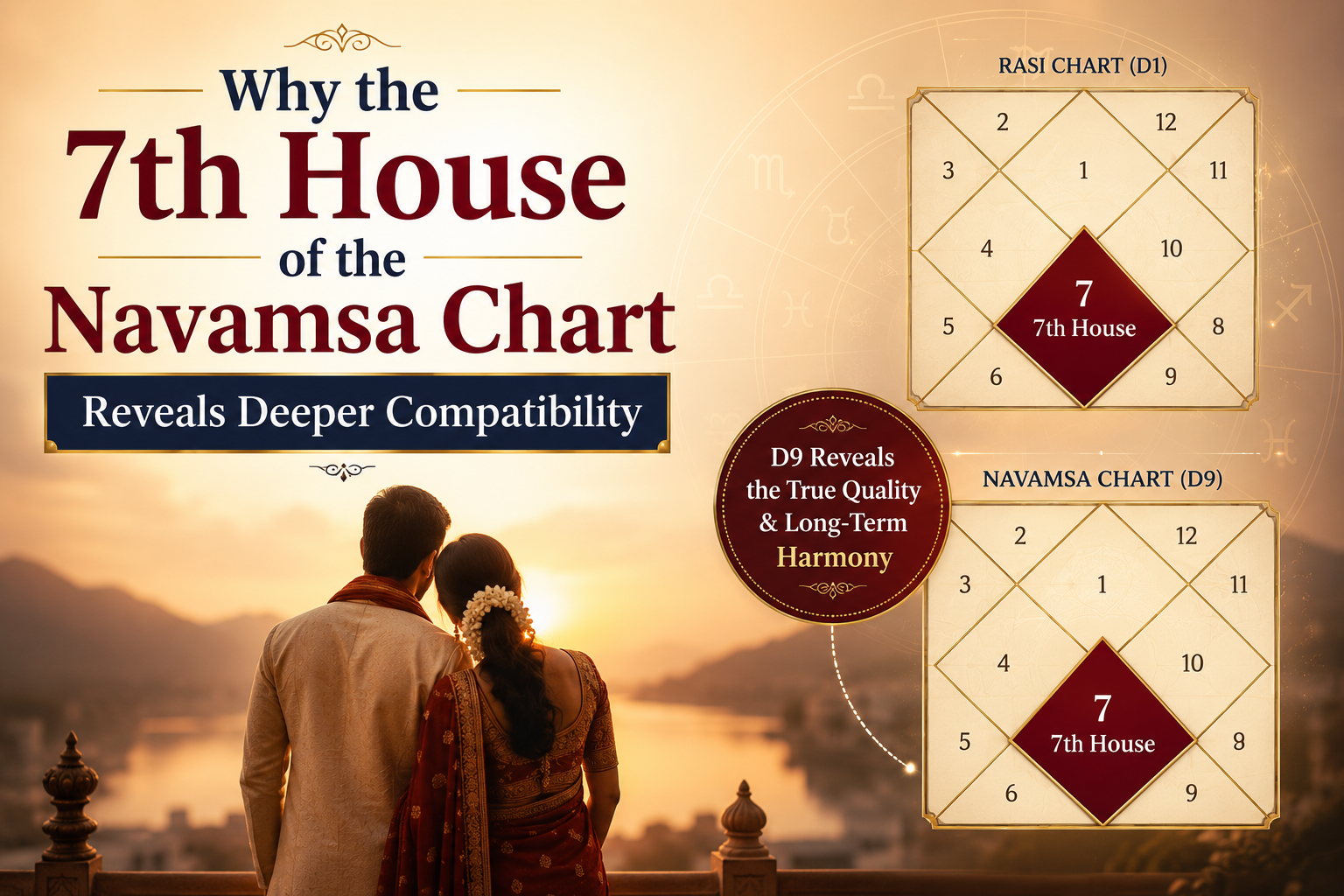
Why the 7th House of the Navamsa Chart Reveals Deeper Compatibility
Discover how the Navamsa 7th house, Venus placement, Vargottama, and D9 chart comparison reveal deeper marriage compatibility beyond Guna Milan.
Comments
Be the first to comment.