Why the 7th House of the Navamsa Chart Reveals Deeper Compatibility
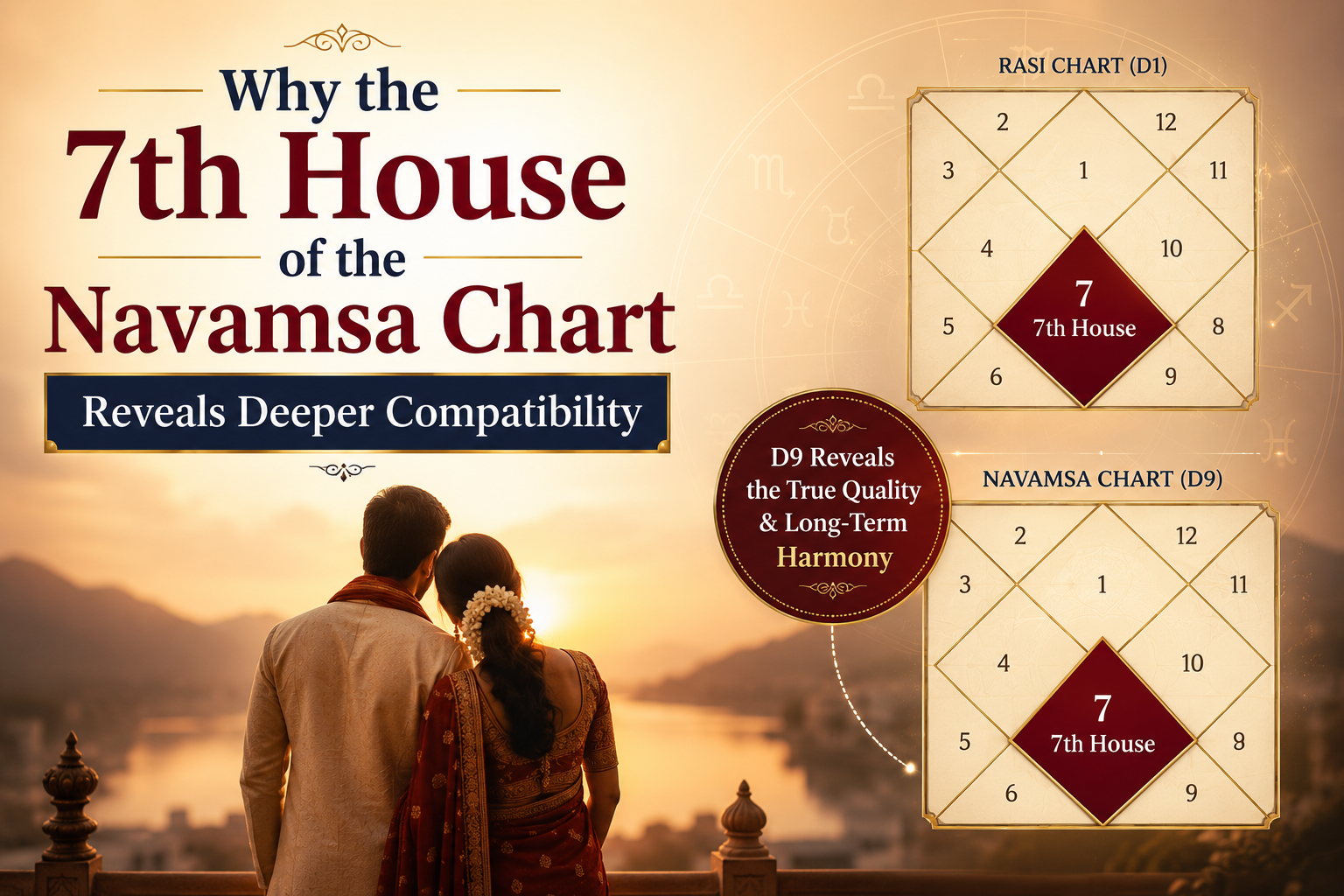
Table of contents
Most Kundali matching stops at the main birth chart. A more complete picture often requires the Navamsa, or D9 chart, particularly its 7th house, which reveals texture the main chart alone doesn't show.
Why Does the Navamsa's 7th House Matter as Much as the Main Chart's?
The Navamsa is generally considered the definitive chart for marriage specifically, revealing the actual quality, stability, and long-term outcome of a relationship, not just whether a marriage is likely to happen. The 7th house within this chart is treated with the same seriousness as the main chart's 7th house.
The 7th lord's position adds real specificity here. When it falls in a Kendra house (1st, 4th, 7th, 10th) of the Navamsa, this is generally associated with a stable, well-supported marriage. In a Trikona (1st, 5th, 9th), it's associated with fortune and genuine dharmic growth within the relationship. In a Dusthana (6th, 8th, 12th), it's associated with specific challenges tied to that particular house's themes.
The specific planet occupying the 7th house itself adds further detail. Jupiter here is generally considered one of the most favourable placements, associated with a wise, generous, dharma-oriented partner. Venus is associated with a romantic, comfort-loving connection with strong aesthetic and physical rapport. The Moon is associated with genuine emotional responsiveness and nurturing. Mars is associated with energy and passion, sometimes alongside more friction.
Why Does Venus's Navamsa Placement Add So Much Specific Detail?
Venus is the natural significator of marriage and romantic connection, so its condition in the Navamsa specifically refines what the 7th house more broadly suggests. A notable pattern worth knowing: even when Venus looks comparatively weak in the main chart, a strong Venus in the Navamsa is generally associated with a marriage that genuinely improves and deepens over time, rather than one destined to struggle throughout.
It's worth adding a real caveat here rather than treating a well-placed Navamsa Venus as an automatic guarantee. Venus in the 7th house of the Navamsa is considered favourable specifically when it isn't conjunct the 6th or 8th lord of that same chart, since this particular combination is associated with complicating the otherwise positive picture.
Why Does Comparing Both Partners' D9 Charts Reveal What Guna Milan Misses?
This is worth understanding clearly, since it explains a genuine limitation of standard matching. The 36-point Ashtakoot Guna Milan system is built entirely from the main chart's Moon position and Nakshatra, it never looks at the Navamsa at all. Comparing both partners' D9 7th houses together, their respective 7th lords' dignity, house placement, and any planets occupying that house, surfaces compatibility angles a Guna Milan score simply cannot see, since that system was never designed to examine this layer of the chart in the first place.
When Does the Navamsa Carry Extra Weight in the Assessment?
This matters most specifically when the main chart's marriage indications feel genuinely ambiguous, neither clearly strong nor clearly troubled. In these cases, a useful technique is directly comparing the main chart's 7th house with the Navamsa's 7th house. Genuine consistency between the two, similar signs or shared elements, suggests a marriage that delivers what its initial promise suggested. Significant divergence between them suggests a real gap between initial expectations and eventual lived experience.
A related concept, Vargottama, applies when a key marriage-relevant planet, the 7th lord or Venus specifically, occupies the exact same sign in both the main chart and the Navamsa. This is generally read as reinforcing whatever that placement already indicates. It's worth being precise about what this means though: Vargottama reinforces strength when the placement is genuinely strong, but it reinforces weakness just as readily when the placement is genuinely weak, a debilitated planet that's also Vargottama is still a difficult placement, not an automatically improved one.
The most balanced approach avoids two common errors: ignoring the Navamsa entirely, which misses this whole layer of quality information, and over-reading the Navamsa in complete isolation, drawing conclusions the main chart doesn't actually support. Both charts genuinely need to be read together.
When to Get a Professional Reading Instead of Checking Guna Milan Alone
Given how much genuine compatibility detail sits in the Navamsa specifically, a full reading is worth it if:
Your Guna Milan score feels inconclusive, or you want a fuller picture beyond the 36-point system
You want both partners' D9 7th houses compared directly, not just checked individually
You want to know whether a marriage-relevant planet is genuinely Vargottama, and whether that reinforces strength or weakness in your specific case
Myth vs. Reality
Myth: A strong Guna Milan score alone confirms good compatibility.
Reality: Guna Milan is built entirely from the main chart's Moon position. It doesn't examine the Navamsa at all, a genuinely separate layer of compatibility information.
Myth: A weak Venus in the main chart always means a difficult marriage.
Reality: A strong Venus in the Navamsa specifically is often associated with a relationship that genuinely improves over time, even when the main chart looked less promising.
Myth: Vargottama always strengthens a marriage indication.
Reality: It reinforces whatever the underlying placement already is, strength if the placement is strong, weakness just as readily if the placement is genuinely weak.
Why Check This on DoPuja
Because genuine compatibility assessment depends on comparing both partners' Navamsa 7th houses together, not just the main chart's Guna Milan score, accurate calculation matters considerably here.
UmasDoPuja's Kundali Matching uses the Swiss Ephemeris engine with NASA/JPL DE431 planetary data and correctly applied Lahiri Ayanamsa, calculating both the main chart and Navamsa precisely for both partners. For a full, personalised comparison of your specific D9 7th houses and Venus placements, Talk to Astrologer connects you with a real astrologer for that context.
Why Trust This
The Navamsa's role in marriage assessment, the 7th lord's house-based significations, and the Vargottama concept described here are consistently documented across multiple classical and current Vedic astrology sources. The caution against both ignoring and over-reading the Navamsa in isolation reflects a genuinely balanced approach rather than treating either chart as sufficient on its own.
Frequently Asked Questions
Is the Navamsa's 7th house really as important as the main chart's?
Yes, it's generally treated with the same seriousness, revealing the actual quality and long-term texture of a marriage rather than just whether one is likely.
Can a marriage improve over time even if the main chart looked difficult?
Yes, this is a recognised pattern, particularly when Venus is strong in the Navamsa even if it looked weaker in the main chart.
What does Guna Milan miss that the Navamsa can reveal?
Guna Milan is built entirely from the main chart's Moon position and never examines the Navamsa, so comparing both partners' D9 7th houses reveals a genuinely separate layer of compatibility detail.
What is Vargottama, and does it always help?
It's when a key marriage planet occupies the same sign in both the main chart and Navamsa. It reinforces the underlying placement, which means it strengthens a good placement but reinforces a weak one just as readily.
When does the Navamsa matter most in an assessment?
Particularly when the main chart's marriage indications feel genuinely ambiguous, comparing the two charts' 7th houses directly can help resolve that uncertainty.
Recommended articles
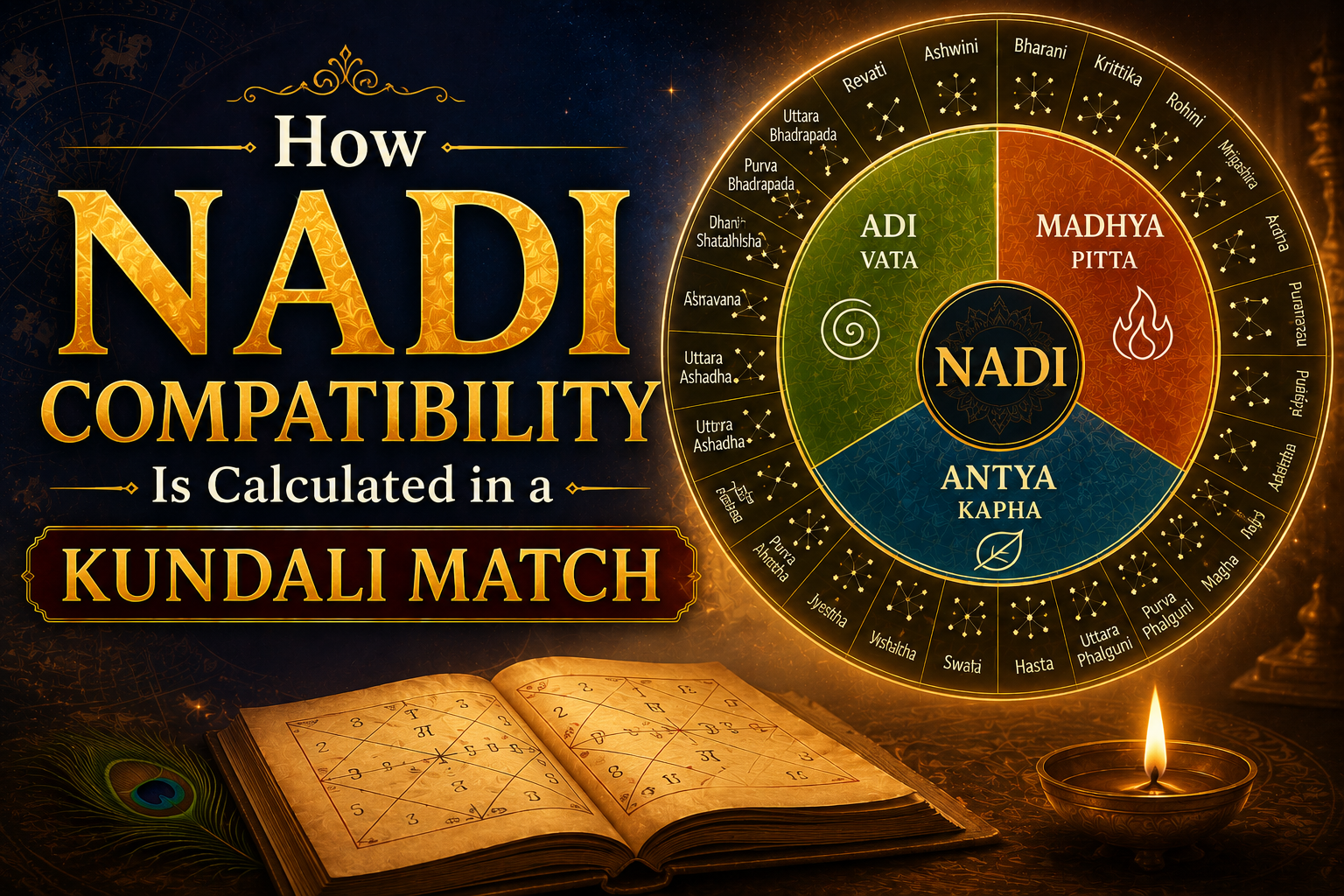
How Nadi Compatibility Is Calculated in a Kundali Match
Learn how Nadi compatibility is calculated in Kundali matching, from birth Nakshatra and Nadi groups to Nadi Dosha, Pada exceptions, and compatibility rules.

How Mars Placement Decides Manglik Compatibility Between Partners
Discover how Mars placement, house-sign combinations, cancellation rules, and Mars strength affect Manglik compatibility between partners in Vedic astrology.

Struggling With Delayed Marriage? What Mangal Dosha Really Means
Struggling with delayed marriage because of Mangal Dosha? Learn what being Manglik really means, cancellation factors, traditional remedies, and when to seek a full Kundali reading.
Comments
Be the first to comment.