How Nadi Compatibility Is Calculated in a Kundali Match
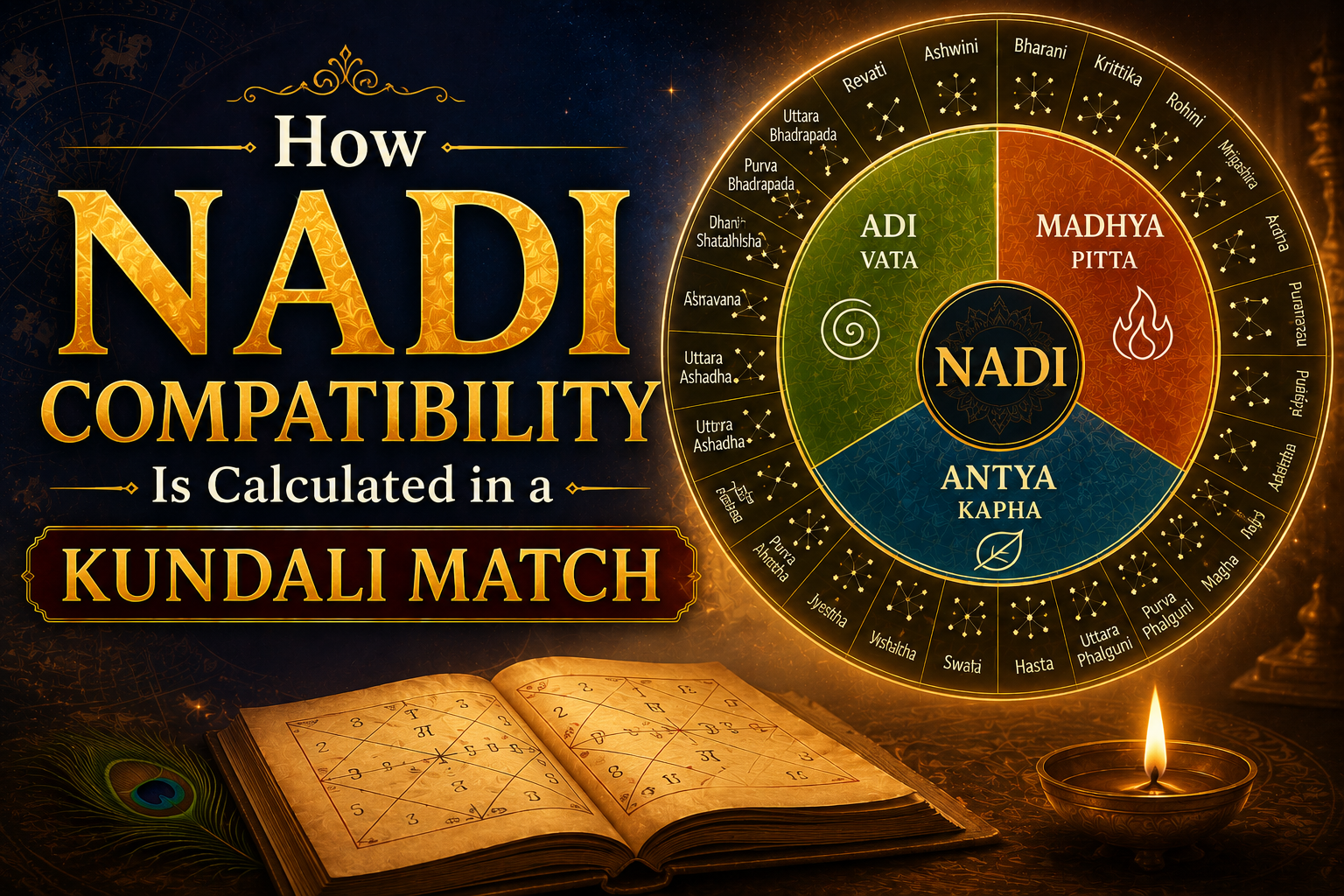
Table of contents
Nadi compatibility often gets summarised as "same star group, bad match," without explaining how that group is actually determined in the first place. Here's the calculation itself, step by step.
Step One: Find Each Partner's Birth Nakshatra
Everything starts with identifying which of the 27 Nakshatras the Moon occupied at each partner's exact moment of birth. This requires precise birth time and location, since the Moon shifts from one Nakshatra to the next roughly once a day, and a birth time that's off by even a modest margin can place the calculation in the wrong star entirely.
Step Two: Map That Nakshatra to a Nadi Group
Each of the 27 Nakshatras belongs to one of three Nadi groups, Adi, Madhya, or Antya, which map onto Ayurveda's three constitutional types, Vata, Pitta, and Kapha, respectively. This mapping is fixed, every Nakshatra has one assigned Nadi, so once the birth Nakshatra is confirmed, the Nadi group follows directly from it. For a deeper look at why this specific three-way grouping exists and what it's meant to represent, our dedicated article on the Ayurvedic reasoning behind Nadi Dosha covers that ground in full.
Step Three: Compare the Two Partners' Nadi Groups Directly
This is the core comparison. If both partners' birth Nakshatras map to the same Nadi group, Nadi Dosha is flagged. If they fall into different groups, no dosha applies at this stage, and Nadi scores its full 8 points, the highest weighting of any single Koota in the 36-point Ashtakoot system.
It's worth being clear about what triggers this specifically: it's the Nadi group that matters, not the exact Nakshatra itself. Two partners can have completely different Nakshatras and still share the same Nadi group, since each group contains nine of the 27 stars.
Can a Closer Look at Pada Change This Result?
Sometimes, and this is worth knowing before assuming a same-Nadi flag is final. If both partners happen to share the exact same Nakshatra, not just the same Nadi group, a further distinction becomes relevant: which of the four Padas, or quarters, within that Nakshatra each partner falls into. Several classical sources treat a same-Nakshatra match as cancelled specifically when the two partners' Padas differ.
This is a genuinely more detailed calculation than most basic matching tools perform, and it only applies in the specific case of a shared Nakshatra, not simply a shared Nadi group more broadly. Our dedicated piece on this exact pada-level exception goes into the full mechanics, including an important further condition that can override even this cancellation in certain cases.
Why Do Some Traditions Apply This Rule More Strictly Than Others?
The core Nadi comparison itself, same group triggers the dosha, is consistently applied across virtually all traditions. Where genuine variation exists is in how readily the more detailed cancellation conditions, including the Pada-level exception above, are accepted. Some astrologers treat these refinements as well-established and routinely apply them. Others read the core Nadi match more strictly and are more conservative about accepting cancellation, even when the specific conditions are technically met.
This is worth knowing if you've received different verdicts from different sources on what looks like the same underlying chart detail, it's often a genuine difference in how strictly a specific tradition applies these refinements, not a calculation error on either side.
When to Get a Professional Reading Instead of a Basic Match Check
Given how much depends on precise birth data and which refinements a specific astrologer applies, a full reading is worth it if:
You want your exact Nakshatra and Pada confirmed from accurate birth time and location, not an approximation
Both partners share the same Nakshatra, and you want to know whether the Pada-level cancellation genuinely applies to your specific case
You've received conflicting verdicts and want to understand which specific tradition or refinement is being applied
Myth vs. Reality
Myth: Nadi Dosha is triggered by having the same birth star.
Reality: It's triggered by sharing the same Nadi group, which contains nine different Nakshatras each, not by sharing the same star specifically.
Myth: The calculation is the same across every tradition.
Reality: The core comparison is consistent, but how strictly the more detailed cancellation conditions are applied genuinely varies by astrologer and tradition.
Myth: A same-Nakshatra match always means the dosha is fully active.
Reality: Several sources treat this as cancelled specifically when the partners' Padas differ, though this is a more detailed calculation most basic tools skip entirely.
Why Check This on DoPuja
Because this calculation depends on precise birth Nakshatra and Pada for both partners, not an approximation, accurate calculation matters considerably here.
UmasDoPuja's Kundali Matching uses the Swiss Ephemeris engine with NASA/JPL DE431 planetary data and correctly applied Lahiri Ayanamsa, calculating exact Nakshatra and Pada for both partners rather than an approximation. For a full, personalised walkthrough of your specific result, Talk to Astrologer connects you with a real astrologer for that context.
Why Trust This
The Nakshatra-to-Nadi mapping and the direct comparison method described here are consistently documented across classical and current Vedic astrology sources. The Pada-level refinement and the genuine variation in how strictly different traditions apply it are covered in more technical depth in our dedicated article on that specific exception.
Frequently Asked Questions
What's the first step in calculating Nadi compatibility?
Identifying each partner's exact birth Nakshatra from precise birth time and location, since this determines which Nadi group they fall into.
Does sharing the same birth star always mean the same Nadi group?
Sharing the same star always means the same Nadi group, but sharing the same Nadi group doesn't require the same star, since each group contains nine different Nakshatras.
Can this result ever be cancelled?
Yes, in the specific case where both partners share the same Nakshatra, a further look at which Pada each falls into can cancel the result, though this doesn't apply to a same-Nadi-group match more generally.
Why do different astrologers sometimes give different verdicts on the same chart?
Usually because they apply the more detailed cancellation conditions with different strictness, not because either calculation is incorrect.
Where can I read more about the Pada-level exception specifically?
Our dedicated article on that exact topic covers the full mechanics, including an important further condition that can override the cancellation in certain cases.
Recommended articles
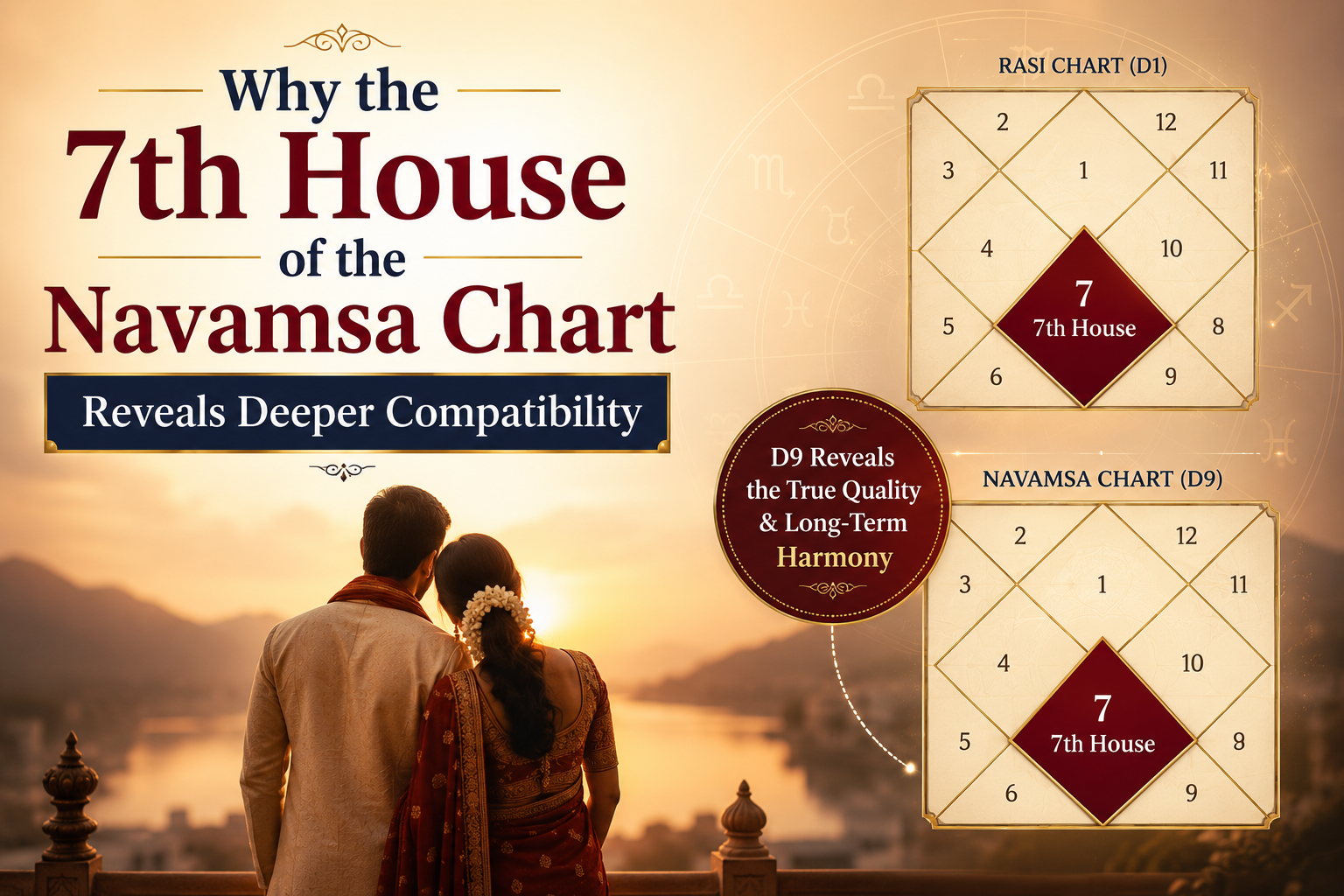
Why the 7th House of the Navamsa Chart Reveals Deeper Compatibility
Discover how the Navamsa 7th house, Venus placement, Vargottama, and D9 chart comparison reveal deeper marriage compatibility beyond Guna Milan.

How Mars Placement Decides Manglik Compatibility Between Partners
Discover how Mars placement, house-sign combinations, cancellation rules, and Mars strength affect Manglik compatibility between partners in Vedic astrology.

Moon Sign and Nakshatra: The Core of Ashtakoot Compatibility
Understand how Moon Sign and Nakshatra drive Ashtakoot compatibility, including Tara, Gana, Bhakoot, Nadi, scoring, doshas, and cancellation rules.
Comments
Be the first to comment.