
Nadi Dosha in Matching: Why Same Nadi Raises Health Concerns
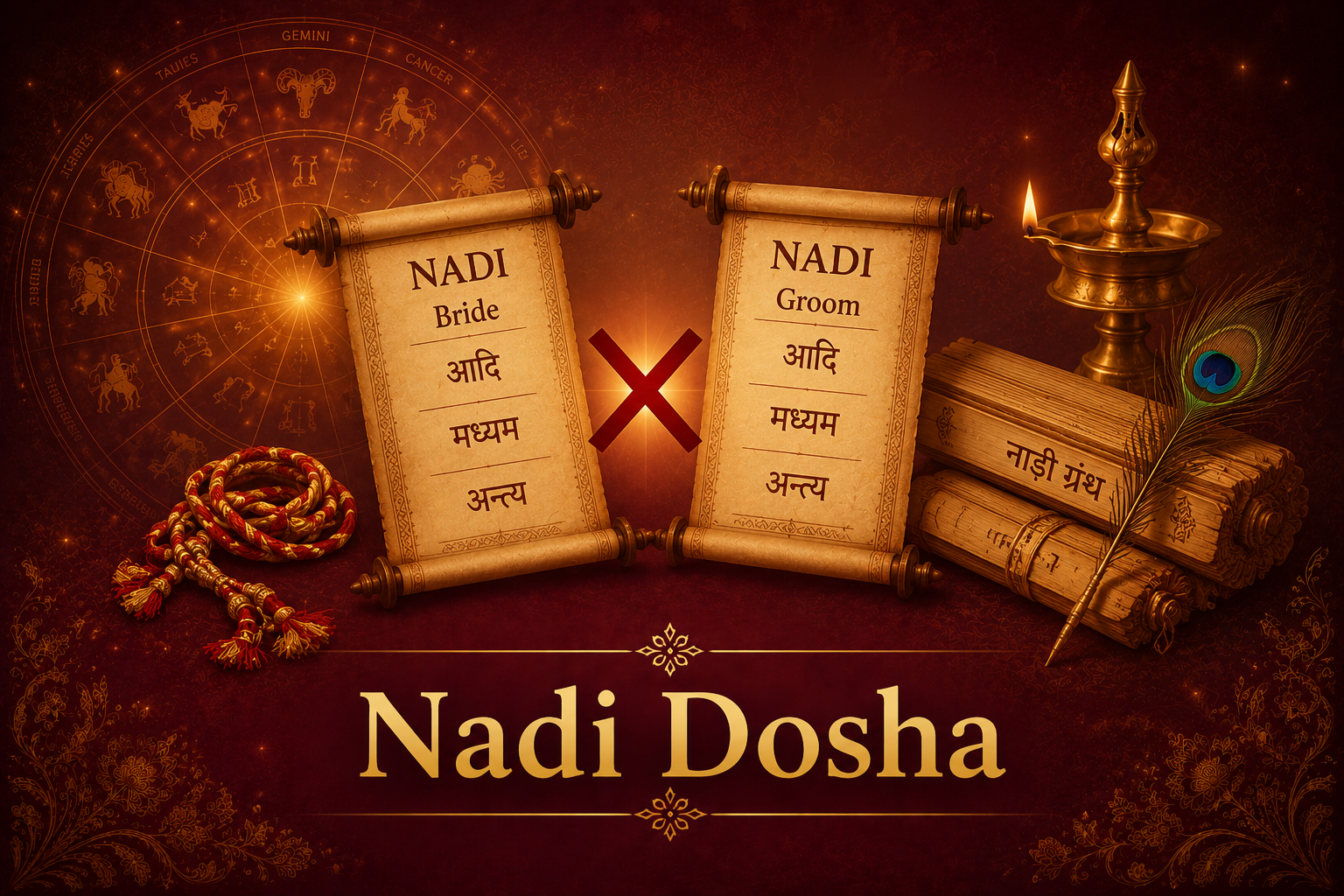
Table of contents
We've covered the mechanics of Nadi Dosha in detail elsewhere on this site, the three Nadi groups, the cancellation conditions, and the traditional remedies. This piece goes somewhere different.
It looks into the actual reasoning behind why classical astrology treats a shared Nadi as a health concern in the first place, and how that reasoning compares honestly to modern medical understanding.
What Are the Three Nadis in Ayurvedic Terms?
Nadi Dosha, evaluated during Kundali matching, checks whether both partners' birth Nakshatras fall into the same one of three groups. These three groups map directly onto the Tridosha framework at the foundation of Ayurveda, India's traditional medical system.
| Nadi | Ayurvedic Dosha | Element | Associated Qualities |
|---|---|---|---|
| Adi | Vata | Air and ether | Movement, activity, intellectual restlessness |
| Madhya | Pitta | Fire and water | Drive, intensity, metabolic heat |
| Antya | Kapha | Earth and water | Stability, groundedness, steady endurance |
In Ayurveda, these three doshas aren't just abstract categories. They're understood as the governing forces behind an individual's physical constitution, temperament, and susceptibility to particular health patterns.
Why Were Complementary Constitutions Considered Better Than Matching Ones?
This is the reasoning worth actually unpacking, since most quick explanations state the rule without explaining the logic behind it. Ayurveda treats a balanced combination of Vata, Pitta, and Kapha, rather than a dominance of just one, as the marker of a healthy constitution.
Classical astrologers applying this framework to marriage reasoned that two people sharing the same dominant Nadi were, in effect, sharing the same constitutional imbalance rather than offsetting each other. Two Vata-dominant individuals, for instance, might share similar vulnerabilities rather than one partner's steadier Kapha grounding the other's Vata restlessness.
A classical saying captures this concern vividly. Marriage between two people of the same Nadi was compared to "drawing water from a dry well," implying that a resource meant to support the household simply wasn't there to draw on.
It's genuinely important to state what this reasoning was, and wasn't, actually claiming. According to more careful classical interpretation, the concern was never that a same-Nadi marriage would fail as a relationship. The reasoning was specifically that genetic and physiological compatibility, particularly as it related to conceiving and raising healthy children, might be comparatively reduced between partners sharing a dominant constitution.
This is a narrower and more specific claim than "same Nadi means an unhappy marriage," which is how the concern often gets flattened in casual retelling.
Why Does Nadi Carry More Weight Than Any Other Koota?
Nadi's 8-point allocation in the 36-point Ashtakoot system isn't an arbitrary number. It reflects how seriously classical astrologers weighted concerns connected to progeny and physical health relative to the other seven Kootas, which cover things like temperament and general prosperity.
In a tradition where continuing the family line carried enormous social and spiritual significance, a factor specifically tied to reproductive and constitutional health was treated as more consequential than factors tied to personality or fortune.
This is also why Nadi Dosha, when it applies without cancellation, drops the entire 8-point allocation to zero rather than a partial deduction. The system treats it as an all-or-nothing concern, not a sliding scale.
How Does This Compare to Modern Medical Science?
Here's where this article wants to go further than a typical explainer. It's worth being genuinely honest about what Nadi Dosha is, and isn't, in relation to modern science.
Nadi Dosha is not a genetic test. It doesn't examine DNA, blood type, hereditary conditions, or any of the specific mechanisms modern genetics uses to assess reproductive health risk between two people. It's a symbolic classification system based on which of 27 birth Nakshatras the Moon occupied at each partner's birth, mapped onto a three-category Ayurvedic framework that predates modern genetics by many centuries.
That said, a genuine, active field of contemporary research called Ayurgenomics does exist, exploring whether Ayurvedic constitutional categories correlate with measurable genomic and molecular patterns. This is real, ongoing academic research, not settled science, and it should not be read as validating Nadi Dosha specifically as a form of genetic compatibility screening.
The honest position is that Ayurveda's constitutional framework and modern genetics are exploring related territory, individual biological variation, through very different methodologies. Treating one as a stand-in for the other overstates what either can currently claim.
What Does a Nadi Dosha Flag Actually Mean in Practice?
If a matching report flags Nadi Dosha, the traditional concern it's pointing to is specifically about constitutional and progeny-related compatibility, filtered through a symbolic, centuries-old framework. It's not a clinical assessment of your specific genetic risk as a couple.
Real concerns about hereditary conditions, blood compatibility, or reproductive health are questions for a genuine medical consultation, a doctor or genetic counsellor, not an astrological reading, however seriously that reading is taken as cultural or spiritual guidance.
For the practical mechanics, how to check your own Nadi, the specific cancellation conditions, and the traditional remedies available, our dedicated Nadi Dosha article covers that ground in full detail.
Why Check This on DoPuja
Nadi Dosha depends entirely on precise birth Nakshatra identification, calculated from exact birth time and location.
UmasDoPuja's Kundali Matching uses the Swiss Ephemeris engine with NASA/JPL DE431 planetary data and correctly applied Lahiri Ayanamsa to fix this accurately for both partners, rather than relying on an approximate birth time.
For a fuller conversation about what a Nadi Dosha flag means for your specific match, alongside genuine medical guidance where relevant, Talk to Astrologer connects you with a real astrologer for that context.
Why Trust This
The Ayurvedic Tridosha framework and its application to Nadi matching are consistently documented across classical Jyotish sources and Ayurvedic literature alike.
The distinction we've drawn between this traditional framework and modern genetic science reflects an honest, current understanding of both fields, including the genuine but still-developing research area of Ayurgenomics, rather than either dismissing the tradition or overstating its scientific standing.
Frequently Asked Questions
Is Nadi Dosha the same as a genetic compatibility test?
No. It's a symbolic classification based on birth Nakshatra, rooted in Ayurvedic constitutional theory, not a clinical or genetic assessment of reproductive health risk.
Why is progeny health specifically the traditional concern, rather than general happiness?
The reasoning traces to Ayurveda's view that a balanced combination of Vata, Pitta, and Kapha supports health, while two people sharing the same dominant constitution were thought to share vulnerabilities rather than balance them.
Does modern science support the idea that same-Nadi couples have worse outcomes?
There's no direct scientific validation of Nadi Dosha specifically. A related research field, Ayurgenomics, explores connections between Ayurvedic constitution and genomics, but this is ongoing academic research, not confirmation of the matching system itself.
Should I get genetic counselling instead of relying on a Nadi Dosha reading?
If you have genuine concerns about hereditary conditions or reproductive health, yes, a qualified doctor or genetic counsellor is the appropriate resource.
Where can I find the cancellation rules and remedies for Nadi Dosha?
Our dedicated Nadi Dosha article covers the specific cancellation conditions, how to check your own status, and traditional remedies in full detail.
Recommended articles
Ashtakoot Guna Milan The 36-Point System Behind Kundali Matching
Learn how Ashtakoot Guna Milan's 36-point Kundali matching system works, the eight kootas, Nadi and Bhakoot importance, Manglik Dosha, and score interpretation.
Nadi Dosha in Kundali Matching: What It Means for Married Life.
Learn what Nadi Dosha is in Kundali matching, how it is calculated from Nakshatras, its effects on marriage, cancellation rules, remedies, and why a full horoscope analysis matters.
Manglik Dosha Explained: Causes, Effects and Why It Matters in Your Kundali
Learn what Manglik Dosha is, how it forms, its impact on marriage, cancellation rules, common myths, and how to accurately check it in your Kundali.
Comments
Be the first to comment.