Sun, Moon, Rahu and Ketu: How Grahan Dosha Actually Forms in a Kundali
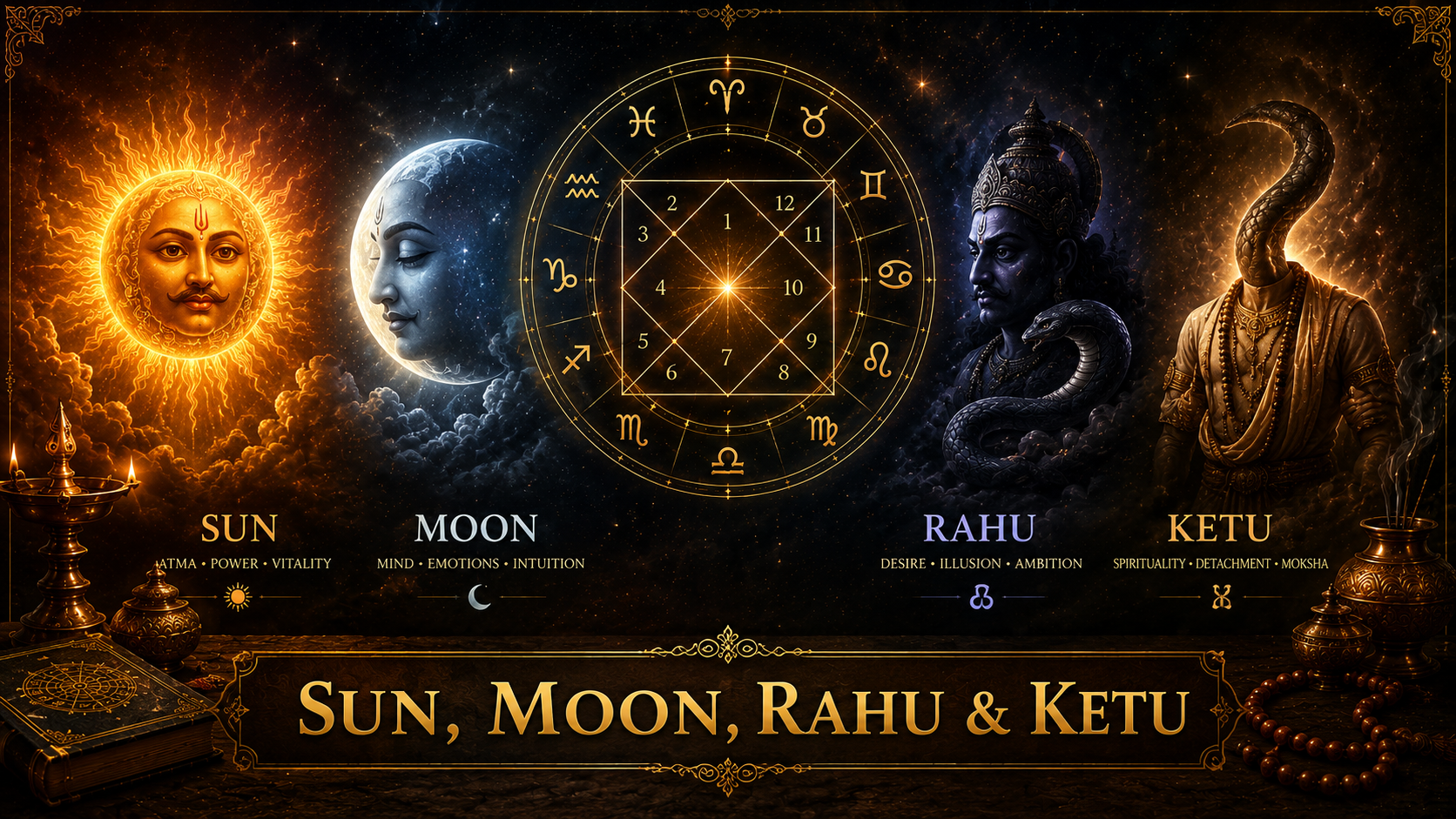
Table of contents
Grahan Dosha forms when the Sun or Moon sits within a close degree range of Rahu or Ketu, with tighter conjunctions (roughly under 5 degrees) considered more intense than wider ones (up to around 10 to 12 degrees). Which life area it affects depends heavily on which house the conjunction falls in, some houses (like the 5th or 9th) can even lean constructive rather than difficult. Rahu and Ketu conjunctions are classically read somewhat differently. A supportive Jupiter aspect can meaningfully soften the whole picture.
We've covered the broader meaning of Grahan Dosha elsewhere on this site, the eclipse symbolism, the four basic type combinations, and the important distinction between having this conjunction and literally being born during an eclipse. This piece goes into the more technical detail behind how astrologers actually confirm and read this dosha in practice.
How Close Does the Conjunction Actually Need to Be?
This is the detail most casual explanations skip. Grahan Dosha isn't a simple yes-or-no based on the Sun or Moon merely sharing a house with Rahu or Ketu, the exact degree separation matters considerably.
Sources vary somewhat on the precise cutoff, which is worth being upfront about rather than presenting one number as universally agreed. Several detailed sources describe a conjunction within roughly 5 degrees as producing a particularly intense, more complete expression of the affliction, while separations extending out toward 10 to 12 degrees are generally described as retaining the underlying theme but with more of the planet's natural expression still intact. Beyond that wider range, most sources treat the conjunction as too loose to meaningfully qualify.
In practice, this means two charts technically flagged as having "the same dosha" by a basic same-house check can carry meaningfully different intensity depending on the exact degree separation, which is exactly the kind of detail a generic list-based check tends to miss.
Does This Only Apply to the Sun and Moon?
Classical treatment focuses primarily on the Sun and Moon, since these are the two luminaries an eclipse metaphor most directly applies to. It's worth knowing, though, that some more detailed frameworks extend the same basic logic, a classical planet in close degree proximity to Rahu or Ketu, to the other five classical planets as well, each affecting that planet's own significations rather than the Sun's or Moon's specifically. The Sun and Moon versions remain the most commonly discussed and the ones this piece focuses on.
How Does House Placement Change What's Actually Affected?
This is where the conjunction's real-world impact gets far more specific than a generic description can capture. A few house placements are worth knowing about directly.
1st house. Since this house represents the self and general identity, a conjunction here is more commonly associated with identity-related confusion or head-related health themes.
2nd house. Associated with finances, and here the specific outcome is described as depending heavily on supporting aspects, favourable influences are linked to genuine gains and additional income sources, while difficult aspects lean toward financial loss or failed ventures.
5th house. Associated with creativity, intelligence, and children. Interestingly, several sources describe this specific placement as leaning toward strong intuition and spiritual inclination rather than straightforward difficulty, a genuine exception to the more troubling reputation this dosha usually carries.
7th house. Associated with partnership, and a conjunction here is more commonly linked to relationship instability or friction within marriage specifically.
9th house. Associated with higher knowledge, fortune, and one's father. Similar to the 5th house, this placement is often described favourably, linked to strong intuition and a genuine pull toward higher learning or philosophical depth.
12th house. Associated with loss and withdrawal, this placement is more commonly linked to financial drain or a pull toward isolation.
The pattern worth noticing here: this dosha isn't uniformly negative across every house. The 5th and 9th house versions in particular are frequently described in more constructive terms than the reputation around this dosha generally suggests.
Does It Matter Whether It's Rahu or Ketu Specifically?
Yes, and this connects to the four-type classification covered in more depth in our main Grahan Dosha article: Purna Surya Grahan Dosh (Sun-Rahu), Surya-Ketu Dosh (Sun-Ketu), Purna Chandra Grahan Dosh (Moon-Rahu), and Chandra-Ketu Dosh (Moon-Ketu). Broadly, Rahu-based combinations tend to be associated with amplified desire, obsession, and unconventional drive, while Ketu-based combinations tend to lean more toward detachment, confusion, or a pull away from the material significations of the luminary involved. The specific texture differs meaningfully between the two, even when the house placement is identical.
Can a Supportive Jupiter Actually Soften This?
Yes, and this is a genuinely well-documented cancellation factor worth knowing specifically. Jupiter aspecting the Sun-Rahu or Moon-Rahu conjunction, through its classical 5th, 7th, or 9th house aspects, or sitting in direct conjunction with either involved planet, is considered to meaningfully moderate the affliction. Jupiter's wisdom and clarity are traditionally described as helping the individual see through Rahu's illusions rather than being fully absorbed by them.
Sign dignity matters here too. A Sun placed in Aries (exalted) or Leo (its own sign) is generally considered more resistant to Rahu's clouding effect than the same conjunction occurring with the Sun in a weaker sign, even at an identical degree separation.
When to Get a Professional Reading Instead of a Same-House Check
Given how much the real severity depends on exact degree separation, house placement, and Jupiter's involvement, a full reading is worth it if:
You've been told you have Grahan Dosha based on a basic same-house flag and want the actual degree separation confirmed
Your conjunction falls in the 5th or 9th house, and you want to know whether the more constructive expression genuinely applies to your chart
You want to check whether a supportive Jupiter aspect is already softening the affliction in your specific case
Myth vs. Reality
Myth: Sharing a house with Rahu or Ketu is enough to confirm Grahan Dosha at full strength.
Reality: The exact degree separation matters considerably, a tight conjunction under roughly 5 degrees is generally read as far more intense than a wider one nearer 10 to 12 degrees.
Myth: This dosha is uniformly difficult regardless of house placement.
Reality: Several house placements, particularly the 5th and 9th, are frequently described in more constructive terms, linked to intuition and higher learning rather than straightforward hardship.
Myth: A Rahu conjunction and a Ketu conjunction produce the same effect.
Reality: They're classically read with a meaningfully different texture, Rahu leaning toward amplified desire and obsession, Ketu leaning toward detachment and confusion.
Why Check This on DoPuja
Because this dosha's real severity depends on exact degree separation, precise house placement, and whether Jupiter is genuinely aspecting the conjunction, not just a same-house flag, accurate calculation matters considerably here.
UmasDoPuja's Kundali tool uses the Swiss Ephemeris engine with NASA/JPL DE431 planetary data and correctly applied Lahiri Ayanamsa, calculating the exact degree separation and checking Jupiter's aspect precisely rather than a rough same-house approximation. For a full, personalised reading on your specific house placement and its likely expression, Talk to Astrologer connects you with a real astrologer for that context.
Why Trust This
The orb-based intensity framework, the house-by-house effects, and Jupiter's specific 5th, 7th, and 9th house aspects as a softening factor are documented across multiple independent Vedic astrology sources. Where sources cite somewhat different exact degree cutoffs for what counts as a close versus wide conjunction, we've presented this as a genuine range rather than asserting one number as universally settled.
Frequently Asked Questions
How close does the conjunction need to be to count as Grahan Dosha?
Sources vary, but a separation under roughly 5 degrees is generally considered particularly intense, while separations extending toward 10 to 12 degrees are considered to retain the theme with more natural expression intact.
Does house placement really change whether this dosha is negative?
Yes, significantly. The 5th and 9th house versions in particular are often described in more constructive terms, linked to intuition and higher learning, rather than the difficulty this dosha is generally associated with.
Is a Rahu conjunction worse than a Ketu conjunction?
Not necessarily worse, but genuinely different in texture, Rahu leans toward amplified desire and obsession, Ketu leans toward detachment and confusion.
Can this dosha apply to planets other than the Sun and Moon?
Some more detailed frameworks extend the same logic to other classical planets, though the Sun and Moon versions remain the most commonly discussed.
Does Jupiter's aspect really help?
Yes, this is a well-documented factor. Jupiter aspecting the conjunction through its 5th, 7th, or 9th house aspects, or conjoining either involved planet, is considered to meaningfully soften the affliction.
Recommended articles

Feeling Stuck for Years? You Might Be in Sade Sati
Feeling stuck in career, finances, or energy? Learn what Sade Sati means, its three phases, Dasha's role, traditional remedies, and when it ends.

Why Does Nothing Seem to Work Out? Understanding Kaal Sarp Dosha
Wondering why repeated setbacks keep happening? Understand Kaal Sarp Dosha, its effects, Rahu-Ketu periods, traditional remedies, and what your Kundali reveals.

Struggling With Delayed Marriage? What Mangal Dosha Really Means
Struggling with delayed marriage because of Mangal Dosha? Learn what being Manglik really means, cancellation factors, traditional remedies, and when to seek a full Kundali reading.
Comments
Be the first to comment.