Why Astronomical Accuracy Actually Matters for Your Birth Chart
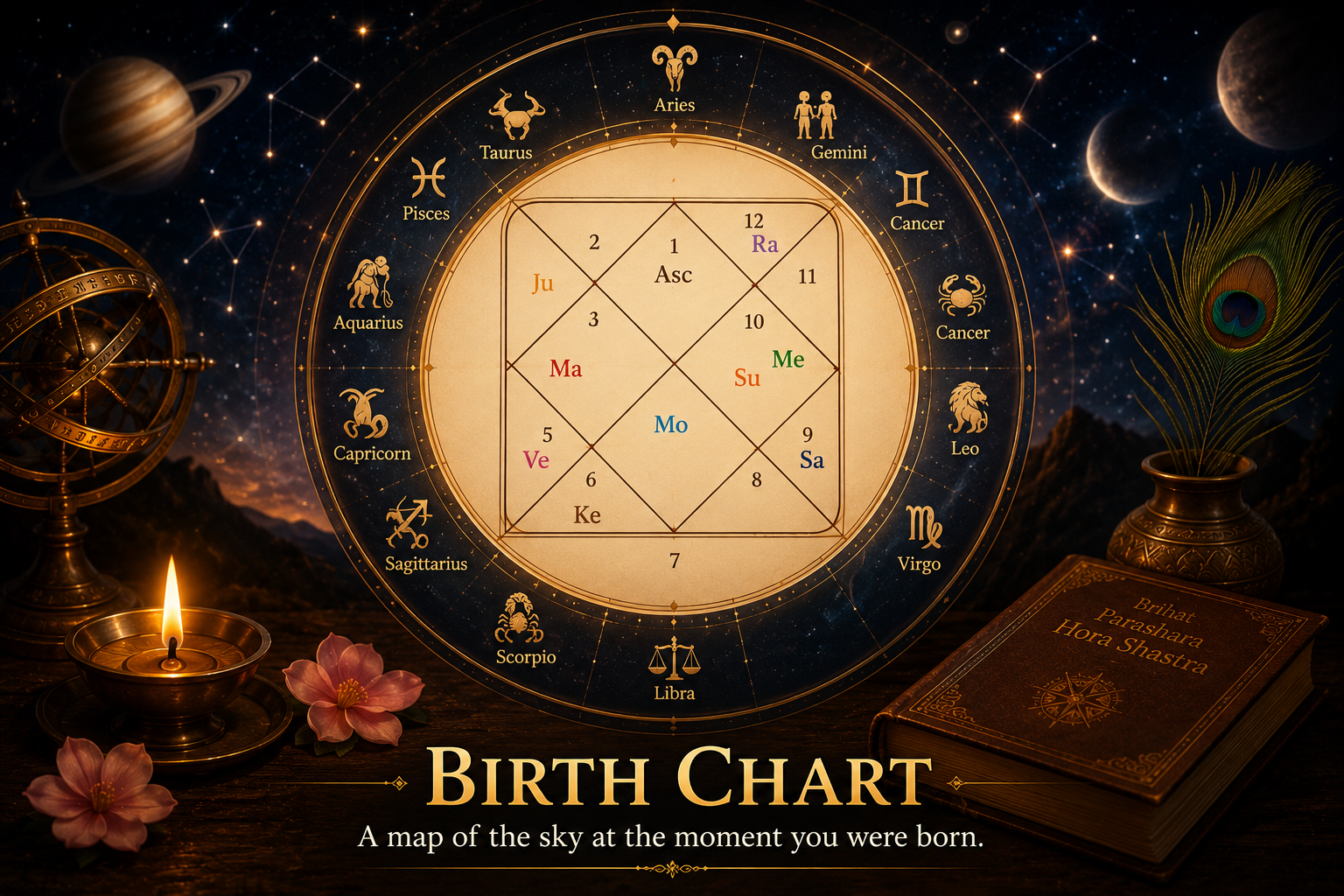
Table of contents
A birth chart is only as reliable as the underlying planetary data. The Swiss Ephemeris, built on NASA/JPL's DE431 planetary model, provides sub-arcsecond accuracy for celestial positions, the same category of data used in space navigation. Beyond raw accuracy, two other factors explain why the same birth details can produce different-looking charts on different platforms: the house system used, and which Ayanamsa (for Vedic charts) is applied.
For centuries, calculating planetary positions meant manual almanacks and hand-computed tables. Modern astronomical data has changed that entirely, but it's worth understanding what "accurate" actually means in this context, since not all platforms are working from the same underlying standard.
Here's what genuinely determines chart accuracy, and why two sites can show different results from the same birth details.
What Is the Swiss Ephemeris, and Why Does It Matter?
At the centre of professional-grade chart calculation is the Swiss Ephemeris, developed by Astrodienst. It's widely regarded as the gold standard for astronomical calculation in astrology software, providing sub-arcsecond accuracy for celestial positions.
It's worth being precise about what this tool actually does: it doesn't predict anything. It calculates exactly where the Sun, Moon, and planets were positioned in the sky at a specific moment and location, a purely astronomical calculation, with the astrological interpretation of that data being an entirely separate step.
The Swiss Ephemeris handles the full range of bodies relevant to a chart, the Sun, Moon, and major planets, along with additional points some traditions include, such as specific asteroids or calculated sensitive points. It supports both Western Tropical astrology and Sidereal systems, including the Lahiri and Raman Ayanamsas used in Vedic astrology.
Where Does the Underlying Planetary Data Come From?
The Swiss Ephemeris itself is powered by the Development Ephemeris (DE431), produced by NASA's Jet Propulsion Laboratory. This is a rigorous numerical model of planetary motion covering a span of roughly 30,000 years, not a speculative or approximate dataset.
It's worth being clear about what this connection does and doesn't mean: this data is public and used as a reliable astronomical reference point, but there's no formal endorsement or partnership between astrology platforms and NASA or JPL. The relationship is simply that this happens to be the most accurate publicly available model of planetary motion, which is why serious astrology calculation tools build on it.
Why Do I Get a Different Chart on Different Websites?
This is worth explaining directly, since it's a genuinely common source of confusion. Two platforms can use identical birth details and still produce visibly different charts, usually for one of two reasons.
House System
Different systems (Whole Sign, Placidus, and others) divide the same chart into houses differently, which shifts where planets appear to fall relative to house boundaries. Vedic astrology most commonly uses Whole Sign.
Ayanamsa
For Sidereal, Vedic-style charts specifically, different Ayanamsas (Lahiri being the most widely used, alongside others like Raman) apply a different correction for the gradual shift between the tropical and sidereal zodiacs. Using a different Ayanamsa shifts every planetary position by a small but meaningful amount, enough to change house placements near a boundary.
If your chart looks different from one platform to another, checking which house system and Ayanamsa each one uses is usually the explanation, not an error in either calculation.
Why Birth Time and Location Precision Still Matter Most
Regardless of which house system or Ayanamsa a platform uses, none of it compensates for imprecise birth data. Even a few minutes' difference in recorded birth time can shift the Ascendant enough to change house placements, and the exact latitude and longitude of the birth location directly affect the calculation of the local horizon at that moment. A tool using the best available ephemeris data still produces an imprecise chart if the underlying birth details themselves are approximate.
Myth vs. Reality
Myth: All astrology platforms calculate planetary positions the same way.
Reality: The underlying astronomical calculation can be equally precise across platforms, but house system and Ayanamsa choices genuinely differ, which is why the same birth details can produce visibly different-looking charts.
Myth: A more "accurate" chart means a more accurate prediction.
Reality: Astronomical accuracy determines whether the planetary positions themselves are correct. Interpretation of what those positions mean is a separate, and inherently more subjective, layer.
Myth: Using NASA/JPL data means a platform is endorsed by NASA.
Reality: The Development Ephemeris is public data used as a reliable astronomical reference. There's no formal partnership or endorsement involved; it's simply the most accurate available model.
Why Check This on DoPuja
Because house system and Ayanamsa choices, alongside birth time and location precision, genuinely shape the final chart, it's worth using a tool that's transparent about all of these.
UmasDoPuja's Kundali tool uses the Swiss Ephemeris engine with NASA/JPL DE431 planetary data and correctly applied Lahiri Ayanamsa, the standard used across mainstream Vedic astrology. For a deeper conversation about how your specific chart was calculated, or to help confirm an uncertain birth time, Talk to Astrologer connects you with a real astrologer for that context.
Why Trust This
The Swiss Ephemeris's role as an industry-standard calculation tool, and its basis in NASA/JPL's DE431 planetary model, are well-documented and independently verifiable facts about the underlying astronomical data, not claims specific to any single platform. The house-system and Ayanamsa explanation for cross-platform chart differences reflects how these calculations genuinely work, a common and legitimate source of confusion worth addressing directly.
Frequently Asked Questions
Does using NASA data mean a platform is officially connected to NASA?
No. The Development Ephemeris is public astronomical data used as an accurate reference point. There's no formal partnership or endorsement involved.
Why does my chart look different on two different astrology websites?
Usually because of different house systems or Ayanamsa choices, not because one calculation is wrong. Check which each platform uses before assuming an error.
Does a more accurate ephemeris guarantee a more accurate reading?
It guarantees accurate planetary positions. The interpretation of those positions is a separate step, and its quality depends on the astrologer or system doing the interpreting.
How much does birth time actually matter for accuracy?
Significantly. Even a few minutes' difference can shift the Ascendant and change house placements, regardless of how precise the underlying ephemeris data is.
What's the difference between Tropical and Sidereal astrology?
Tropical astrology, more common in the West, is based on the seasons. Sidereal astrology, used in Vedic astrology, is based on the actual fixed positions of constellations, requiring an Ayanamsa correction to translate between the two systems.
Recommended articles
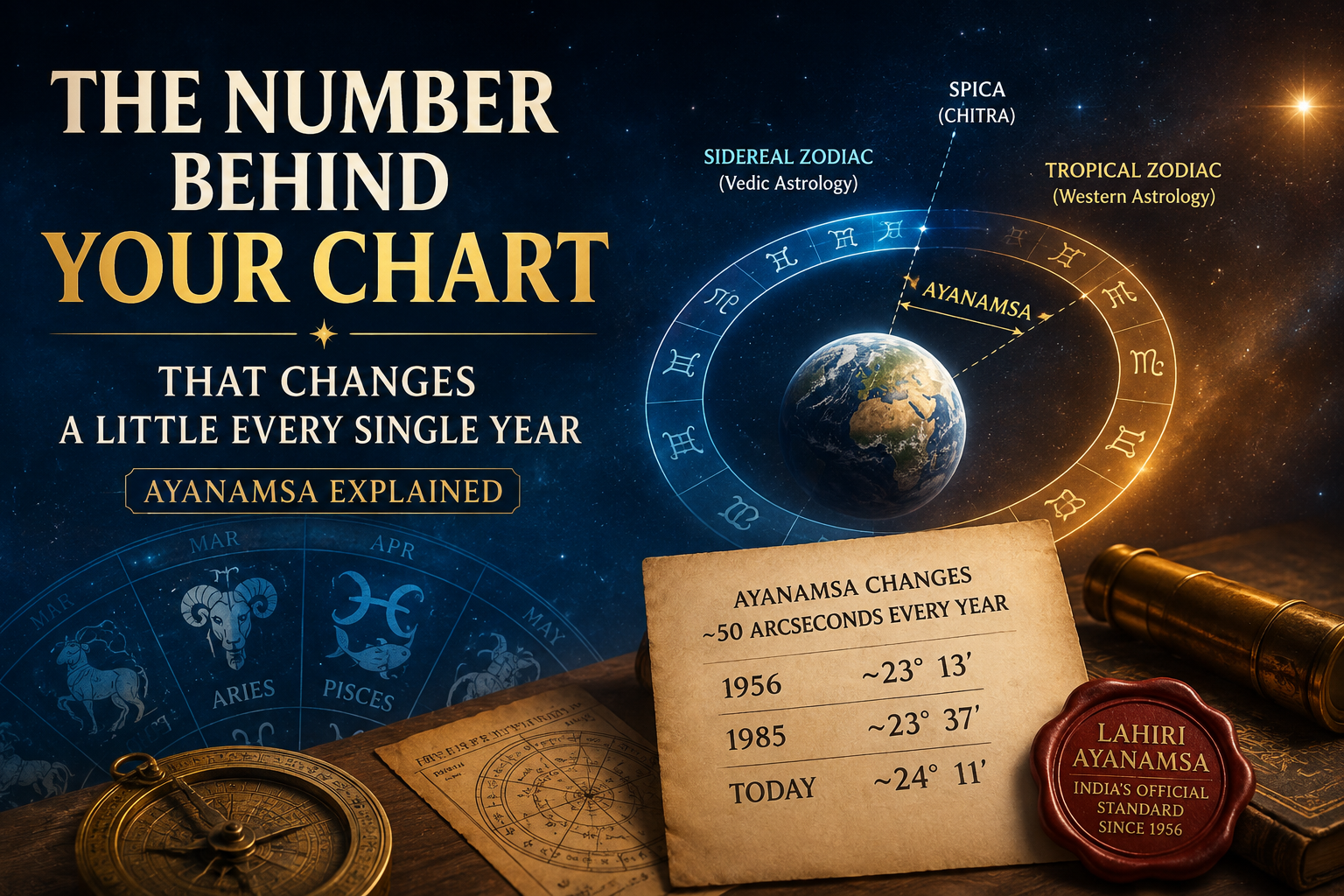
The Number Behind Your Chart That Changes a Little Every Single Year
Discover why Ayanamsa changes every year, how Lahiri Ayanamsa became the Vedic astrology standard, and why its precise value matters for accurate Kundali calculations.

Why Does Nothing Seem to Work Out? Understanding Kaal Sarp Dosha
Wondering why repeated setbacks keep happening? Understand Kaal Sarp Dosha, its effects, Rahu-Ketu periods, traditional remedies, and what your Kundali reveals.

Why the Same Daily Horoscope Can Feel Completely Different Two Months Apart
Discover why the same daily Rashifal can feel different at different times. Learn how Moon transits, Jupiter, Saturn, Gochar Samyukti and Dasha shape daily predictions.
Comments
Be the first to comment.