Why Your Birth Chart Report Actually Contains Several Charts, Not Just One
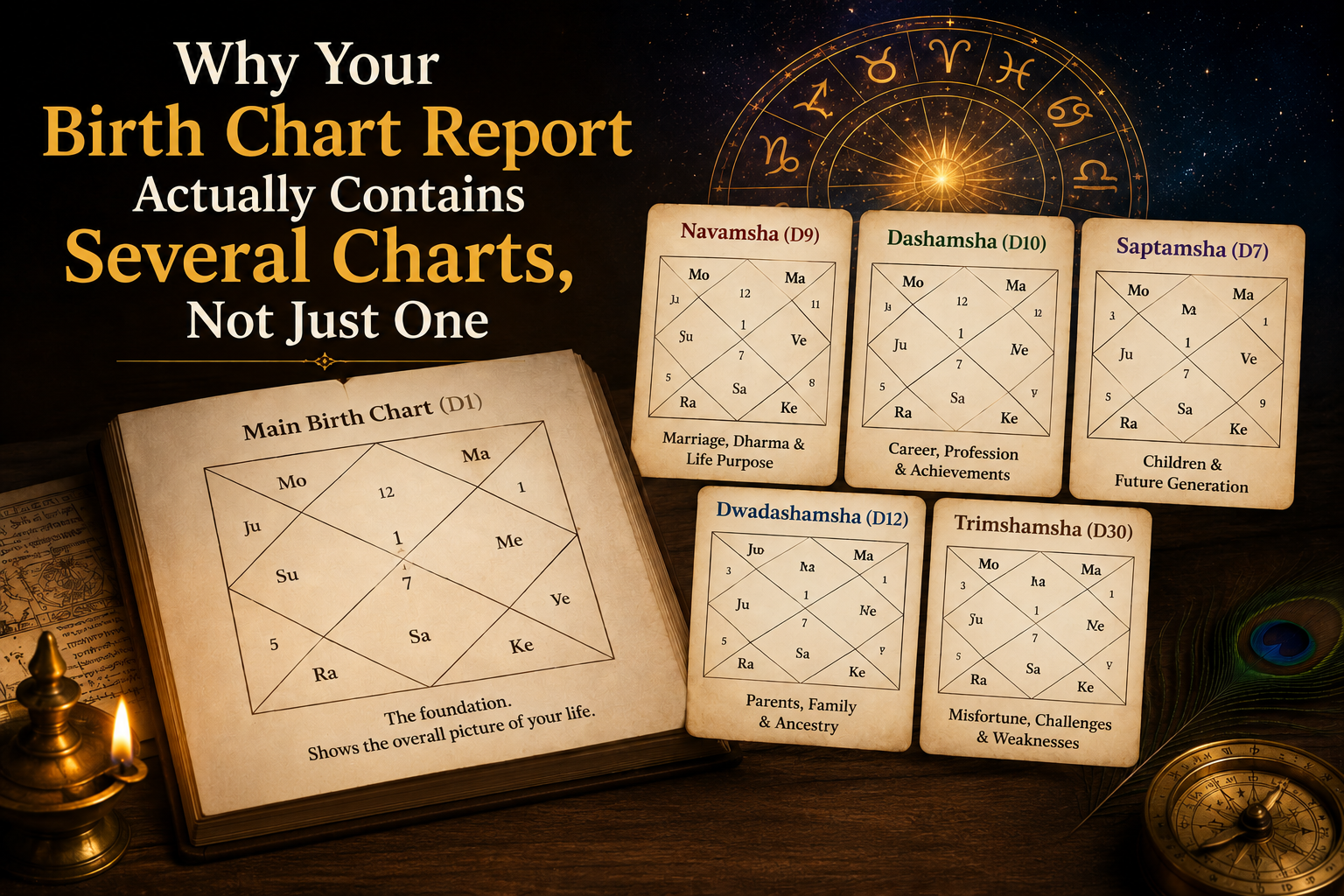
Table of contents
Open a genuinely detailed Kundali report, and you'll usually find more than one chart. This isn't padding, each additional chart answers a specific question the main chart alone can't answer with the same precision.
What Are These Additional Charts, in Simple Terms?
Your main birth chart, sometimes called D1, gives the overall shape of your life. Divisional charts take that same chart and divide it further to zoom into one specific area with much more precision. Classical texts describe 16 of these divisional charts in total, though most detailed modern readings work with a smaller, practical set of five or six.
The most commonly used ones are the Navamsha, focused on marriage and life purpose, the Dashamsha, focused on career, the Saptamsha, focused on children, the Dwadashamsha, focused on parents and family lineage, and the Trimshamsha, focused on general misfortune and challenges.
Which One Matters Most, and Why?
The Navamsha is considered the single most important divisional chart after the main birth chart itself, treated as almost equally significant for a complete reading. It's checked in virtually every detailed session, since it reveals marriage quality and the general trajectory of the second half of life in a way the main chart alone can only hint at.
Do These Extra Charts Reveal Completely New Information?
This is the single most common misunderstanding worth correcting directly. A divisional chart does not create a result independently of the main chart. If the main chart shows no real indication for a specific life area, the corresponding divisional chart cannot manufacture one out of nothing. Instead, these charts confirm, refine, or occasionally soften what the main chart already suggests.
A planet that looks genuinely promising in the main chart but turns out weak in the relevant divisional chart tends to deliver more muted results in that specific area than the main chart alone would suggest. There's also a specific term worth knowing, Vargottama, describing a planet that occupies the exact same sign in both the main chart and a divisional chart, generally considered a sign of exceptional stability and reliability for whatever that planet represents.
Does a Promising Divisional Chart Guarantee Results Will Actually Show Up?
Not on its own. Even a genuinely strong, favourable divisional chart stays largely theoretical until the matching Dasha period, the relevant planetary period, is actually running. A beautiful career-focused divisional chart with no supportive Dasha behind it describes real potential, but potential that hasn't yet found its moment to activate.
When to Get a Professional Reading Instead of a Basic Report Alone
Given how much a complete picture depends on reading these charts together rather than any single one alone, a full reading is worth it if:
You want to know whether a specific area of concern, marriage, career, or children, shows genuine support across both your main chart and the relevant divisional chart
You've seen a promising indication somewhere and want to know whether your current Dasha actually supports it showing up now
You want your planets checked for Vargottama, since this specific detail adds real confidence to an otherwise uncertain reading
Myth vs. Reality
Myth: A divisional chart can show something completely absent from the main chart.
Reality: These charts refine and confirm what the main chart already indicates. If the main chart shows nothing for a given area, the divisional chart can't manufacture a result independently.
Myth: Checking just the main chart is enough for a complete reading.
Reality: The Navamsha specifically is treated as almost equally important as the main chart, particularly for marriage and long-term life direction.
Myth: A favourable divisional chart guarantees the result will show up in life immediately.
Reality: It describes genuine potential, but that potential generally needs the matching Dasha period active before it visibly manifests.
Why Check This on DoPuja
Because a complete picture depends on reading your main chart together with the relevant divisional charts and current Dasha, not any one piece alone, accurate calculation matters here.
UmasDoPuja's Kundali tool uses the Swiss Ephemeris engine with NASA/JPL DE431 planetary data and correctly applied Lahiri Ayanamsa to calculate your main chart, Navamsha, and current Dasha together precisely. For a full, personal reading that connects all of these pieces for your specific questions, Talk to Astrologer connects you with a real astrologer for that context.
Why Trust This
The 16 classical divisional charts, their specific life-area focuses, and the principle that they refine rather than independently create results are consistently documented across the Brihat Parashara Hora Shastra and multiple current Vedic astrology sources. The Dasha-activation requirement reflects a genuinely important, commonly overlooked point rather than a minor technical footnote.
Frequently Asked Questions
What's the difference between the main chart and a divisional chart?
The main chart shows the overall shape of a life. A divisional chart divides that same chart further to zoom into one specific area, like marriage or career, with more precision.
Why is the Navamsha considered so important specifically?
It's treated as almost equally significant to the main chart itself, particularly for marriage quality and the general direction of the second half of life.
Can a divisional chart show something the main chart doesn't support at all?
No. These charts refine and confirm what the main chart already indicates rather than creating an independent result out of nothing.
What does it mean if a planet is "Vargottama"?
It occupies the same sign in both the main chart and a divisional chart, generally considered a sign of exceptional stability for whatever that planet represents.
Does a strong divisional chart mean results will show up right away?
Not necessarily. It describes genuine potential, which generally needs the matching Dasha period active before it visibly manifests in real life.
Recommended articles
Why the Same Daily Horoscope Can Feel Completely Different Two Months Apart
Discover why the same daily Rashifal can feel different at different times. Learn how Moon transits, Jupiter, Saturn, Gochar Samyukti and Dasha shape daily predictions.
The Number Behind Your Chart That Changes a Little Every Single Year
Discover why Ayanamsa changes every year, how Lahiri Ayanamsa became the Vedic astrology standard, and why its precise value matters for accurate Kundali calculations.

Why Your Horoscope Might Be Meant for a Million Other People Too
Discover why daily horoscopes are shared by millions, while a personalised Kundali reading uses your exact birth details, houses, Nakshatra, Dasha and unique chart combinations.
Comments
Be the first to comment.