Why Your Moon's Sign and House Decide How Moon Dasha Feels
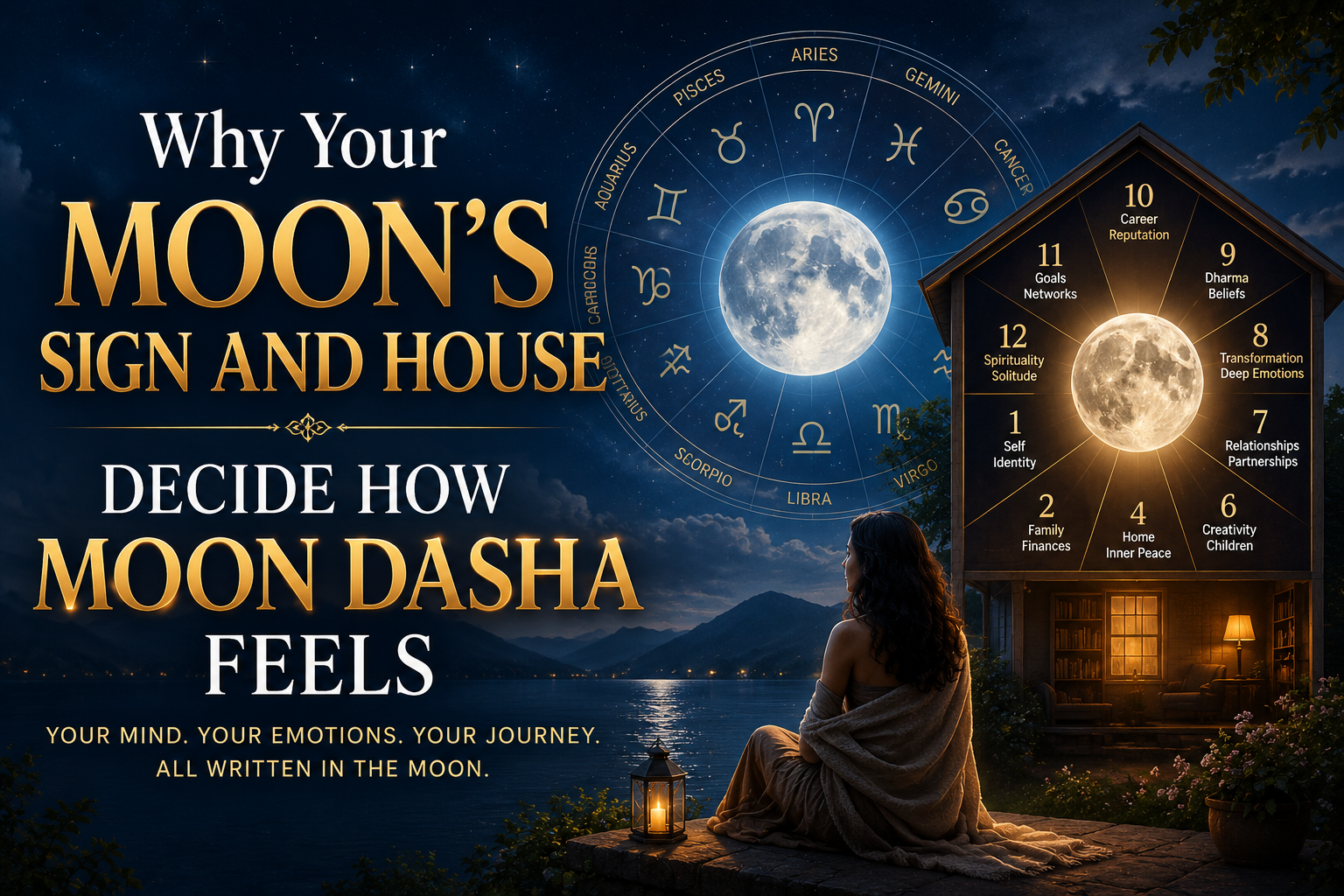
Table of contents
We've covered the general shape of Moon Mahadasha elsewhere on this site, its ten-year duration, the importance of waxing versus waning phase, and a responsible note on how this period is sometimes discussed in connection with emotional difficulty. This piece goes deeper into the specific sign, house, and conjunction factors that shape how this dasha actually feels.
How Different Are Exaltation in Taurus and Debilitation in Scorpio?
The contrast here sits at opposite ends of the spectrum. A Moon exalted in Taurus during its own Mahadasha tends to bring genuine emotional stability, a steady, comfortable relationship with material security, and a naturally calmer disposition throughout the period.
A Moon debilitated in Scorpio tends to bring the opposite texture, heightened emotional intensity, a more turbulent relationship with change, and a general sense of instability that requires more conscious effort to manage. This isn't a minor difference, it's genuinely one of the most decisive factors shaping whether this ten-year period feels manageable or genuinely demanding.
Why Does a Kendra House Support Grounding and Recognition?
The Kendra houses (1st, 4th, 7th, and 10th) are classically considered the most structurally stable positions in a chart. A Moon placed here during its own Mahadasha tends to translate the Moon's emotional themes into more visible, externally recognised territory rather than remaining purely internal.
A Moon in the 1st house tends to bring emotional themes directly into identity and self-presentation. A Moon in the 4th house, its own natural house of comfort and home, tends to support genuine domestic peace and emotional security. A Moon in the 7th house tends to bring emotional themes into partnership specifically, sometimes producing a genuinely supportive, emotionally attuned relationship. A Moon in the 10th house tends to bring emotional and intuitive qualities into public, career-facing recognition, sometimes associated with public-facing or caring professions gaining real visibility during this period.
What Happens When Saturn Is Involved?
This is worth explaining in more depth than a simple conjunction check, since the combination classically called Vish Yoga, poison combination, can actually form in several distinct ways, not only through direct conjunction in the same house.
Direct conjunction. Moon and Saturn sharing a house is the most straightforward and commonly discussed version.
Specific Nakshatra placements. Some classical sources describe Vish Yoga forming when Saturn occupies the Rohini or Shravana Nakshatras, or when the Moon itself occupies the Pushya or Uttara Bhadrapada Nakshatras, independent of house placement entirely.
Mutual aspect. Saturn's classical seventh aspect on the Moon, the same configuration underlying Sade Sati, is considered to form a version of this combination, with Saturn's third and tenth aspects considered to form a milder version.
Sign exchange (Parivartana). If Moon and Saturn occupy each other's signs in a mutual exchange, this is also considered to form the combination.
Whichever route forms it, this combination is generally associated with sustained emotional weight and, particularly during Moon Mahadasha itself, a period where the Moon's usual emotional resources feel less readily available. Given the genuine emotional intensity some sources associate with this specific combination, it's worth repeating what we've said elsewhere: any sustained, real emotional difficulty during this period deserves professional medical or psychological support as the primary response, not astrological explanation alone.
What About Rahu or Ketu Involvement?
A Moon conjunct Rahu or Ketu specifically forms Chandra Grahan Dosha, a distinct combination covered in more technical detail, including the specific degree separation that matters, in our dedicated Grahan Dosha article. Broadly, this combination tends to bring anxiety and restlessness, since the Moon's usual clarity is described as being clouded by the node's disruptive influence, with the Rahu and Ketu versions carrying a somewhat different texture from each other.
How Much Does the Moon's Specific Nakshatra Actually Matter?
This is worth framing honestly rather than overstating its importance. The Moon's Nakshatra placement is generally considered a refining detail layered on top of sign and house, not a factor that overturns what those two already establish. Practitioners commonly describe its effect as shifting the expression of an already-set outcome somewhat, making an already favourable placement somewhat more favourable, or an already difficult one somewhat more manageable or more pronounced, rather than reversing the underlying picture entirely.
This is most relevant for finer, more detailed predictions, when a birth chart's sign and house placements suggest a generally clear outcome, but a family or individual wants a more precise sense of the specific emotional or situational flavour within that broader picture.
When to Get a Professional Reading Instead of a Generic Sign Check
Given how much this period's real texture depends on sign, house, and the specific way any Saturn or node involvement has formed, a full reading is worth it if:
Your Moon is debilitated in Scorpio and you want to know whether other chart factors are already offsetting the more difficult themes
You suspect a Saturn connection but aren't sure which of the several routes, conjunction, Nakshatra placement, aspect, or exchange, actually applies to your chart
You want your Moon's specific Nakshatra checked for a more precise picture, once the broader sign and house context is already clear
Myth vs. Reality
Myth: Vish Yoga only forms through a direct Moon-Saturn conjunction.
Reality: It can also form through specific Nakshatra placements, mutual aspects including the configuration underlying Sade Sati, or a sign exchange between the two planets.
Myth: The Moon's Nakshatra is as important as its sign and house placement.
Reality: Nakshatra is generally considered a refining layer on top of sign and house, adjusting an already-established outcome rather than overturning it.
Myth: A Moon-Rahu or Moon-Ketu conjunction is the same combination regardless of which node is involved.
Reality: These form Chandra Grahan Dosha, and the Rahu and Ketu versions carry a meaningfully different texture from each other.
Why Check This on DoPuja
Because this period's real character depends on the specific combination of sign, house, and how any Saturn or node involvement has actually formed, not any single factor alone, accurate calculation matters considerably here.
UmasDoPuja's Kundali tool uses the Swiss Ephemeris engine with NASA/JPL DE431 planetary data and correctly applied Lahiri Ayanamsa, calculating your Moon's exact sign, house, Nakshatra, and conjunctions precisely rather than approximating. For a full, personalised reading on how your specific Moon placement is likely to shape this ten-year period, Talk to Astrologer connects you with a real astrologer for that context.
Why Trust This
The exaltation and debilitation contrast, the Kendra house effects, and the multiple formation routes for Vish Yoga described here are consistently documented across classical and current Vedic astrology sources. On the Nakshatra's relative importance specifically, we've deliberately framed it as a refining factor rather than overstating its weight, consistent with how experienced practitioners generally describe its role relative to sign and house.
Frequently Asked Questions
Is Moon Mahadasha always difficult if the Moon is debilitated?
Not automatically, but it does tend to bring more emotional intensity and instability compared to an exalted Moon, and other chart factors can meaningfully offset this.
Does Vish Yoga only apply if Moon and Saturn are in the same house?
No. It can also form through specific Nakshatra placements, mutual aspects, or a sign exchange between the two planets, not only direct conjunction.
How important is my Moon's exact Nakshatra compared to its sign?
Generally less important on its own. Nakshatra typically refines an outcome already suggested by sign and house rather than determining the outcome by itself.
Is a Moon-Rahu conjunction the same as a Moon-Ketu conjunction?
No, they form Chandra Grahan Dosha but with a meaningfully different texture from each other, covered in more detail in our dedicated Grahan Dosha article.
If I'm struggling emotionally during this period, is checking these placements enough?
No. These placements offer context, but real, sustained emotional difficulty deserves professional medical or psychological support as the primary response.
Recommended articles
Why Does Nothing Seem to Work Out? Understanding Kaal Sarp Dosha
Wondering why repeated setbacks keep happening? Understand Kaal Sarp Dosha, its effects, Rahu-Ketu periods, traditional remedies, and what your Kundali reveals.
Why the Same Daily Horoscope Can Feel Completely Different Two Months Apart
Discover why the same daily Rashifal can feel different at different times. Learn how Moon transits, Jupiter, Saturn, Gochar Samyukti and Dasha shape daily predictions.
The Number Behind Your Chart That Changes a Little Every Single Year
Discover why Ayanamsa changes every year, how Lahiri Ayanamsa became the Vedic astrology standard, and why its precise value matters for accurate Kundali calculations.
Comments
Be the first to comment.