Why Do We Break Coconuts Before God? Hidden Spiritual Meaning
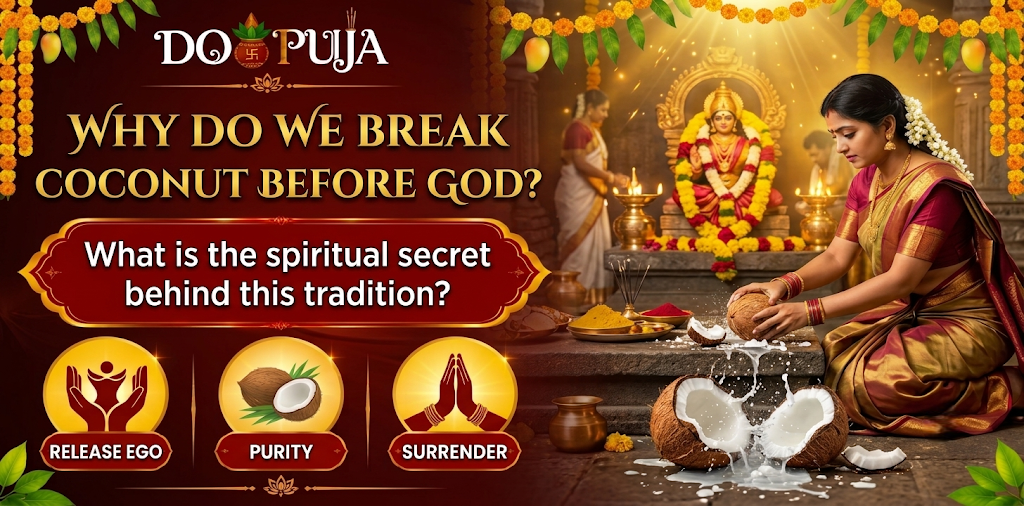
Table of contents
Why Do We Break Coconuts Before God? Discover the Hidden Spiritual Meaning Behind This Hindu Tradition
Have you ever wondered why breaking a coconut is one of the first things people do when they visit a Hindu temple?
Whether it is a new house, a new vehicle, a wedding, a business opening, or a special religious ceremony, offering a coconut to God is a common Hindu tradition. But why do people specifically choose a coconut when there are so many other fruits available?
Is breaking a coconut simply a religious ritual? Or does it carry a deeper spiritual message about human life, devotion, and surrender?
In Hindu traditions, the coconut is considered a sacred offering known as Shriphala. It symbolizes auspiciousness, purity, devotion, and the surrender of ego before the divine.
Interestingly, every part of a coconut has a symbolic interpretation in traditional spiritual explanations.
Let's explore why coconuts are broken before God, the significance of their three markings, their connection with Lord Shiva, and the deeper spiritual message behind this ancient Hindu practice.
1. Why Is a Coconut Called Shriphala in Hindu Tradition?
In Hindu religious traditions, a coconut is commonly known as Shriphala, which means an auspicious or sacred fruit.
The word "Shri" is associated with prosperity, auspiciousness, abundance, and divine blessings, while "Phala" means fruit.
Because of its sacred significance, a coconut is traditionally offered during various Hindu religious ceremonies and auspicious occasions.
Some common occasions include:
Griha Pravesh (Housewarming Ceremony)
Satyanarayana Swamy Vratham
Ganesh Puja
Lakshmi Puja
Marriage and Engagement Ceremonies
Vehicle Puja
Bhoomi Puja (Land Worship)
Business Inauguration Ceremonies
Offering a coconut is a way of expressing gratitude, devotion, and seeking divine blessings before beginning something important.
2. What Is the Real Spiritual Meaning Behind Breaking a Coconut?
This is perhaps the most interesting aspect of the entire tradition.
One of the most widely shared spiritual interpretations of breaking a coconut is the idea of surrendering one's ego before God.
Think about it: A coconut has a hard outer shell that protects the soft, white flesh inside.
In traditional spiritual symbolism, the hard shell represents human ego, pride, arrogance, and attachment to worldly things.
Breaking the coconut before God is therefore interpreted as breaking away from these negative qualities and approaching the divine with humility.
The white coconut flesh symbolizes purity, a clean heart, and a sincere mind.
The underlying message is simple:
Just as the coconut shell is broken to reveal its pure inner part, we should let go of our ego and allow our inner goodness to emerge.
This is why coconut breaking is considered more than just a physical ritual. It is also a symbolic expression of surrender, faith, and devotion.
3. Why Does a Coconut Have Three Eyes? Is There a Connection with Lord Shiva?
Have you ever carefully observed the three markings on one end of a coconut?
These markings are commonly called the three eyes of the coconut.
Interestingly, these three markings are also associated with Lord Shiva in Hindu spiritual traditions.
Lord Shiva is traditionally depicted as Trinetra, meaning the three-eyed deity. His third eye represents divine knowledge, awareness, and the power to see beyond ordinary perception.
Because of this association, some Hindu traditions connect the three markings of a coconut with Lord Shiva's three eyes.
However, from a botanical perspective, these markings are natural features of the coconut, associated with the structure of the seed.
The connection with Lord Shiva is a symbolic religious interpretation rather than a scientific explanation.
This association adds another layer of spiritual significance to the coconut as a sacred offering.
4. What Does Each Part of a Coconut Symbolize Spiritually?
A coconut has three prominent parts, and each is associated with a different spiritual meaning in traditional interpretations.
1. Outer Husk – Worldly Attachments
The outer fibrous layer is sometimes associated with external distractions, material attachments, and worldly desires.
It reminds us not to become overly attached to temporary things.
2. Hard Shell – Ego and Pride
The hard outer shell is commonly interpreted as a symbol of human ego, pride, and arrogance.
Breaking it represents the willingness to overcome these qualities.
3. White Flesh – Purity and Inner Goodness
The white inner flesh is associated with purity, honesty, and a clean heart.
It reminds devotees to maintain good thoughts and approach God with sincerity.
Together, these symbolic interpretations offer a meaningful spiritual lesson: True devotion begins when we move beyond external appearances and focus on inner purity.
5. When Did the Tradition of Offering Coconuts to God Begin?
Offering coconuts is a long-standing practice in Hindu religious traditions.
Coconuts are used in various forms of worship, including temple rituals, homams, yajnas, festivals, and family ceremonies.
Over time, coconut offerings became an important part of religious practices across different regions of India.
In South India, especially, coconuts hold a prominent place in temple worship and auspicious ceremonies.
However, there is no single universally established historical explanation identifying the exact origin or date when coconut breaking began.
Today, the tradition continues in temples and households as an expression of devotion, gratitude, and the desire for auspicious beginnings.
6. Is a Coconut Compulsory in Every Hindu Puja?
Many devotees have an interesting question: Can a puja be performed without a coconut? Does the absence of a coconut make a religious ceremony incomplete?
The answer depends on the particular puja, deity, and family or regional tradition.
Although coconuts are important offerings in many Hindu rituals, they are not compulsory in every form of worship.
Daily prayers, for example, may involve offerings such as:
Flowers
Fruits
Water
Incense
Oil lamps
Traditional food offerings
Special ceremonies, vrathams, homams, and temple rituals may have specific requirements.
Therefore, it is advisable to follow the relevant puja procedure and consult an experienced priest when performing an elaborate religious ceremony.
7. Why Do People Break Coconuts Before a New Vehicle or House?
Have you noticed people breaking coconuts when purchasing a new car, entering a new house, or starting a business?
This practice is connected with the idea of beginning something new with divine blessings.
People believe that offering a coconut during an auspicious beginning expresses gratitude and prayers for happiness, prosperity, and the smooth completion of their new journey.
Here is how the tradition is followed on different occasions.
Griha Pravesh (Housewarming Puja)
When entering a new home, families perform Griha Pravesh Puja to seek blessings for peace, happiness, and prosperity.
A coconut is often included as part of the traditional offerings.
Vehicle Puja
Before using a newly purchased vehicle, many families perform vehicle puja and offer a coconut as a prayer for safe and trouble-free journeys.
Business Inauguration
During the opening of a new shop, office, or business, coconut offerings are made as part of the auspicious beginning.
In each case, the underlying intention is to begin a new chapter with faith and positive thoughts.
8. How Should You Offer a Coconut During Puja?
Although the exact procedure may differ between temples and family traditions, some common practices are followed when offering a coconut.
Select a fresh coconut suitable for the particular puja.
Clean the coconut properly.
Apply turmeric and kumkum according to the ritual.
Pray to the deity with devotion and express your intention.
Break or offer the coconut at the designated place, following the temple's instructions.
Receive or distribute the coconut as prasadam according to the temple tradition.
For special religious ceremonies, it is always better to follow the instructions of the priest performing the puja.
9. Is It Inauspicious If a Coconut Does Not Break Properly?
This is one of the most common questions people ask during temple visits and religious ceremonies.
Sometimes a coconut does not break easily. On other occasions, it may split into unusual pieces or release its water differently.
Some people associate these occurrences with good or bad signs.
However, there is no established scientific evidence that the way a coconut breaks predicts future events.
The way it splits can depend on its internal structure, shell thickness, moisture, and the force applied.
Therefore, devotees need not become frightened if a coconut does not break properly.
The central purpose of the offering is devotion, faith, and sincere prayer rather than the exact way the coconut breaks.
10. What Life Lessons Can We Learn from Breaking a Coconut Before God?
The coconut offering is not just a temple ritual. Its symbolic meaning can also be applied to everyday life.
Here are five meaningful lessons associated with this tradition:
1. Let Go of Ego
Approach others with humility instead of pride and arrogance.
2. Maintain Inner Purity
Just as the white coconut flesh symbolizes purity, try to maintain good thoughts and intentions.
3. Practice Gratitude
Remember to be thankful for the opportunities, relationships, and blessings in your life.
4. Begin New Things with Positive Intentions
Whether it is a new home, business, or personal journey, begin with faith and responsibility.
5. Develop a Sincere Connection with God
True devotion is not limited to rituals. It also reflects in our thoughts, actions, and behavior towards others.
The next time you break a coconut before God, remember that the ritual can also serve as a reminder to let go of ego and approach life with humility.
Book Experienced Pandits for Your Traditional Hindu Puja with DoPuja
Every Hindu puja has its own significance, rituals, and traditional procedures.
From Griha Pravesh and Satyanarayana Vratham to Ganesh Puja and Lakshmi Puja, every ceremony represents a unique spiritual tradition.
However, finding an experienced pandit, understanding the puja requirements, and arranging the ceremony can sometimes be challenging.
This is where Do Puja – Pandit Booking App can help.
DoPuja makes it easier to find and book pandits for different religious ceremonies based on your requirements.
Puja Services Available Through DoPuja
Home Puja Services
Griha Pravesh Puja
Satyanarayana Swamy Vratham
Ganesh Puja
Lakshmi Puja
Birthday Puja
Namakaranam (Naming Ceremony)
Annaprashana (First Feeding Ceremony)
Marriage and Engagement Puja
Special Religious Services
Homams and Havan
Festival Pujas
Special Vrathams and Nomulu
Temple Puja Services
Digital Puja and Online Puja Services
Why Choose DoPuja?
Find and book experienced pandits for different pujas.
Explore puja services based on your requirements.
Check the number of pandits required for a particular puja before booking.
Arrange home, temple, and digital puja services.
Book traditional Hindu ceremonies conveniently through your phone.
Whether you are planning a housewarming ceremony, a special vratham, or a festival puja, DoPuja helps simplify the process of arranging religious services.
Make your puja arrangements easier with DoPuja!
Website: https://umasdopuja.com/
Download the Do Puja App:
https://play.google.com/store/apps/details?id=com.umasdopuja.user
Do Puja – Your Trusted Companion for Hindu Puja and Pandit Booking Services.
Frequently Asked Questions (FAQs)
1. Why do Hindus break coconuts in front of God?
In Hindu traditions, coconuts are considered sacred offerings. Breaking a coconut is commonly interpreted as a symbolic act of surrendering ego, expressing devotion, and seeking divine blessings.
2. Why is a coconut called Shriphala?
Shriphala means an auspicious or sacred fruit. Coconuts are traditionally associated with prosperity, purity, and auspicious beginnings in Hindu religious ceremonies.
3. What is the significance of the three eyes of a coconut?
The three natural markings on a coconut are symbolically associated with Lord Shiva's three eyes in certain Hindu traditions. This connection represents divine awareness and spiritual significance.
4. Does breaking a coconut represent removing ego?
Yes. According to a popular spiritual interpretation, the hard coconut shell represents ego and pride, while the white inner flesh represents purity and a clean heart.
5. Is breaking a coconut compulsory in every puja?
No. The requirements depend on the deity, type of puja, and regional or family traditions. Not every Hindu prayer requires a coconut offering.
6. Why do people break coconuts during Griha Pravesh?
During Griha Pravesh, devotees offer coconuts as part of the traditional rituals while praying for happiness, peace, prosperity, and auspicious beginnings in their new home.
7. Is it bad luck if a coconut does not break?
There is no established scientific evidence that an improperly broken coconut predicts bad luck. The coconut's physical condition and the force used can influence how it breaks.
8. Can I book a pandit for home puja through DoPuja?
Yes. You can use the DoPuja app to explore and book pandits for home pujas, Griha Pravesh, Satyanarayana Vratham, Ganesh Puja, Lakshmi Puja, and other available religious services.
9. Does DoPuja offer online and digital puja services?
DoPuja provides access to online and digital puja services, allowing devotees to explore options for arranging religious ceremonies remotely, subject to service availability.
Conclusion
Breaking a coconut before God is one of the most recognizable practices in Hindu religious traditions.
Although it may appear to be a simple ritual, its spiritual interpretations carry meaningful lessons about humility, purity, gratitude, and surrender.
The coconut, traditionally known as Shriphala, represents an auspicious offering. Its hard shell is often associated with ego, while its pure white flesh symbolizes inner goodness.
The next time you visit a temple or perform a puja at home, remember the deeper message behind this beautiful tradition.
True devotion is not just about the offerings we make to God. It is also about the goodness, humility, and purity we carry within ourselves.
For your next religious ceremony, make your arrangements easier with Do Puja – your companion for traditional Hindu puja and pandit booking services.
Recommended articles
 DoPuja services
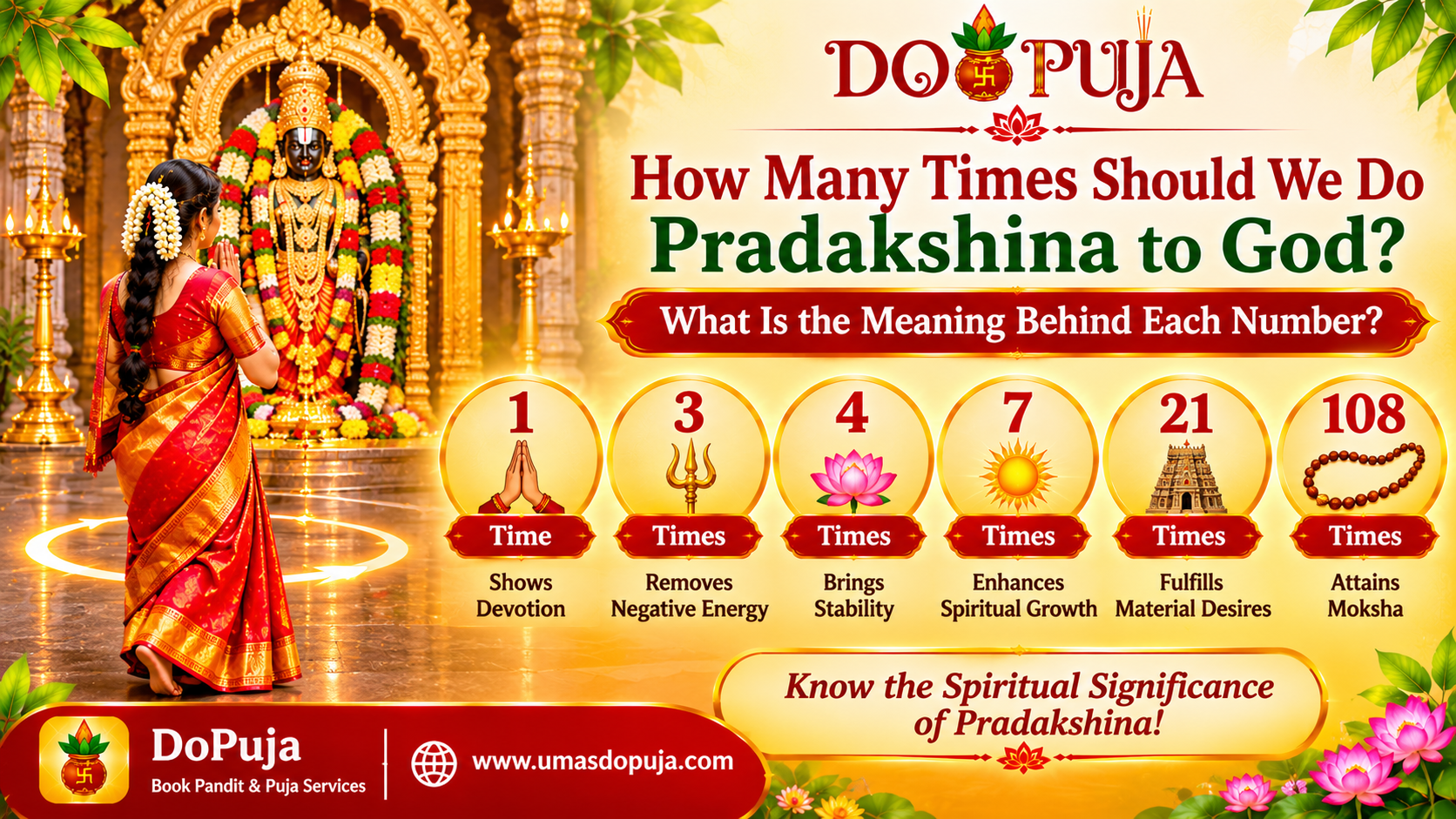
How Many Times Should You Do Pradakshina? Meaning of 1,3, 7 & 108
Why do devotees perform 1, 3, 7 or 108 Pradakshinas around God? Discover the spiritual significance behind different Pradakshina numbers, Hindu temple traditions, the correct way to perform circumambulation and special rituals associated with Lord Shiva, Ganesha and other deities. Explore Hindu traditions and puja services with Do Puja.
 DoPuja services
When should Naivedyam be taken? Traditions to follow during Puja
When should Naivedyam be offered to God? How long should it be kept? Learn what Hindu traditions say about the procedure for accepting Naivedyam.
 DoPuja services
What Really Happens During a Homam at Home? 8 Types and Their Spiritual Benefits
Homam is an important Hindu Vedic fire ritual performed to seek divine blessings, peace, prosperity and well-being. But did you know that different Homams are performed for different spiritual purposes? Explore the significance of Ganapathi Homam, Lakshmi Homam, Navagraha Homam, Ayushya Homam, Maha Mrityunjaya Homam, Dhanvantari Homam, Sudarshana Homam and Vastu Shanti Homam. Learn about their traditional benefits, occasions, puja materials and the importance of choosing an experienced purohit. Discover how DoPuja makes booking a pandit for Homam and other Hindu rituals easier.
Comments
Be the first to comment.