How Many Times Should You Do Pradakshina? Meaning of 1,3, 7 & 108
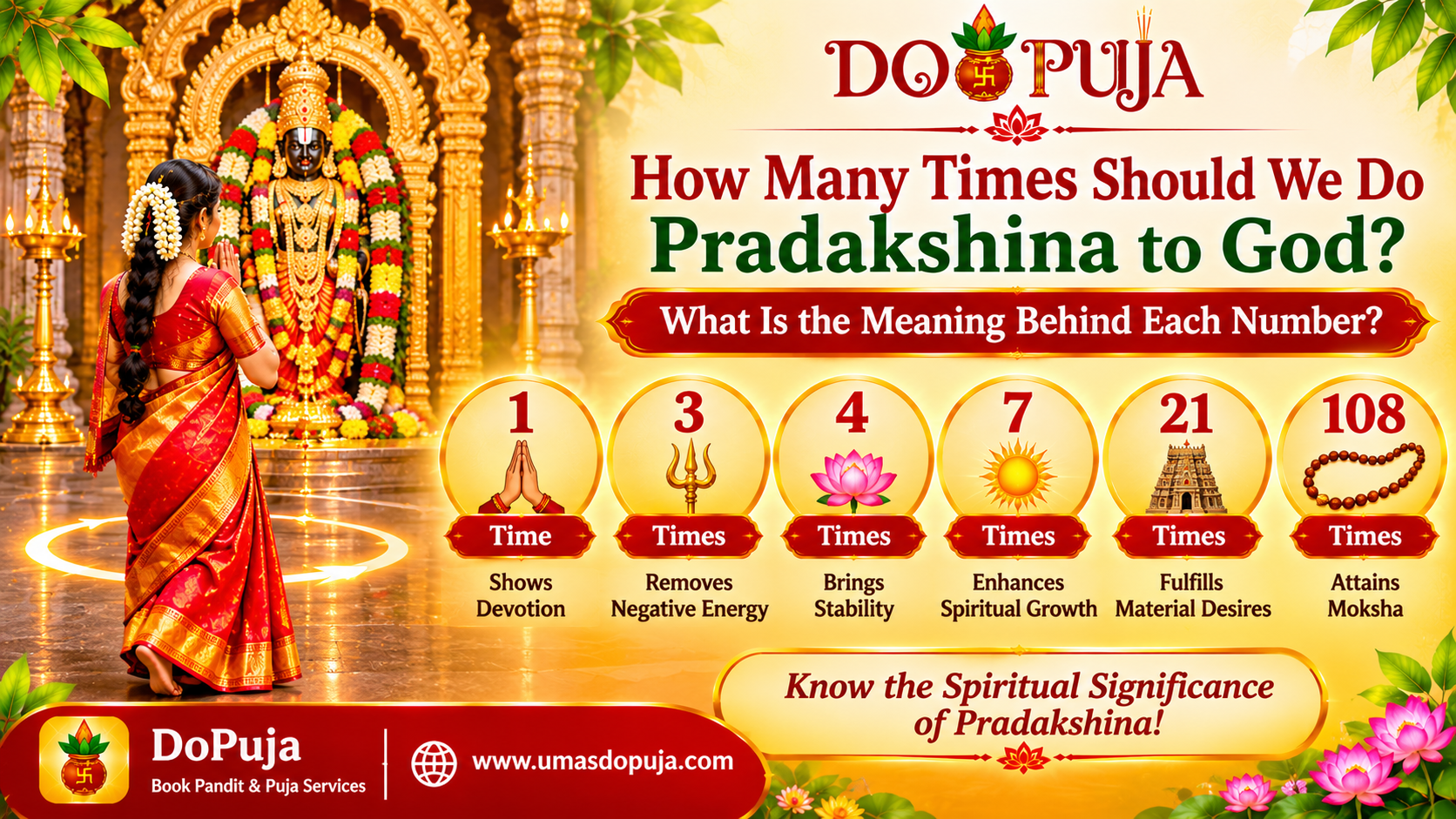
Table of contents
How Many Times Should You Do Pradakshina Around God? Discover the Spiritual Meaning Behind 1, 3, 5, 7 and 108 Circumambulations
Have you ever wondered why some devotees perform 3 Pradakshinas around God, while others perform 5, 7, 11, 21 or even 108? Is there a special spiritual meaning behind each number? Does performing 108 Pradakshinas have a deeper significance?
When visiting a Hindu temple, performing Pradakshina (circumambulation) is one of the most common religious practices. However, many people follow this tradition without knowing the spiritual significance behind it.
In Hindu tradition, Pradakshina is not simply walking around a deity. It represents devotion, surrender, gratitude and the belief that God is the centre of our lives.
So, how many Pradakshinas should you perform? Why are certain numbers considered special? Let's explore the spiritual meaning behind different Pradakshina counts and the traditions associated with them.
1. What Is Pradakshina and Why Do Hindus Perform It?
Pradakshina is a traditional Hindu ritual in which devotees walk around a deity, temple sanctum or sacred object in a clockwise direction, keeping the deity on their right side.
The word Pradakshina is associated with showing respect and reverence to the divine.
In Hindu spirituality, performing Pradakshina represents:
Devotion: Expressing love and dedication towards God.
Surrender: Placing God at the centre of one's life.
Gratitude: Thanking the divine for blessings and guidance.
Concentration: Focusing the mind on prayers and divine names.
Humility: Reminding ourselves to let go of ego and develop devotion.
Devotees often chant God's name or silently pray while performing Pradakshina.
2. How Many Pradakshinas Should You Perform? The Spiritual Meaning Behind Each Number
Different numbers of Pradakshinas are followed in different Hindu temples and regional traditions. Certain numbers also carry symbolic spiritual meanings.
Let's understand the significance of the most commonly followed Pradakshina counts.
1 Pradakshina – A Symbol of Complete Surrender
Performing one Pradakshina represents placing complete faith in God.
It symbolically expresses the belief that the divine is the centre of our existence and that our lives are guided by a higher power.
Spiritual significance: Devotion, concentration and complete surrender.
3 Pradakshinas – The Significance of the Trinity
Three Pradakshinas are commonly performed in many Hindu temples.
The number three is traditionally associated with the Hindu Trinity:
Brahma – The Creator
Vishnu – The Preserver
Shiva – The Destroyer
Another symbolic interpretation connects three Pradakshinas with the purification of the mind, speech and actions.
Spiritual significance: Creation, preservation, destruction and purity of thoughts, words and actions.
5 Pradakshinas – The Five Elements of Nature
According to Hindu philosophy, the universe and the human body are associated with five fundamental elements known as Pancha Bhootas.
They are:
Prithvi – Earth
Jala – Water
Agni – Fire
Vayu – Air
Akasha – Space
Five Pradakshinas are sometimes symbolically associated with these five elements and the importance of maintaining harmony with nature.
Spiritual significance: Balance, harmony and gratitude towards nature.
7 Pradakshinas – The Connection with the Seven Worlds
The number seven has an important place in Hindu traditions.
It appears in several spiritual concepts, including the Sapta Lokas (seven worlds), Sapta Rishis (seven sages) and other traditional beliefs.
Seven Pradakshinas are associated by some devotees with spiritual completeness, prosperity and auspiciousness.
Spiritual significance: Spiritual growth, completeness and auspiciousness.
9 Pradakshinas – A Symbol of the Nine Forms of Goddess Durga
The number nine is closely associated with Navadurga, the nine forms of Goddess Durga.
During Navaratri and special Devi worship, some devotees perform nine Pradakshinas as an expression of devotion and prayers for strength, courage and family well-being.
Spiritual significance: Divine feminine energy, strength, courage and devotion.
11 Pradakshinas – The Special Connection with Lord Shiva
The number eleven holds a special place in Shiva worship because of the traditional concept of Ekadasha Rudras (eleven forms of Rudra).
Some devotees perform eleven Pradakshinas in Shiva temples, especially on Mondays and during Maha Shivaratri.
It is traditionally associated with prayers for peace, spiritual well-being and the blessings of Lord Shiva.
Spiritual significance: Shiva devotion, discipline and spiritual reflection.
21 Pradakshinas – A Symbol of Faith and Personal Sankalpa
Some devotees perform 21 Pradakshinas as part of a personal vow or religious commitment.
This practice can be seen in certain temples dedicated to Lord Ganesha and Lord Hanuman.
Devotees undertake these Pradakshinas to express their faith, determination and prayers for the fulfilment of a personal wish.
Spiritual significance: Determination, devotion and commitment to a spiritual vow.
108 Pradakshinas – Why Is the Number 108 So Special?
Among all the numbers associated with Hindu spiritual practices, 108 holds a particularly important place.
Have you noticed that many Hindu prayer malas contain 108 beads? Many mantras are also traditionally chanted 108 times.
Similarly, some devotees perform 108 Pradakshinas during special religious occasions, personal vows and spiritual practices.
The number 108 is traditionally associated with spiritual completeness, devotion and disciplined spiritual practice.
Spiritual significance: Complete devotion, spiritual discipline and surrender to the divine.
3. How Many Pradakshinas Should You Perform for Different Gods?
One common question among devotees is whether every Hindu deity has a specific number of Pradakshinas.
There is no single universal rule followed by every temple. The number and method can differ depending on the deity, temple traditions and regional customs.
Here are some commonly followed practices:
Lord Ganesha: Three Pradakshinas are followed in some traditions. Some devotees also perform 21 Pradakshinas as part of special worship.
Lord Shiva: Shiva temples may follow a special Pradakshina method called Chandi Pradakshina or Soma Sutra Pradakshina, depending on temple traditions.
Lord Vishnu: Four Pradakshinas are followed in certain traditions.
Goddess Durga: Some devotees perform one or three Pradakshinas, while other traditions follow different counts.
Lord Surya: Seven Pradakshinas are performed in certain traditions.
Lord Hanuman: Five, seven or eleven Pradakshinas are followed by devotees in some temples.
These are examples of traditional practices, not compulsory rules for every temple. It is always best to follow the specific instructions given by the temple priests.
4. Important Rules to Follow While Performing Pradakshina
Pradakshina is not simply about completing a particular number of rounds. Devotion, discipline and respect are equally important.
Here are some things to remember:
Walk in the clockwise direction: Generally, keep the deity on your right side while performing Pradakshina.
Chant God's name: Reciting your favourite deity's name or mantra while walking is a common practice.
Avoid rushing: Perform Pradakshina calmly without disturbing other devotees.
Maintain devotion: Focus on prayer instead of worrying only about the number of rounds.
Follow temple customs: Different temples may have specific rules and rituals.
Consider your health: Do not force yourself to perform too many rounds if you have physical difficulties.
5. Why Do Some Shiva Temples Have a Different Pradakshina Method?
Have you ever noticed that devotees in certain Shiva temples do not walk completely around the Shiva Lingam?
There is a traditional reason behind this practice.
During the Abhishekam of a Shiva Lingam, the water used for the ritual flows out through a designated channel known as the Soma Sutra.
According to certain Shaiva traditions, devotees should not cross this sacred channel. Therefore, instead of performing a complete circular Pradakshina, they follow a specific method known as Chandi Pradakshina or a form of half Pradakshina.
However, the exact procedure can vary between temples. Devotees should follow the instructions of the temple priests.
6. What Are the Benefits of Performing Pradakshina?
Pradakshina is not only a religious tradition but can also be viewed as a mindful spiritual practice.
Some commonly experienced benefits include:
Mental Peace: Walking slowly while chanting God's name may help calm the mind.
Better Concentration: Repeating prayers while walking can encourage mental focus.
Discipline: Following a regular prayer routine can develop consistency.
Physical Movement: Walking provides a simple form of physical activity.
Spiritual Connection: It offers an opportunity to express devotion, gratitude and faith.
These benefits relate to personal spiritual experience and ordinary physical activity. There is no scientific guarantee that performing a particular number of Pradakshinas will cure illnesses or remove life's problems.
7. Is the Number of Pradakshinas More Important Than Devotion?
Here is something worth remembering.
One person may perform three Pradakshinas with complete devotion and concentration. Another person may perform 108 rounds while thinking about something else.
Does that mean the second person has greater devotion?
Not necessarily.
The deeper meaning of Pradakshina lies in devotion, humility and surrender rather than simply completing a specific number of rounds.
Whether you perform one, three or 108 Pradakshinas, the important thing is to remember God with a peaceful mind and a sincere heart.
Remember: Pradakshina is not just about how many times you walk around God. It is about how deeply you connect with the divine.
Make Your Every Puja Special with DoPuja!
Whether you want to perform a puja at home, organise a special temple ritual or observe traditional Hindu festivals and vratams, finding an experienced pandit is an important part of the process.
With Do Puja – Pandit Booking App, you can conveniently explore and book experienced pandits for different Hindu religious ceremonies.
Do Puja offers services for:
Griha Pravesh Puja (Housewarming Ceremony)
Satyanarayana Swamy Vratham
Ganesh Puja
Lakshmi Puja
Marriage and Engagement Puja
Namakaranam (Naming Ceremony)
Homam and Special Pujas
Online and Digital Puja Services
You can book a pandit for your puja requirements through the DoPuja app without having to search endlessly for a priest.
Looking for a pandit for your next puja?
Download the Do Puja app and make your Hindu puja bookings easier!
Download the app: https://play.google.com/store/apps/details?id=com.umasdopuja.user
Website: https://umasdopuja.com/
Frequently Asked Questions (FAQs)
1. How many times should we do Pradakshina around God?
Three Pradakshinas are commonly performed in many Hindu temples. However, the number may vary depending on the deity, temple customs and family traditions.
2. How many Pradakshinas should we do daily at home?
You can perform one or three Pradakshinas after your daily home puja, depending on your family traditions and personal preference.
3. Why do devotees perform 108 Pradakshinas?
The number 108 is considered spiritually significant in Hindu traditions. It is associated with completeness and spiritual practice. Some devotees perform 108 Pradakshinas during special vows and religious observances.
4. How many Pradakshinas should we do for Lord Ganesha?
Three Pradakshinas are followed in certain traditions. Some devotees also perform 21 rounds during special Ganesha worship.
5. How many Pradakshinas should we do for Lord Shiva?
Certain Shaiva traditions follow a special Pradakshina method without crossing the Soma Sutra. The exact method should be followed according to the temple's customs.
6. Which direction should we follow while performing Pradakshina?
Generally, devotees walk in a clockwise direction, keeping the deity on their right side. However, specific temple traditions should always be respected.
7. Can we worship God without performing Pradakshina?
Yes. Pradakshina is a devotional practice, not a compulsory requirement for receiving God's blessings. You can worship and seek divine blessings even if you cannot perform Pradakshina due to age, health or other reasons.
Final Thought: Pradakshina reminds us to keep God at the centre of our lives. Whether you perform one round or 108 rounds, let every step reflect faith, gratitude and devotion.
Recommended articles
 DoPuja services
Why Do We Break Coconuts Before God? Hidden Spiritual Meaning
Why is a coconut broken before God in Hindu temples? Discover the spiritual significance of Shriphala, the meaning of its three eyes, its connection with Lord Shiva, and how coconut breaking symbolizes surrendering ego and embracing purity. Explore Hindu puja traditions and discover how DoPuja makes booking experienced pandits for home, temple, and online puja services easier.
 DoPuja services
How to Perform a Baby Naming Ceremony? Namakaranam Rituals | DoPuja
Discover the significance of the Hindu Namakaranam ceremony and learn when to perform it, how to select a baby's name based on birth Nakshatra, the required puja items, and the traditional rituals. Explore how DoPuja can help you find pandit-booking options for your baby's special day.
 DoPuja services
How to Perform Satyanarayana Swamy Vratam at Home? | DoPuja
Learn how to perform Satyanarayana Swamy Vratam at home with this simple guide. Explore the puja vidhi, required puja materials, Satyanarayana Vrat Katha, prasadam preparation, and spiritual significance. Discover how to book an experienced pandit for Satyanarayana Swamy Puja through Do Puja.
Comments
Be the first to comment.